

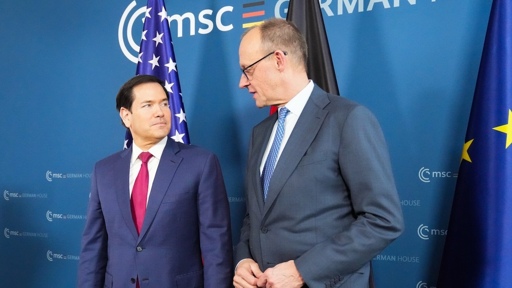
A year after US Vice President JD Vance shocked European politicians at the Munich Security Conference 2025 by signaling an end to the transatlantic relationship as they had known it, they appear to have found their footing again. It only cost them agreeing to all demands of the Trump administration and channeling most of the bloc’s resources into war and rearmament. In their addresses at this year’s conference, everyone from European Commission President Ursula von der Leyen to German Chancellor Friedrich Merz referred to this increased military spending, the building of new armies, and tearing down “the rigid wall between the civilian and defense sectors,” to quote von der Leyen.
In return, they received a speech by US Secretary of State Marco Rubio tailored to EU communication standards: measured, restrained, and full of declarations of goodwill. After Rubio’s detailed account of the “historic links” between the US and Europe, along with assurances that the current administration still sees Europe as a desirable partner, the relief in the room was so palpable that moderators acknowledged it. This feedback left little doubt that the building of Europe’s new independence, announced by many of the officials at the conference, would still depend on signals from Washington.
Colonialists of the world, unite
In reality, Rubio’s speech offered probably a more chilling vision of Europe’s future than Vance’s had. “We are part of one civilization – Western civilization,” the US Secretary of State said. According to him, this historic link, described as a result of Europe’s export of exploratory spirit and Christianity – what others would term colonial plunder – now faces new challenges that must be confronted in Western unity. According to Rubio, those challenges stem from decades of permissiveness toward the “climate cult,” migration, and deindustrialization. He did not clarify how deindustrialization imposed on Eastern European countries through US-controlled financial institutions fits into this account.
“The fundamental question we must answer at the outset is what exactly are we defending, because armies do not fight for abstractions,” Rubio said. “Armies fight for a people; armies fight for a nation. Armies fight for a way of life. And that is what we are defending: a great civilization that has every reason to be proud of its history, confident of its future, and aims to always be the master of its own economic and political destiny.”
Read more: Peter Mertens: “Don’t be afraid, seize the opportunities of 2026 with both hands”
In this picture, Europe’s shiny new armies – led by the German Bundeswehr, if Merz is to have a say – will fight for the protection and revival of Western power (and against communism, considering how many times Rubio mentioned a shared anti-communist heritage). “For five centuries, before the end of the Second World War, the West had been expanding – its missionaries, its pilgrims, its soldiers, its explorers pouring from its shores to cross oceans, settle new continents, build vast empires, extending out across the globe,” Rubio continued, insisting that European partners should be “proud” of that history if they are to protect their position in the world. To achieve that, he pointed out, the proud West should also “no longer place the so-called global order above the vital interests of our people and our nations.”
“China will be a staunch force for peace”
There was no meaningful sign of discomfort among so-called European leaders at hearing such a creative account of history, which relativizes centuries of colonialism and extractive violence against other regions of the world. Even politicians who spoke of pursuing new partnerships with the Global South and securing more independence from the US did so using concepts that have eroded living standards for millions in Europe and beyond over recent decades: free trade agreements and a (more or less discreet) disdain for cooperation with China.
Inside the conference halls, the only substantial alternative to the dystopia offered by Rubio came, in fact, from Chinese Foreign Minister Wang Yi, who emphasized the importance of international mechanisms built through global cooperation – not the goodwill of Western powers, as suggested in the US intervention – and alternatives to armed confrontation. “The reason why the international system is not functioning well enough lies not with the UN itself, but rather with [a] certain country seeking to magnify differences and disagreements, put itself above everyone else, stoke bloc confrontation and even revive the Cold War mentality,” Wang said.
“China will be a staunch force for peace,” he continued. “We will commit to the path of peaceful development and call on all countries to do the same. China will be a reliable force for stability […] China will be a progressive force in history. We will resolutely defend the outcomes of the progress of human civilization, advance the four major global initiatives, and promote the building of a community with a shared future for humanity.”
Read more: Students on strike against military service: “You’re not a coward if you don’t want to die for Germany!”
Outside the conference, thousands of people – trade union activists, youth groups, members of left and progressive parties – demonstrated against the agenda advanced by the US and its European partners. They called for an end to US assaults on Cuba, Venezuela, and other Latin American countries; true peace and sovereignty for the people of Palestine; and a Europe free of conscription and war.
The post US urges Europe to embrace colonial legacy to protect Western world domination appeared first on Peoples Dispatch.
From Peoples Dispatch via this RSS feed