

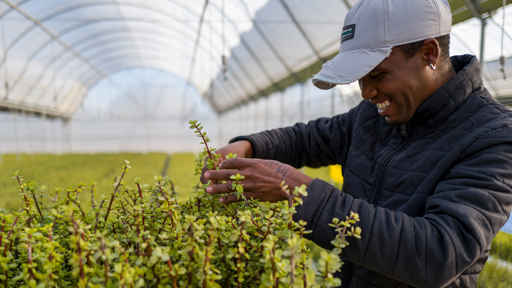
“Spekboom is everywhere, it’s all anyone talks about … what used to be an Angora goat farming town is now a spekboom town,” says field ecologist Rae Attridge. In the past two years, Nat Carbon, the carbon project developer Attridge works for, has planted 10,000 hectares (nearly 25,000 acres) of spekboom in the Klein Karoo, a semidesert region of South Africa. Their work is the first phase of an effort to restore 100,000 hectares (250,000 acres) of degraded land on five farms near Jansenville in Eastern Cape province. The company is one of more than 60 entities carrying out spekboom thicket restoration projects across 800,000 hectares (2 million acres), all loosely tied up under what the United Nations calls the Thicket Restoration Movement. The Subtropical Thicket Restoration Programme was started in 2004 by the South African government with $8 million of funding intended to catalyze large-scale investment into thicket restoration efforts in the region. These were the first green shoots of a growing collection of projects now recognized by the U.N. In 2009, researchers had planted spekboom (Porticularia afra) on 331 quarter-hectare plots scattered across over roughly 7.5 million hectares (18.5 million acres) of the biome to evaluate the potential for restoration. These earlier experiments found that thicker stems would increase survival rates, but watering at planting time had a negligible impact. It also found that animals, both wild and domestic, easily found their way to these small poorly protected plots. An Angora goat in South Africa’s Eastern Cape province.…This article was originally published on Mongabay
From Conservation news via this RSS feed