


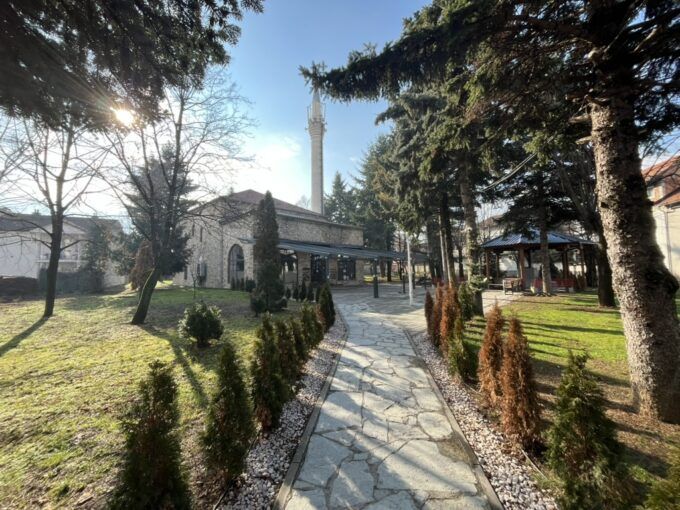
A mosque in Peja, Kosovo. Photograph by Matthew Stevenson.
In search of winter sun, I decided to travel from Geneva (where I live, despite the risks of “civilizational erasure”) to Cyprus and ride my bike along the contours of the Green Line—the dividing line between the largely Greek Republic of Cyprus and the Turkish Republic of Northern Cyprus. Wallowing in central European fog, I decided I knew almost nothing about the politics of the divided island—as all I knew had come from reading Lawrence Durrell’s Bitter Lemons (Cyprus circa 1953-55) in the late 1970s.
I also wanted to read—on location, so to speak—Brendan O’Malley’s and Ian Craig’s The Cyprus Conspiracy: America, Espionage and the Turkish Invasion, a detailed diplomatic history (2001) that has a menacing picture of Henry Kissinger on the jacket, as so far, away from Aphrodite’s island, I had never made it past page 10. Maybe, I reasoned, I would get through it while bike riding along the Green Line?
+++
Cyprus was partitioned in 1974, in no small thanks to the evil machinations of Henry Kissinger and the Nixon administration, then in the last throes of its president’s resignation.
Unfortunately, in winter, there are no direct flights from Geneva to Larnaca (on the Greek side). There are several connecting flights through Istanbul to Ercan International Airport, the runway for Lefkosia, what the Turks call their (northern) side of Nicosia, once the capital of all Cyprus.
If I chose to fly into the Turkish “republic” in northern Cyprus (other than Turkey, no other country recognizes it), I might well be hassled if I then tried to cross the Green Line into the south, for “entering Cyprus illegally through occupied territory.” Nor could I then leave from Larnaca or—so I was warned—later return to Cyprus on good terms with its border department.
I decided, instead, to enter Cyprus through its front door at Larnaka International Airport, which replaced the old Nicosia International Airport, which in the 1974 partition, found itself lost in the no-man’s land of the Green Line and abandoned.
For those whose Cyprus geography is wobbly, Nicosia is inland, roughly in the center of Cyprus, while Larnaca is on the southern Mediterranean coast. At least by arriving in Larnaca, I could ride my bicycle without always looking over my shoulder.
+++
The problem with my idea for “Green Lining” was that all the connecting flights from Geneva were either prohibitively expensive or involved an overnight plane change in some concrete oasis such as Luton, England.
Sometimes I don’t mind cheap flights that take up to 31 hours, if I am routed through cities that are new to me (think of Sibiu in Romania or Kutaisi in Georgia), but all the connection combinations to Cyprus seemed to involve an overnight in some discount airline hub.
In the end I decided to fly into Pristina (the capital of Kosovo) and catch a connecting flight, a day later, from Skopje, North Macedonia (50 miles to the south).
In between I would rent a car at Adem Jashari International Airport (Jashari was a KLA jihadist killed in 1998) and spend the night in Peja (what Serbs call Peć), the one corner of Kosovo that I had yet to visit.
For my sins, I am addicted to the regions and autonomous republics of the former Yugoslavia, and I collect memories of them as I once did baseball cards. But so far Peja and its celebrated Orthodox monasteries had eluded me.
On this great circle route I would also have time to visit Skopje’s Museum of the Macedonian Struggle for Independence, which can be best understood as a work in progress (as, for more than 150 years, Macedonia has remained divided or conquered).
+++
Normally in Europe I try not to fly, to give the ozone a rest. As former Yugoslavia has lost most of its trains, to get to Pristina I was condemned to easyJet (suggested motto: “We hate you as much you hate us…”). But this flight was surprisingly pleasant.
As if from a time warp, the stewardess handed me a sandwich and sparkling water, and the seat next to me remained vacant, allowing me to unfold my Yugoslav road map of Kosovo (then spelled Kossovo), which is something of a collector’s item.
After World War II, Kosovo was an “autonomous region” within Serbia, then incorporated as one of the socialist republics of federal Yugoslavia. Later Kosovo became an “autonomous province” of Serbia and Yugoslavia, until 1999, when Serbia, Kosovo, and NATO fought a short but intense triangular war, in which NATO bombed Belgrade (the capital of Serbia) in response to Serbia’s military operations and ethnic cleansing against irredentist Kosovo.
By that point Yugoslavia had been shorn of Slovenia, Croatia, Bosnia-Herzegovina, and North Macedonia, and Montenegro was eyeing the door; multinational Yugoslavia had become little more than Serbia reduced to its 1878 borders, and Kosovars saw no future as a minority inside a Serbian state.
The consequences of the Belgrade bombings were to launch Kosovo on the path of its independence, but it also re-ignited the Cold War between Russia and the West.
Vladimir Putin—the puppet master to Donald J. Trump and many other marionettes of the Quisling variety—cites the Kosovo coup de main as the reason why Russia subsequently had to liberate contested areas of the Caucasuses and now Ukraine.
For the moment, Serbs consider the Autonomous Province of Kosovo and Metohija still legally part of Serbia; for their part, in 2008 Kosovars declared independence.
+++
Entering Kosovo through the modern corridors of its rebuilt international airport (complete with ATMs, rental car agencies, and duty-free shops selling single-malt whisky in an otherwise Muslim country), I was reminded of my first trip to Pristina in summer 1976, shortly after I graduated from college.
In my senior year at Bucknell University, I had studied Serbian history and language under Professor Robert Beard, a brilliant linguist and historian. He had me reading Rebecca West’s Black Lamb and Grey Falcon (Yugoslavia on the edge of its destruction in World War II) and Ivo Andrić’s The Bridge on the Drina, a paean to Bosnia’s Yugoslav multiculturalism, soon to vanish down a black hole of civil conflict.
That summer after graduation, I lived with a family in the regional city of Niš (south of Belgrade), which was still clinging onto Yugoslavia’s brave old world.
My quarters were a sofa in the living room. During the day I had little to do, other than read my books (Milovan Djilas’s Wartime was the best), swim in nearby mountain streams, and eat a near-endless supply of ćevapčići (essentially hamburger sausages).
+++
Best of all, my host family stood ready to tour me around Yugoslavia as I wished. One of our first excursions (against their druthers, I now reflect) was to show me around Kossovo and Pristina, then capital of the autonomous province.
I wanted to see it, as much of Rebecca West’s Black Lamb and Grey Falcon is set in what she called “Old Serbia,” the ancestral lands (from the 15th century) of the Serbs that even when she was writing (it was published in 1941) was becoming largely an Albanian enclave. In the book West writes: “I had come to Yugoslavia to see what history meant in flesh and blood.”
Of the one million people living in Kosovo at that time, about three-quarters were of Albanian origin, and one-quarter was Serbian. Now Kosovo has a population of 1.6 million, and less than three percent are Serbs (mostly living north of the Iber River in Mitrovica—the Nicosia of divided Kosovo).
+++
In an old Zastava Yugo that spewed heavy exhaust, we spent much of the morning on small country roads navigating toward Pristina, only about 70 miles from Niš.
As it was high summer, my host friends often stopped along the way to visit their own friends, which then involved rounds of slivovitz (plum brandy) consumed under shady trees at a small table with wobbly chairs.
In the 1970s, Kossovo was the poorest region of Yugoslavia, less prosperous than even Macedonia or Bosnia, and I was warned on the ride to “expect trouble.” But nothing prepared me for what I came across on the main street of Pristina, which had elements of what looked like a farmer’s revolt or perhaps Shays’s Rebellion.
There, in the shadow of a few crumbling administrative buildings (paid for by Marshal Tito’s workers paradise) was a long line of marching protestors, many carrying pitchforks and walking beside a long line of oxen carts.
Many were dressed in black, and they marched to the shouts of agony protests—chants that in no particular order denounced Serbia, Yugoslavia, Serbs, and President-for-Life Tito.
As I recall, the issue was the lack of Albanian-language courses in local schools and at the university, but really, as my hosts whispered by the side of the capital’s angry streets, it was an independence rally (in which, clearly, the pitchfork would become the weapon of choice).
This is the first in an occasional series about travels through the Balkans to and from the Green Line in Cyprus.
The post Letter From Kosovo appeared first on CounterPunch.org.
From CounterPunch.org via this RSS feed