

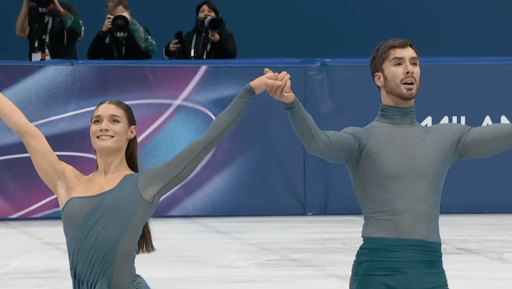
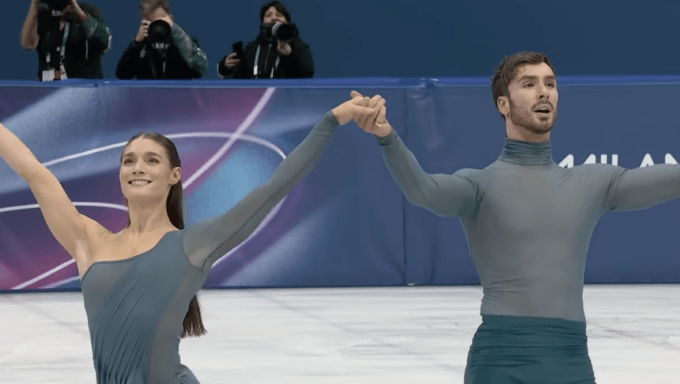
France’s Laurence Fournier Beaudry and Guillaume Cizeron after their controversial gold medal performance in Milan. (Screengrab from video posted to X.)
Olympic figure skating is once again rocked by scandal. This time, as in the 2002 Salt Lake City Olympics, it involves ice dancing (read down to “Controversy”). Last time, it was purported point trading between French and Russian judges, with the French agreeing to go hard on the Canadian pairs team in exchange for support on the part of the Russian judge for the French ice dance team. This time, the issue concerns whether the French judge was too parsimonious with points for the American ice dance team of Madison Chock and Evan Bates and too generous with the French team of Laurence Fournier Beaudry and Guillaume Cizeron. The American team were flawless, while the French team purportedly had one minor mistake. Yet the French team still beat the American team to win gold.
The problem with ice dancing, and the reason it is so frequently the subject of controversy, is that it’s more subjective than other figure skating events. Both pairs and men’s and women’s singles events involve jumps, and mistakes in jumps are usually pretty obvious. Even if a skater doesn’t fall, people with little knowledge of skating can tell when a skater is struggling to stay on their feet. And then there is the “popping” of jumps, which refers to the spontaneous abandonment of multiple revolutions, so that planned quads become doubles, or even singles, as was demonstrated so heartrendingly in Ilia Malinin’s disastrous free skate. Those are pretty obvious as well.
What casual fans of skating may not realize is that skating judges have intimate knowledge of each skater’s program. Every jump, every spin, every sequence of footwork is meticulously recorded because each has a theoretical maximum number of points if performed perfectly. Judges also observe skaters’ practices, and not just at the competition they are judging, but throughout the entire competitive season. Judges have biases and favorites, hence they are not always entirely fair in the awarding of points. Fortunately, with singles’ and pairs’ events, the superior program, or programs, are pretty conspicuous as such even to those uninitiated in the intricacies of figure skating judging, and this serves to keep those who judge these events more or less honest.
Dance is different. Not only are mistakes often hard for the uninitiated to recognize, they are sometimes impossible to detect. Cizeron purportedly exited a twizzle early in the program too soon. That is, he purportedly made a mistake. I couldn’t see it, though, and I’ve been following skating for years. I could see he exited his twizzle a millisecond before Fournier Beaudry exited hers, but my impression was that this move had been deliberate, a part of the choreography. The announcer could tell because she’d undoubtedly seen them skate that portion of the program before. To anyone who hadn’t seen it before, though, it likely looked perfect. That’s how it appeared to me, anyway. There was no breach whatever in the flow of the movement, and that speaks to the genius of Cizeron. Not since Torvil and Dean’s “Bolero” program at the 1984 Sarajevo Olympics can I remember a program that was such a flowing and uninterrupted whole.
What’s generally missing from figure skating, and even from ice dancing, is a commitment to the aesthetics of dance. Ballet dancers speak of “the dance” (which is how they often refer to ballet) with an almost religious reverence. There’s lots wrong with ballet, of course, as recent scandals have made clear, but they’ve got that right. There’s a spiritual dimension to dance. When it’s done right, it gestures toward a transcendent aesthetic ideal. Every proper dance is, in effect, a particular attempt to grasp that ideal, to bring it to concrete expression.
You wouldn’t know that, though, from ice dancing, not normally, anyway, and you certainly don’t get that impression from watching Chock and Bates, or at least I don’t. Their technical prowess is unsurpassed, but their programs rarely give the impression that they are pursuing a particular aesthetic vision. All too often, the impression they create is rather one of determined pursuit of a medal.
Ice dancing is changing, though, in positive ways. Fournier Beaudry and Cizeron were not alone in delivering a transcendently beautiful performance. The American team of Emilea Zingas and Vadym Kolesnik did so as well. That isn’t the change I’m talking about, but I believe it is a consequence of it. Both Fournier Beaudry and Cizeron and Zingas and Kolesnik have spoken about the love they feel for their partners. The latter are a romantic couple, but the former are not. It’s rare to hear teams speak so openly about the depth of their emotional bond.
Cizeron’s former partner, Gabriella Papadakis, has published a book about her relationship with him, and about the culture of figure skating more generally, which details how devastatingly negative is the effect that culture frequently has on girls and women. There are so many more women in skating than men, she explains, that female pairs skaters and ice dancers are frequently encouraged to tolerate abusive treatment from their male partners or risk losing them. Male skating partners are so rare, they sometimes have to be imported from other countries (hence Vadym Kolesnik, who is originally from Ukraine).
The bias against women in skating is not restricted, however, to pairs and ice dancing; even female singles skaters feel it. The problem, again, is that there are just so many more women than men in the sport. There are thousands and thousands of little girls in competitive figure skating. That’s a lot of people one has to defeat on the way to the top. And although singles judging is less subjective than judging in ice dancing, there’s still an element of subjectivity to it. Then there is the fact that many girls lose their jumps, as they say, when they hit puberty and their weight distribution changes. Some eventually get their jumps back, but others don’t. So betting on the success of any particular little girl is very risky.
The situation is different with respect to male skaters. A coach who can secure a talented male protégé is going to be instantly visible to the bigwigs in the sport. Boys often start skating later than girls, but they usually rise through the competitive ranks much more quickly because there is so much less competition. Also, boys aren’t going to lose their jumps when they hit puberty. They’ll only get better and better over time. Finally, while the general public is drawn to the women’s competition and the spectacle of the ice princess, skating insiders generally see the men’s event as the culmination of any serious competition. The reason is that it’s the men who push the boundaries of the sport. Men were doing triples in competition long before women were and to date, only a man, Ilia Malinin, has successfully completed a quadruple axel, a jump once believed to be impossible, in competition.
Hence boys are sought after by coaches. Girls? Not so much.
It’s ironic because the general public tends to think that figure skating is an inherently feminine sport. Yet the culture of skating is often toxic to women. That’s a generalization, of course. I’m sure there are lots of female skaters who are sheltered from that by particularly supportive families, coaches and training environments. I fear, however, that they are the exception rather than the rule.
Papadakis charges her former partner with abusive behavior toward her. To her credit, though, her real objective is to reform the culture of skating that encourages such behavior. What people forget, when pointing the finger at abusers, is how profoundly social human beings are. A boy who grows up in a culture that denigrates girls and women is going to find it extraordinarily challenging not to absorb those attitudes himself and bring them to expression in his relationship with his ice dance partner.
That has to change. Interpersonal relationships are dances, of a sort, and when the relationship is one of partners in a competitive sport, the dynamic can become incredibly complicated. It takes extraordinary emotional maturity to navigate this well, and the culture of figure skating is not one that encourages the development of emotional maturity.
Zingas spoke openly about how she and her partner were working with a sports psychologist and how this was actually encouraged by their coach, Igor Shpilband, who has his own complicated history in the sport. Fournier Beaudry’s former partner Nikolaj Sørensen has been charged with sexual assault of a former skater turned coach and banned from competition, hence the necessity of her finding a new partner.
I’ll confess I never cared much for the Papadakis-Cizeron partnership. I couldn’t have told you why, exactly. They were both outstanding athletes, but their performances failed to move me the way say, Virtue and Moir’s performances did. I suspect now that the problem was the dynamic between them. There was too much unhappiness, antagonism, and mutual frustration. That’s hard to hide. It may not be obvious what’s wrong with a team that appears to be technically perfect, but something seemed wrong to me with Papadakis and Cizeron. Now I think I know what it was.
Positive change is often slow and sometimes painful. It appears, however, that it is finally coming to figure skating, and this is going to be good, not merely for the emotional lives of the athletes, but for the sport, or should I say art, of skating.
The post Scandal on Ice appeared first on CounterPunch.org.
From CounterPunch.org via this RSS feed