

Good news to start our weekend! The Supreme Court invalidated Trump’s illegal tariffs in an opinion that reasserts the separation of powers, the primacy of the Constitution, and the role of Congress in making law. Clear-cut victories are rare; we should celebrate!
The seven opinions by nine justices are unnecessarily complicated, but at root, the majority agreed that the Constitution means what it says (Congress has the authority to impose duties and taxes) and that a statute that does not mention tariffs does not authorize the president to impose tariffs.
The political and economic consequences deserve comment (see below), but we should not lose sight of the simple but powerful fact that the Constitution prevailed. It could have been otherwise.
The victory was expected, but we can take nothing for granted. Let’s breathe a sigh of relief and prepare ourselves for the next battle.
Friday livestream and video appearance before Elders for Sound Democracy
The recording of my weekly livestream (on Friday) is here: Live with Robert B. Hubbell – Friday, Feb 20.
A video recording of an appearance I made before Elders for Sound Democracy on Wednesday of this week is here: Elders for Sound Democracy - Democracy Forum Speaker Series with Robert Hubbell.
Trump rejects gift horse offered by Supreme Court
The Supreme Court tried to save Trump from his misguided, destructive tariffs. Rather than taking the win by saying, “Thank you,” and then blaming the Court for whatever happens to the economy, Trump did the following:
Called the justices “fools and lapdogs” who were “unpatriotic and disloyal to the Constitution” and “an embarrassment to their families.”
Suggested that some of the justices had been “swayed by foreign interests.”
Immediately imposed a global 10% tariff on all imports.
Ending the unpopular tariffs was a gift to Trump, whether he likes the outcome or not. See David Frum, The Atlantic, The Supreme Court Delivers Trump a Humiliating Gift. (Gift article accessible to all.)
Per David Frum,
The ironic political question for 2026 is whether the U.S. Supreme Court acted in time to save Trump from himself. Whether or not it was the justices’ intention to help Trump, a generally Trump-friendly Supreme Court has offered the president an exit from one of his most unpopular domestic policies.
There is an old saying about “not looking a gift horse in the mouth.” The origin of that saying (about being grateful for a gift) is detailed in the footnote below,1 but whatever its historical meaning, Trump took it to the next level. He was not only an ungrateful recipient of the Court’s gift, but he also insulted the gift-giver and then shot the horse.
Trump’s reaction demonstrates that he is a weak loser who knows he is a weak loser. The most logical response to a judicial opinion holding that “You need the consent of Congress to impose tariffs” is to secure that consent to impose new tariffs. This is especially true when your party holds a majority in both chambers of Congress. But Trump knows that he would be unable to convince Congress to pass legislation authorizing him to impose tariffs.
Trump imposes a 10% “ad valorem tax” on all imports—almost.
So, a defeated Trump invoked a different statute to apply a universal 10% global tariff on all imports (except for Canada and Mexico). See CNN, A defiant Trump vows new tariffs while fuming at Supreme Court.
Although Trump’s 10% global tariff effectively offsets the economic impact of the invalidated tariffs, a universal tariff is not a weaponized tool of foreign policy. If a country cannot be singled out for punishment via tariff, Trump loses the ability to exercise economic coercion over foreign nations.
The presidential proclamation imposing a 10% ad valorem tax excludes a dozen categories of products, including vehicles, aerospace, electronics, beef, and certain agricultural products, fertilizers, and minerals. See Imposing a Temporary Import Surcharge to Address Fundamental International Payments Problems – The White House.
The core legal ruling and its implications
The opinion turned on the meaning of the word “regulate” in the International Emergency Economic Powers Act. See Ian Millhiser in Vox, Why a Republican Supreme Court struck down Trump’s tariffs, in Learning Resources v. Trump.
Millhiser explains the core of Chief Justice Roberts’ opinion:
In the part of Roberts’s opinion that five other justices joined, he explains that the word “regulate” means “to ‘fix, establish, or control; to adjust by rule, method, or established mode; to direct by rule or restriction; to subject to governing principles or laws.’” But it does not mean the power to tax.
For all practical purposes, the above holding could and should be the end of the legal analysis. You could stop reading here and not miss anything.
But there is a nuance worth further discussion that is not essential to the holding but may be good news if Trump claims he has the authority to regulate elections by, for example, requiring Voter ID and proof of citizenship. He does not have that authority, and today’s opinion suggests that Roberts, Gorsuch, and Barrett would rule against Trump on such a claim by applying the Major Questions Doctrine.
Why the Major Questions Doctrine discussion in today’s ruling matters.
Three of the Republican justices also relied on a judicial creation known as “the Major Questions Doctrine,” which asserts that “in the Supreme Court’s words, “we expect Congress to speak clearly if it wishes to assign to an agency decisions of vast ‘economic and political significance.’”
Because only three justices relied on the Major Questions Doctrine, it is not a “controlling” part of the holding. But it is informative, nonetheless.
Although the Major Questions Doctrine was developed in the context of congressional delegation to executive agencies, Roberts, Gorsuch, and Barrett applied it to Trump’s claim that the IEEPA delegated the power to impose tariffs to the president. The three conservative justices firmly rejected Trump’s claim that the tariff power was delegated to him by implication in the IEEPA.
Roberts writes,
[T]he President must “point to clear congressional authorization” to justify his extraordinary assertion of the power to impose tariffs. . . . He cannot.
The argument is much more complicated and nuanced than I have described, but the point is that three conservative justices are willing to apply the strict test of the Major Questions Doctrine to Trump’s claims of congressionally delegated power.
Why does this matter?
Because Trump is likely to make similar arguments of “delegation of congressional power” to the executive in the context of the regulation of elections. And Congress has not made a “clear delegation of congressional authorization” to the president to regulate elections. See Rick Hazen, The Supreme Court’s Tariffs Opinion Suggest Strong Limits on President Trump’s Attempts to Exert Power over the Administration of Congressional Elections - Election Law Blog.
As Hazen notes, Roberts, Gorsuch, and Barrett hold:
[W]e would not expect Congress to relinquish its tariff power through vague language or without careful limits.
Rick Hazen comments on the above holding as it might apply to a future case contesting Trump’s assertion that Congress has delegated authority to him to regulate elections:
The same could be said with the power to override state laws governing the time, place, and manner of congressional elections. The Constitution gave that power to Congress alone in Article I, section 4’s “Elections Clause.”
Any attempt for Trump to try to defend his exercise of executive powers over the conduct of congressional elections under state rules should fail for the same reason as his power over tariffs fails: the conduct of election is certainly a question of major national importance, and “there is no major questions exception to the major questions doctrine.”
This discussion is more complicated and technical than I intended, so let me distill the Major Questions Doctrine discussion to its essence:
Congress did not explicitly delegate tariff authority to Trump, so he cannot impose tariffs. This matters because Congress has not explicitly delegated authority to regulate elections to Trump, so he cannot regulate elections.
Overall, today’s opinion was a significant limitation of Trump’s claims that Congress delegated its powers to the president. That is a good result.
Mitch McConnell is blocking a committee vote on the SAVE Act
Here is an unexpected twist: Mitch McConnell is refusing to hold a committee vote that would advance the SAVE Act to the Senate floor for a vote. (Even if the bill is advanced to the floor, it is subject to the filibuster and will not pass.) See The New Republic, McConnell Stalls Trump’s Election Overhaul Bill as Republicans Fume.
Why is McConnell stalling the bill? Because he understands it can pass only if Republicans create a carve-out from the filibuster for voting legislation. That will spell disaster for Republicans when Democrats regain control of Congress and the presidency.
Per The New Republic, McConnell explained his views in a Wall Street Journal editorial last year:
Last year, McConnell wrote in The Wall Street Journal that such a bill would give a future Democratic president and Congress the ability to “use more sweeping mandates to carry out a complete federal takeover of American elections.”
“The current administration has better ways to spend its time than laying the groundwork for a leftwing election takeover,” McConnell wrote.
In short, unless McConnell relents, the SAVE Act will not even reach the Senate floor for a vote. But if it does, it will be subject to the filibuster.
Opportunity for Reader Engagement
Markers for Democracy
Join Markers For Democracy on Zoom on Monday, February 23 at 7:30 pm ET for States and Sanity. Come learn about The States Project’s important work flipping state legislatures from red to blue, and how joining a giving circle, or starting your own giving circle, can keep you from screaming into the void during these fraught political times. Our all-star panel includes:
Jessica Craven, author of the Substack, Chop Wood, Carry Water
Mandara Meyers, Executive Director, The States Project
Melissa Walker, Principal Strategist, Giving Circles, The States Project
Please rsvp here.
Commit to Democracy with Robert Hubbell
Waking up every day wondering if you are having a nightmare, only to realize it is another day living in the era of Trump? Needing some words of wisdom and perspective on the entire political landscape and how we can win against the Trump regime?
Well, we are honored and grateful to have as our friend the very knowledgeable and steady Substack writer of the Today’s Edition, Robert Hubbell, as our trusted friend.
We are delighted to have him as our guest at our March Town Hall, where we will hear his perspective, and we will have a chance to engage with him on questions of the day. Get ready for another Hubbell Hug!
March 09, 2026, 4:00 pm—5:30 pm Pacific.
Reserve and RSVP here: CTD Town Hall With Robert Hubbell.
Concluding Thoughts
Friday was a good day for democracy. We don’t have to win every battle, just most of them, over time. The tariff ruling augers well for future decisions limiting Trump’s expansive claims of congressionally delegated powers. That is a good result all around.
Talk to you tomorrow!
Pro-democracy protest photos
North Country Resilience Sidewalk Brigade in Littleton, NH

Silver Spring, MD
We repeated this message in Silver Spring to support legislation in the Maryland General Assembly that would prohibit converting warehouses to detention centers and would also bar private immigration detention facilities

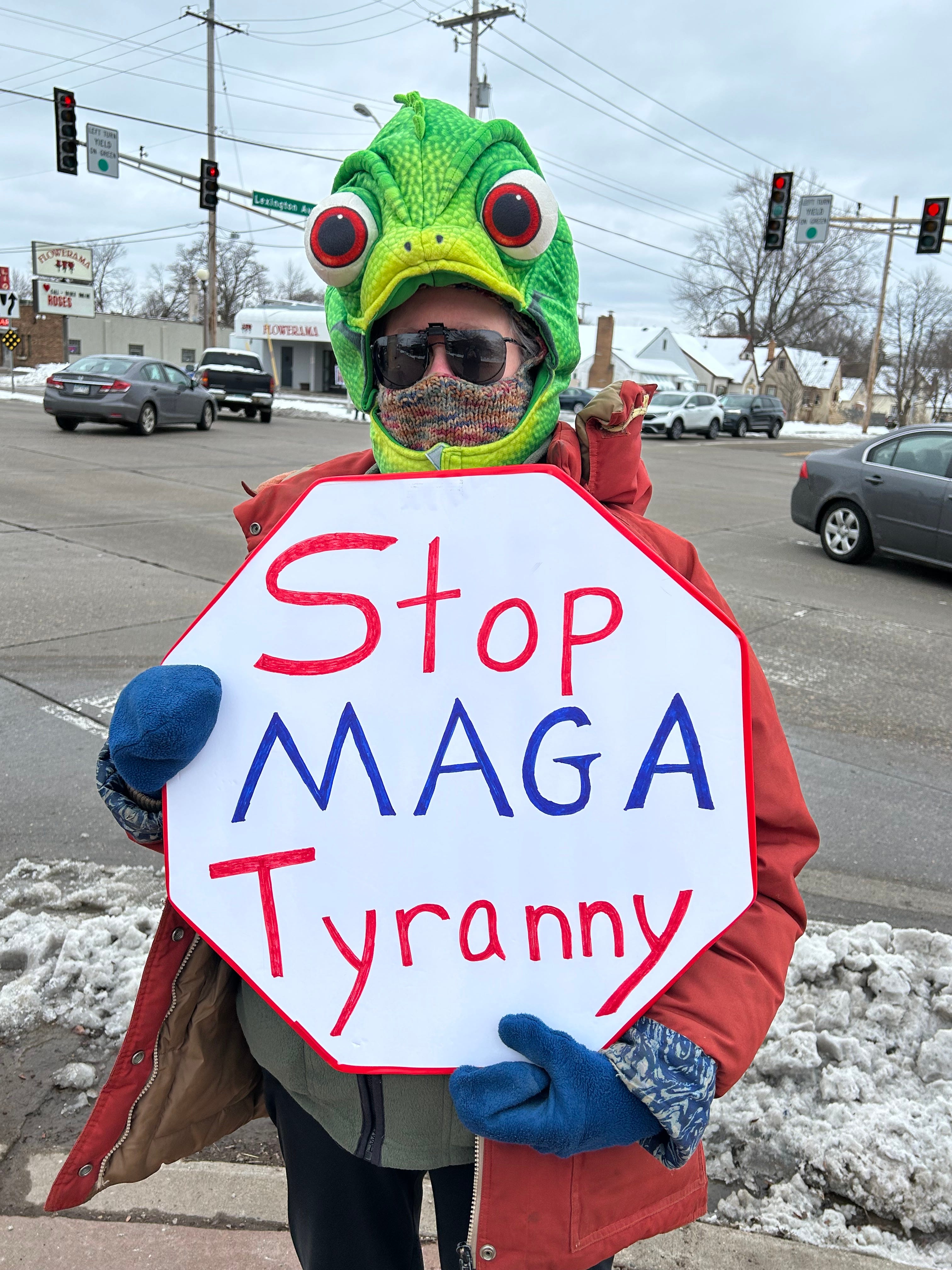
Frogs in Minnesota in February!

At one of ICE facilities protest in Scarborough, Maine

Bridge Brigade in Bakersfield, CA, over the 99 freeway.


Happy Hour Visibility Brigade, Lexington MA

Eugene, Oregon. We meet twice weekly on the Delta Highway bike bridge at evening rush hour


Dictionary.com, “This term, generally expressed as a cautionary proverb (Don’t look a gift horse in the mouth), has been traced to the writings of the 4th-century cleric, St. Jerome, and has appeared in English since about 1500. It alludes to determining the age of a horse by looking at its teeth.
From Today’s Edition Newsletter via this RSS feed