

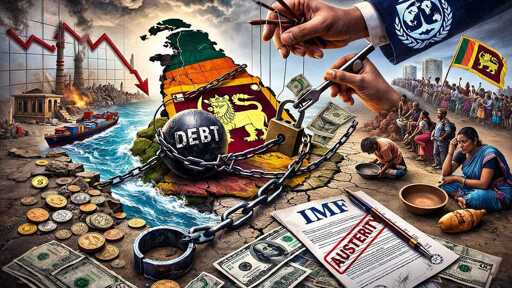
Since 2022, Sri Lanka has been struggling with the worst debt crisis in the country’s history due to a substantial decline in foreign exchange revenues from tourism, remittances, and exports. I wrote about it back then in The Lens (Stephanie Kelton’s substack). The debt crisis forced the country to agree to the 17th IMF intervention since 1965 with one of the most aggressive austerity programs in the country’s history. If we track IMF interventions in Sri Lanka, the record shows that the IMF intervened in Sri Lanka once every 3 years on average to dictate the country’s domestic economic policy choices.
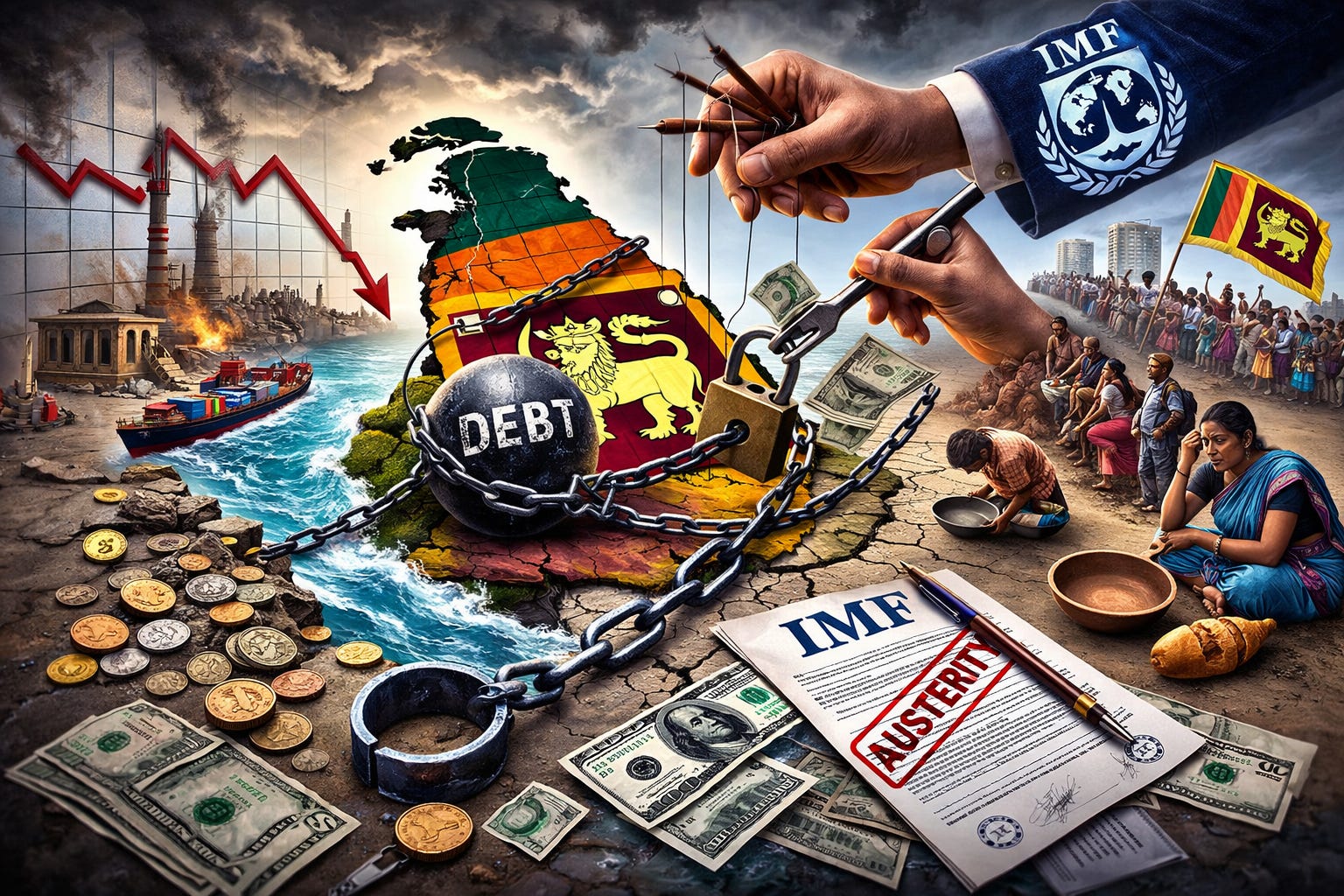
The fact that Sri Lanka is deeper in debt after 60 years of IMF micromanagement has got to mean one of two things; either the IMF is an incompetent institution, or it is in fact engaging in intentional economic entrapment in Sri Lanka and the rest of the Global South. I believe it is the latter. Either way, this means that Ski Lanka and the rest of the Global South must reject the IMF’s so-called “Debt Sustainability Analysis” (DSA), refuse to follow IMF policy prescriptions, and develop a coherent alternative that addresses the root causes of external debt (see for example what I wrote with my colleague Andrés Chiriboga here; and here is the Spanish version of the same paper).
Sadly, what made the Sri Lanka debt crisis worst was a climate-induced disaster on November 28, 2025 when Cyclone Ditwah killed 643 people and displaced 2.2 million people across the entire country. At the time, I joined more than 120 economists calling for a halt on Sri Lanka’s debt payments. and I co-authored an op-ed calling on the Sri Lankan government to move away from austerity-based policies and to mobilize its fiscal and monetary sovereignty to rebuild the country’s productive capacity and to boost recovery efforts after the cyclone’s devastation. This devastation is not unique to Sri Lanka, according to UN Trade & Development, debt service on external public debt alone reached $487 billion in 2023. In Africa, debt service exceeds what countries spent on health and education combined between 2021 and 2023.
A small but important historical note here. When the Global North decided to re-industrialize West Germany after WWII, it orchestrated a major debt cancellation program to write off 50% of Germany’s external debt under the London Debt Accords of 1953 and delivered a real industrialization plan with non-debt inducing financing and transfer of technology etc (I wrote about this here). Sri Lanka, along with many Global South countries contributed to Germany’s debt cancellation. Is it even conceivable today to cancel 50% of any developing country’s external debt? No! We only hear about rescheduling of payments, new loans to pay older loans, and nothing but entrapment. Wouldn’t it be reasonable to expect Germany’s ministry of finance to reciprocate Sri Lanka’s solidarity today (especially after a major climate disaster induced by Global North historic polluters)? I would hope so, but all signals indicate that none of that is on the horizon.
How to Paralyze a Nation
Sixty years of IMF interventions have systematically avoided the most important “structural adjustment” that Sri Lanka needed, which is to undo 400 years of colonial economic entrapment. If anything, the IMF’s so-called Debt Sustainability Analysis and Structural Adjustment Program have intentionally avoided addressing the structural root causes of external borrowing. If we pay attention to the composition of Sri Lanka’s exports and imports, it becomes very clear that the country has three major structural deficiencies that produce and reproduce the external debt trap: (1) food imports, (2) energy imports, and (3) high value-added manufactured goods (see figures below).
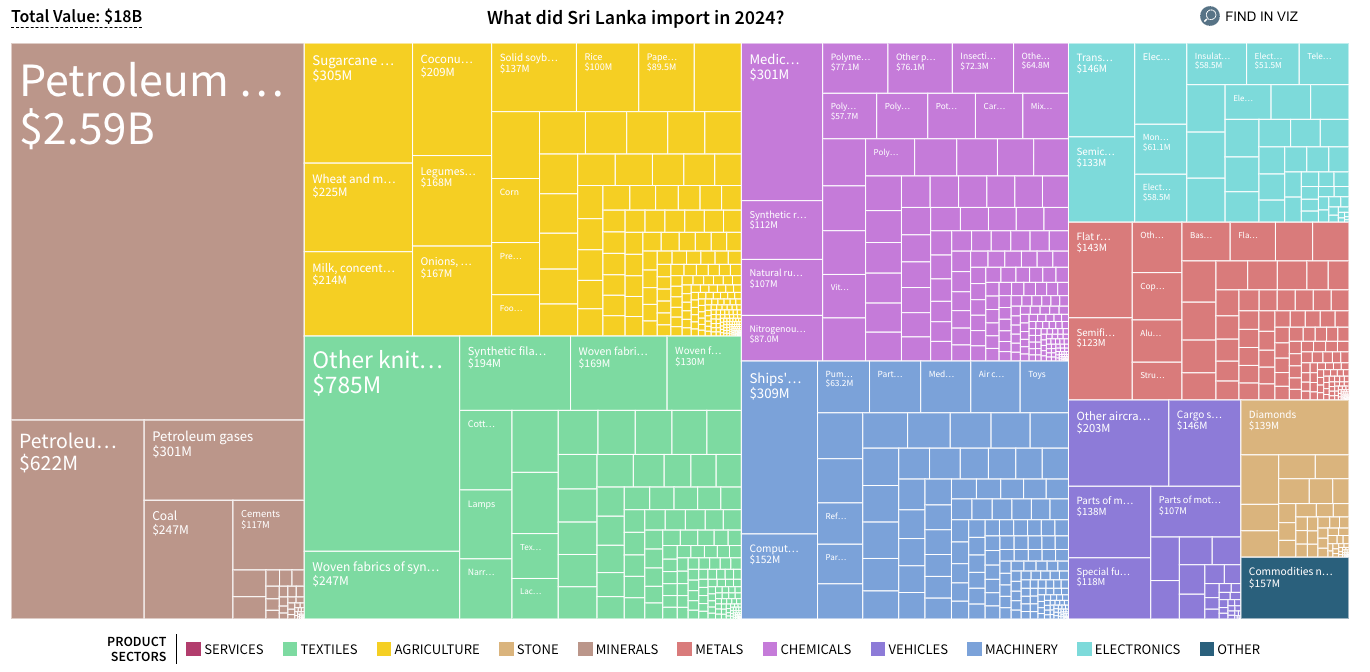
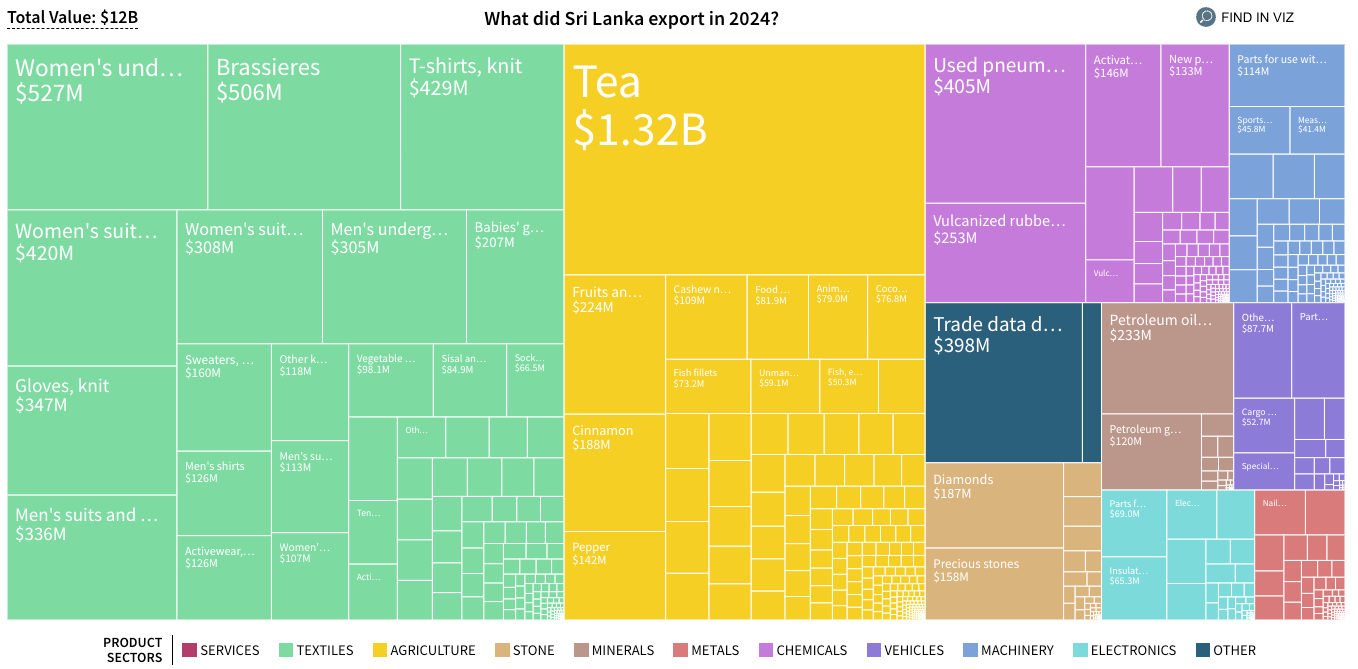
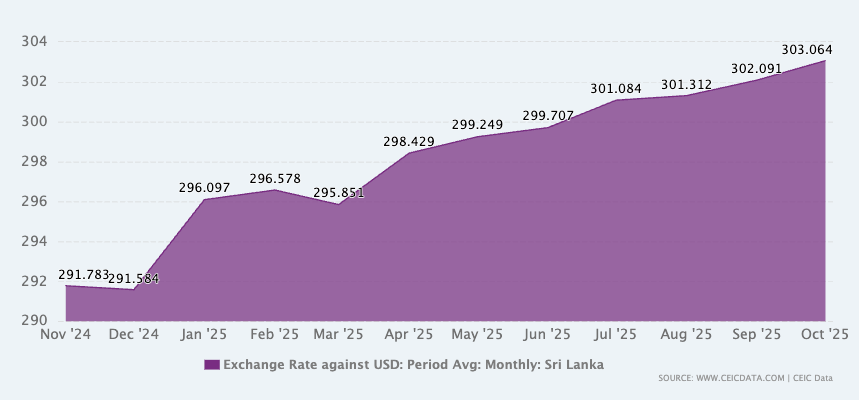
In 2024, Sri Lanka imported $18 billion dollars worth of goods, while it only earned $12 billion in export revenues. This persistent structural current account deficit puts downward pressure on the value of the Sri Lankan rupee relative to the US dollar, the euro and other major currencies. A weaker rupee (see graph below) means that everything the country imports (food, fuel, medicine, etc…) will cost more (imported inflation). The higher cost of living becomes unbearable for the people unless the government intervenes immediately with two basic bandaid solutions. First, the government will be compelled to subsidize basic necessities such as food, fuel, medical services as much as possible, which becomes unsustainable over time. Second, the central bank will intervene in the foreign exchange market to artificially stabilize the exchange rate by borrowing more dollars, thus fueling the debt trap (see graph below).
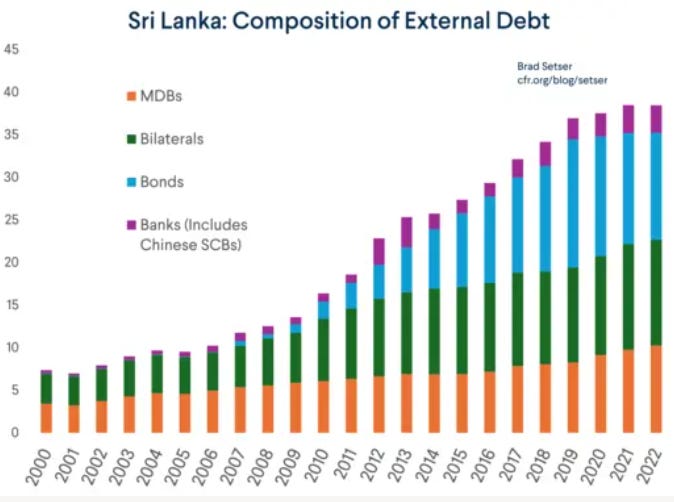
And the deeper the country goes into this debt trap the harsher the conditionalities imposed by the lenders who now want to prioritize economic activity to service the debt rather than develop the country or to serve the social and economic priorities of its people. Lenders now want less government spending on health and education, and better incentives to attract investors to extract natural resources, export crops, low-cost textiles and manufacturing. All of which reproduces the colonial economic entrapment of 400 years of making Sri Lanka play the role of the provider of cheap raw materials. the consumer (not the producer) of imported industrial products and technologies, the host of low-cost and low-value-added production units that are no longer needed in the industrialized world, therefore locking the country at the bottom of the global value chain with no hope of escaping the debt trap. The same formula is applied repeatedly across the Global South.
Share Global South Perspectives ~ by Fadhel Kaboub
The Needed Structural Transformation
Addressing the root causes of the external debt trap requires strategic investment that enhances Sri Lank’s degree of food sovereignty, energy sovereignty, and industrial capabilities.
Sri Lanka can target fiscal spending (in rupees, not in foreign currencies) to boost domestic production of core food crops (not export crops) and renewable energy. Every metric ton of rice produced locally saves the equivalent amount in dollars that would have been borrowed to import food and the interest paid over many years. Every green kilowatt hour produced domestically saves the equivalent amount in dollars that would have been borrowed to import fuel and the interest paid over many years.
Escaping these structural traps is a very difficult task for a small developing country to do it alone. Regional cooperation, South-South strategic cooperation and South-North solidarity play a fundamental role in the process of structural transformation. Regional cooperation creates tremendous benefits when it leverages the complementarity of resources and capabilities. Not every country can be fully self-sufficient in food and energy production, so collective self-reliance creates a virtuous cycle of win-win partnership opportunities.
Coordinating and negotiating joint procurements from international suppliers allows Sri Lanka and its partners to negotiate steep discounts that produce substantial foreign currency savings. Information sharing about frequently purchased items may reveal common sense joint industrial policies to manufacture frequently imported items. The advantage of joint industrial policies is that it benefits from the necessary economies of scale to reduce the cost per unit, improve quality, efficiency and product competitiveness. This is a game changer that allows Sri Lanka and the rest of the Global South to escape the bottom of the global value chain once and for all.
The stronger the cohesion of regional economic blocs on joint procurements, food and energy policies, and joint industrial policies, the stronger the bargaining position of these blocs in terms of multilateral negotiations on debt, climate, technology transfers, and development finance.
Reforming the Global Economic “Architecture”
The rules of the global economic “architecture” have imposed on the Global South an economic role that is systematically conducive to unsustainable debt burdens and condemns the Global South to endless economic entrapment. Today, the Global South (including Sri Lanka) plays the role of the place where: 1) the industrialized world acquires cheap raw materials (including critical minerals); 2) industrial output from the Global North can be dumped in a large consumer market; 3) the Global North finds low-cost tourist destinations; and 4) obsolete technologies, and low-tech, low labor-cost, assembly-line manufacturing that is no longer needed in the Global North is outsourced to in the name of “development”, “cooperation”, and “job creation”, which in fact guarantees that the Global South remains locked at the bottom of the global value chain. Therefore, one of the most important aspects of reforming the international financial architecture must be an intentional strategy to rebalance the global economy and to reposition Global South countries away from the bottom of the global value chain.
The biggest mistake that developing countries are currently making when it comes to reforming the global financial “architecture” is to limit the reforms to: demanding a seat at the table, lower cost of capital, a fair credit ratings assessment, more SDR issuance, and better terms that allow for stoping debt service payments during a climate disaster. All of these reforms are helpful, but they are bandaids that do not challenge the existing system.
In short, we need a two-pronged approach to the global economic reform:
Reducing the existing debt burden via a combination of debt cancellations and debt restructuring, and elimination of unjustifiably punitive financing terms; and
Channeling new concessional financing, grants, transfer of technology, and exemptions of intellectual property rights towards strategic sectors of economic transformation (agriculture, energy, higher value-added manufacturing) that target the very sources of external debt.
This two-pronged formula has been successfully implemented by the Global North for geopolitically strategic allies like West Germany, Japan, South Korea, Israel, Taiwan and Singapore. The rest of the Global South has been intentionally excluded from this privilege because its implementation on a large scale would simply mean repositioning the Global South majority at the center (not at the bottom) of a new international economic order that puts to rest once and for all the existing colonial hierarchy.
P.S. A small note here to apologize to all the wonderful architects out there. On behalf of everyone involved in these discussions about reforming the global economic “architecture” which I often describe as violent, unstable, unsustainable, undemocratic, abusive and unjust. It is truly an insult to the world of real architecture which generally symbolizes stability, safety, warmth and beauty. I really wish that my colleagues would borrow more than just the name from your field.
Global South Perspectives ~ by Fadhel Kaboub is a reader-supported publication. To receive new posts and support his work, consider becoming a paid subscriber.
Fadhel Kaboub is an associate professor of economics at Denison University, and the president of the*Global Institute for Sustainable Prosperity.* He is the author of*Global South Perspectives* on substack. In 2025, Dr. Kaboub was recognized by the New African Magazine in the Top 100 Most Influential Africans under the Thinkers & Opinion Shapers category. He is a board member of the United Nations High-Level Advisory Board on Economic and Social Affairs at UN-DESA. He is also a member of the*Independent Expert Group on Just Transition and Development, an expert group member with theGlobal Solidarity Levies Task Force, a member of theEarth4All 21st Century Transformational Economics Commission, a Steering Committee member with theFossil Fuel Non-Proliferation Treaty Initiative*, and a member of the Independent Expert Group on Just Transition Finance. He has recently served as Under-Secretary-General for Financing for Development at the Organisation of Southern Cooperation in Addis Ababa, Ethiopia. Dr. Kaboub is an expert on designing public policies to enhance monetary and economic sovereignty in the Global South, build resilience, and promote equitable and sustainable prosperity. His recent work focuses on Just Transition, Climate Finance, and transforming the global trade, finance, and investment architecture. His most recent co-authored publications include “A Coherent Framework for Sovereign Debt and Economic Transformation: Towards a Global South Debtors’ Coalition,” (Institute for Economic Justice, 2025), and Just Transition: A Climate, Energy, and Development Vision for Africa (May 2023). He has held a number of research affiliations with the Levy Economics Institute (NY), the John F. Kennedy School of Government at Harvard University (MA), the Economic Research Forum (Cairo), Power Shift Africa (Nairobi), African Forum on Climate Change, Energy and Development (Abuja), and the Center for Strategic Studies on the Maghreb (Tunis). Dr. Kaboub is currently working on a book manuscript tentatively called The Geopolitical Bargain of the Century: Towards a New International Economic Order of Peace, Justice, and Sustainable Prosperity (forthcoming).
You can follow him on LinkedIn, X/Twitter, Bluesky, YouTube, and TikTok @FadhelKaboub.
From Global South Perspectives ~ by Fadhel Kaboub via this RSS feed
You must log in or # to comment.