




Shuttered factory, Astoria, Oregon. Photo: Jeffrey St. Clair.
A sharp decline in federal spending knocked 1.15 percentage points off the growth rate in the fourth quarter. Some of this was clearly due to the government shutdown, which will be reversed in the first quarter of this year, but most of the falloff was due to cutbacks put in place by the Trump administration. (Roughly two-thirds of federal employees worked through the shutdown.)
However, the federal government was not the only source of weakness in the report. Investment grew at just a 3.7 percent rate, with structure investment falling at a 2.4 percent rate, its 8th consecutive quarter of decline. Durable good consumption also fell, dropping at a 0.9 percent rate.
Inflation edged slightly higher in the quarter, with the rate for the Personal Consumption Expenditure Deflator rising from 2.8 percent to 2.9 percent. This is being driven by inflation in services, which was 3.3 percent for the quarter. Inflation in durable goods, which had been negative for 9 consecutive quarters by the end of 2024, fell back to a 0.8 percent rate, after tariffs had led to a 3.1 percent jump in the second quarter.
Services Drive Consumption Growth as Durable Consumption Falls
Consumption of durable goods has been on a seesaw pattern since the 2024 election due to tariffs. Spending jumped at a 13.0 percent annual rate in the 4th quarter of 2024, as people purchased cars and other items in anticipation of tariffs. It then fell back at a 3.4 percent rate in the first quarter of 2025. It grew modestly in the next two quarters as the tariffs were put into effect before dropping in the fourth quarter. Real consumption of durables is now 3.0 percent above its level in the third quarter of 2024. It will likely grow modestly going forward assuming no major further changes in tariffs.
Health Care Spending Continues to Rise Rapidly
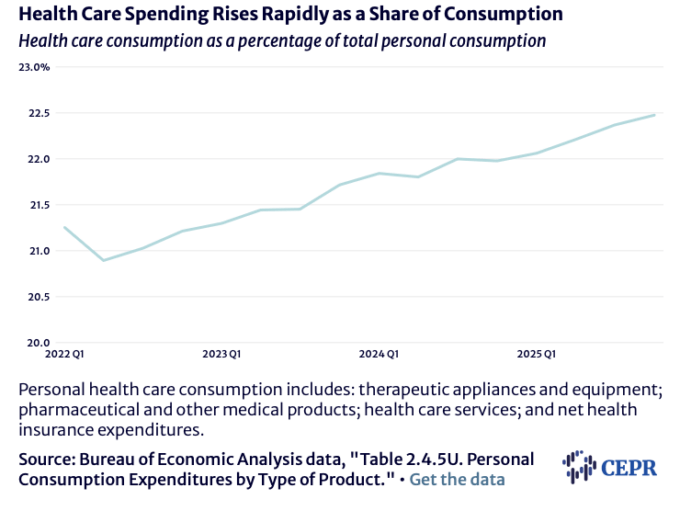
The increase in real health care spending accounted for 45 percent of the growth in the quarter as it grew at a 5.6 percent annual rate. Nominal spending rose even more rapidly, growing at an 8.9 percent annual rate. From the standpoint of affordability, nominal spending on health care is arguably the major concern, and it is hugely outpacing income growth.
Spending on prescription drugs also continues to rise rapidly. While nominal spending on pharmaceuticals grew at just a 2.3 percent annual rate in the fourth quarter, it was 7.0 percent above the year ago level.
Investment Spending Surprisingly Weak, as Factory Construction Continues to Fall
Non-residential investment grew at just a 3.7 percent rate, as structure investment continued to fall, declining at a 2.4 percent rate. Factory construction fell at a 6.3 percent rate in the quarter. Factory construction is now 11.2 percent below its peak in 2024.
Equipment investment grew at a modest 3.2 percent rate, led by a 36.1 percent jump in investment in information processing equipment. Other major areas of equipment investment declined. Investment in intellectual property products rose at a 7.4 percent rate, led by software and research and development. Investment in entertainment and artistic products declined at a 3.8 percent rate, the fourth consecutive quarter of decline.
Housing Investment Falls for the Fourth Consecutive Quarter
Housing investment fell at a 1.5 percent rate in the fourth quarter. It stood 3.7 percent below its year ago level last quarter. The falloff in multifamily housing has been considerably sharper. The level of construction in the fourth quarter was 23.7 percent below the peak hit in the third quarter of 2023.
Federal Government Spending Fell at a 16.6 Percent Rate, Driven More by Policy Than Shutdown
The sharp drop in federal spending was a big hit to growth in the quarter, but it was likely driven more by the cutbacks put in place by DOGE than the shutdown. With close to two-thirds of federal employees still going to work in shutdown, the falloff in spending as a direct result of the shutdown would be limited. By contrast, the layoff of almost 170,000 federal employees hit in October, with further employment drops in November and December. There will be a bounce back in the federal spending that was associated with the shutdown in the first quarter, but the drop due to the layoffs will persist. State and local government spending grew a 2.4 percent pace, roughly consistent with the pace of the prior two years.
Trade Provides a Modest Boost to Growth, as Imports Fall More than Exports
Imports and exports both declined in the fourth quarter, but the 1.3 percent drop in imports was larger than the 0.9 percent decline in exports. As a result, trade added 0.09 p.p. to the quarter’s growth. After erratic tariff driven swings earlier in the year, trade may settle back to more normal growth patterns barring further changes in tariffs.
Inflation Edges Higher, as Goods Inflation Rise and Service Inflation Remains Elevated
The annual rate of inflation in the Personal Consumption Expenditure Deflator was 2.9 percent in the quarter, up from 2.8 percent in the third quarter. The increase was due to a modest uptick in goods inflation. Durable goods prices rose at a 0.8 percent rate in the quarter, almost certainly due to tariffs. They had been falling for nine consecutive quarters through the end of 2024.
Service prices rose at a 3.3 percent rate, the same as the pace in the third quarter. There is no clear downward trend here, which means it will be difficult for the Fed to get to its 2.0 percent inflation target.
Overall Picture: Modest Growth, but Inflation Remains Elevated
The fourth quarter GDP figure was lower than generally expected, but without the effects of shutdown and layoffs — both one-time events — growth would have been around 2.5 percent. However, the balance is not great. Investment outside of AI-related areas is weak. Housing continues to drift lower, and trade is not providing any major boost to growth.
Consumption is driven largely by health care, as is job growth. This likely explains much of the concern on “affordability.” People likely care more about what they have to spend on health care than the measured rate of health care inflation. With the former rising much more rapidly than the latter, many families likely feel squeezed.
This first appeared on Dean Baker’s Beat the Press blog.
The post Soft Investment, Falling Federal Spending Lower GDP Growth to 1.4 Percent in Q4 appeared first on CounterPunch.org.
From CounterPunch.org via this RSS feed