

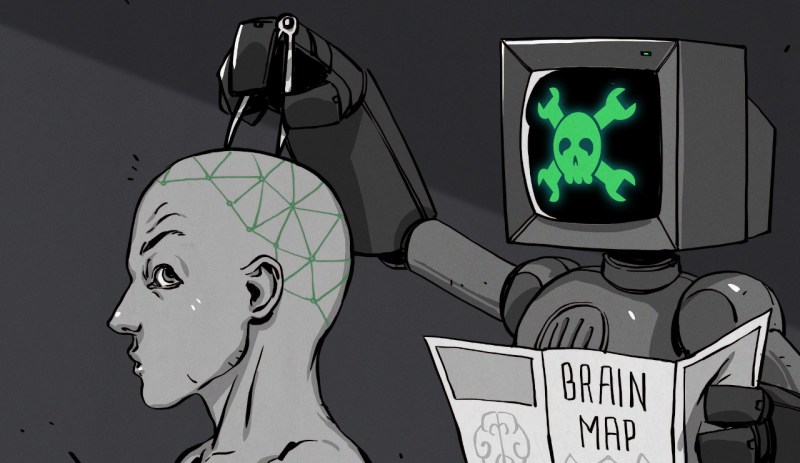
It’s quite the understatement to say that at this point in time we don’t quite understand how even the tiniest brain works exactly. Much of this is due to the sheer complexity and scale of these little biological marvels: with the human brain packing billions of neurons and their associated supportive scaffolding into a few kilograms of gooey pink-white mass, the sheer connectivity density is more than we can reasonably hope to measure in-situ. Ergo attempts to recreate digital simulations of small sections of such brains, a process that’s making gradual progress.
Most recently we have been doing mapping of neurons and their connections in the brain of the humble fruitfly, D. melanogaster. Despite their brains being minuscule, with only about 140,000 neurons and 50 million connections, we’re not quite at the level where we can have a simulated fruitfly brain spark to life. This should probably give us some hints as to the sheer complexity of mapping the human brain, never mind simulating even a small part like a cubic millimeter of the temporal cortex with about 57,000 cells and 150 million synapses.
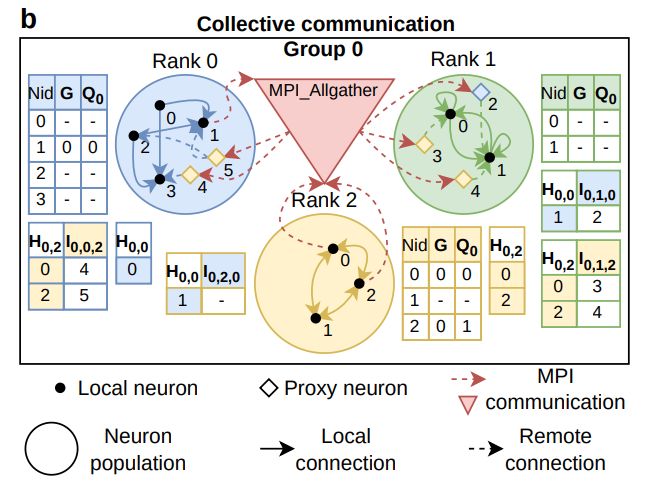
Even once you have all the connectome data of such a bit of brain, it’s not like you can just toss it onto a supercomputer and expect a meaningful simulation. All supercomputers today are massively parallel, meaning thousands of networked computers that require the computing task to be split up and all communication between nodes restricted as much as possible to not starve nodes.
(Credit: Bruno Golosio et al., 2025)
In the paper, these challenges are addressed and a model suggested that should provide the best possible optimization for such a simulation. Both point-to-point and collective communication are investigated on the NVIDIA A100 GPU-equipped supercomputer.
Based on their findings they conclude that the entire 6 MW-rated Leonardo Booster supercomputer with its 3,456 nodes could simulate a model with about 3.5 · 1013 connections, roughly 10% of that of the human cortex if assuming random connectivity. A more realistic model would feature more directed mapping that could be more efficient.
Regardless of this, their conclusion that an optimal design would be a hybrid, with both point-to-point communication for local spikes and collective communication for long-range communication, seems valid. For now it would seem that simulating an entire human brain is still far beyond the realm of possibilities, but we might actually have a shot at simulating the fruitfly brain on a modern supercomputer in the near future.
From Blog – Hackaday via this RSS feed
You must log in or # to comment.