

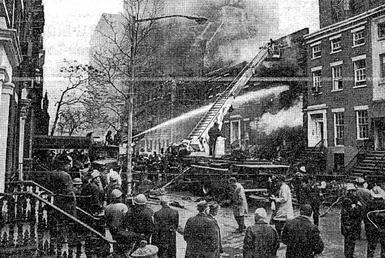
FDNY responds to Weatherman townhouse explosion – Fair Use
Of all the events that unfolded in the first half of the 1970s, none has haunted me more than the blast in an apartment building in Manhattan that claimed the lives of three members of Weatherman and their fledgling underground organization. All that past came back to me the other day when a journalism student at Columbia reached out to interview me about the “townhouse explosion,” as it has come to be known. A very cold case has suddenly heated up, and not by any prosecutor or by Trump’s Justice Department. The case is so old that it’s now “academic.” But is it “safe” to talk about it?
I have been interviewed about it and have written about it for more than five decades. I keep trying to wrap my head around it and it doesn’t want to be wrapped. It’s too messy.
The BBC interviewed me before anyone else could get their hands on me. I had no problem talking about the explosion. I have never had a problem. I talk too easily and perhaps make up for people who say little or nothing, perhaps out of a sense of fear. The Columbia journalism student who reached out to me belonged to a team assigned by their professor the task of writing about the blast and its fallout. A tough assignment. Memories have faded. Secrets have burrowed even deeper down than ever before. Sixties self-proclaimed revolutionaries have become armchair lefties and wallow in nostalgia. I live on memories.
At this late date, we probably won’t ever know what actually took place in the townhouse on March 6, 1970, and in the days and weeks running up to that time. I did hear through the grapevine that one of the bomb makers accidentally connected two wires that ought not to have been connected. Kaboom! In the winter of 1971, about a year after the townhouse explosion, I watched a knowledgeable bomb maker assemble the bomb that went off in the US Capitol, that destroyed property and didn’t take anyone’s life.
Cathy Wilkerson is the only person alive today who was inside the building when the bomb went off. She wrote her memoir, Flying Close to the Sun: My Life and Times as a Weatherman published in 2007.
Odd that she didn’t call herself a Weatherwoman. Wilkerson did not tell all. Maybe she didn’t remember. After all, in the wake of the explosion, she was in a state of shock and had to rely on a Weather sister to lead her to safety and wash the debris from her clothes and her body. I hope she tells all now. The statute of limitations has expired, and as far as I know no one can be charged with the murder of Diana Oughton, Teddy Gold and Terry Robbins, the firebrand of all firebrands, who was not destined to grow old and live a long life. I learned that about Terry when I worked with him in the SDS national office on Madison Street in the summer of ’69, two months before the Days of Rage.
Does anyone care what happened in the townhouse? Maybe no one who is politically active today. Protesters from Minneapolis to Los Angeles and beyond seem to have rejected violent tactics and armed struggle, which were watchwords in the Sixties. In the streets today, most demonstrators advocate and practice non-violent resistance. They haven’t picked up the gun or made bombs, though that hasn’t stopped them from being maligned as “terrorists.”
In the late 1960s and early 1970s, I espoused violence and took part in violent demonstrations, rioted in the streets, trashed windows, overturned cars and was arrested and tortured. I was also charged with attempted murder of a police officer and criminal anarchy. The charges were dropped. I didn’t become a pacifist until 1995 when I traveled to Vietnam, met old Vietnamese men who had fought against the French, and young Vietnamese men and women who spoke Russian, and in the wake of the fall of the Soviet Union, wanted to learn English. They saw the handwriting on the wall. I gave them assignments and they took me to the movies. In Hanoi, I came to the conclusion that no one wins a war, though everyone involved loses one.
I was then and still am today reluctant to condemn the use of violent means to overthrow oppressive regimes from Iran to Hungary. MLK was reluctant to condemn the young Black men who used violence in the 1960s. He pointed out famously that his own government was “the greatest purveyor of violence in the world.” Maybe it still is, though it has competition from other nations, including Russia which is bombing the fuck out of Ukraine.
In 1970, when the French novelist, Jean Genet visited the US to rally support for the Black Panthers, I asked him about the Weather Underground. “The underground has very small bombs,” he said. “The US has very big bombs.” Or as Allen Ginsberg said, “Who bombs? We Bomb.”
In Hanoi, among survivors of the French War and the American War and the War against the Japanese, it struck me for the first time that violence corrupts and contaminates. It comes back to bite the hands of those who use it against their perceived enemies, though as far as I can see the Vietnamese have been able to evade the curse attached to violence. Perhaps because more violence was perpetrated against them than they perpetrated against the US.
I wondered and still wonder if the Weather Underground was a terrorist organization and whether Terry, Teddy and Diana were terrorists. Perhaps not when compared to Hamas or the Shining Path or any of the guerrilla organizations that once operated from Angola to Bolivia. Now, as then, state terror rains down a global reign of terror. The goal of the Weather Underground, or at least one of them, was to strike fear into the hearts and minds of Nixon administration heavies and to try to terrorize them.
In one of her earliest communiqués, issued on July 26, 1970, Bernardine Dohrn intoned, “Today we attack with rock, riots and bombs, the greatest killer-pig ever known to man—American imperialism.” She added, in an aside to Attorney General John Mitchell, “Don’t look for us, dog. We’ll find you first.” I knew Bernardine and I know that it felt good to express those sentiments. It also felt good to hear them if you were a Yippie, an anti-war radical, or like me a target of a federal grand jury investigating the townhouse explosion. I didn’t testify, though I received a subpoena. That’s another story.
On New Year’s Eve 1969, after I attended the Weatherman “War Council” in Flint, Michigan—where I declined Kathy Boudin’s invitation to me to join the underground cell she was forming— I talked to Monthly Review (MR) editor Paul Sweezy. I said, “MR shares with Weatherman the notion that the main contradiction in the world is between the imperial center and the underdeveloped world on the periphery.”
Paul replied, “That’s true, but it doesn’t mean that we advocate armed struggle in the US.” I found it challenging to accept Weatherman ideology and to reject Weatherman tactics and strategy. Ah, if only revolution was a simple, straightforward matter, in which no one on my side died or was injured.
I hope that the students assigned to write about the townhouse will not accept at face value what their sources tell them, and that after nearly 70 years, they realize it might not be possible to ascertain the facts. Still, the stories that have been told can be just as, if not more, illuminating than any facts. Maybe a “terrible beauty,” to borrow William Butler Yeats’ expression, will emerge and surprise us all. Those of us who were alive in 1970 and those of us awakening to the terror authored by the greatest purveyor in the world today—the US government.
The post A Cold Case Heats Up: The Townhouse Explosion 56 Years Later appeared first on CounterPunch.org.
From CounterPunch.org via this RSS feed
You must log in or # to comment.