

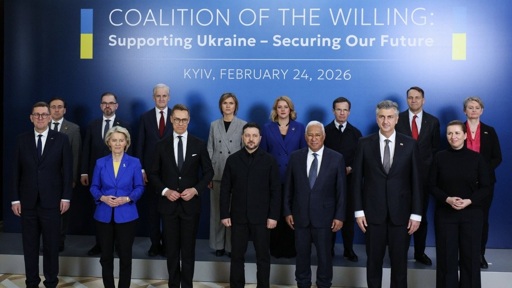
The war in Ukraine has entered its fifth year with scarce hopes for an end. European politicians, who joined commemoration events on February 24, bear much of the responsibility for the devastating situation faced by Ukraine’s population. Yet, instead of advocating for a vibrant peace movement, they continue advocating for more fighting by promising new loans, stronger links with the European military industry, and raising Ukrainian flags in Brussels. The statements by European leaders in Brussels suggest that they are either willfully or ignorantly mischaracterizing the progression of the war to justify their political goals.
“Russia has not achieved its military objectives in Ukraine”
On Tuesday, the presidents of the European Council, European Commission, and European Parliament stated that since 2022, “Russia has not achieved its military objectives in Ukraine.” With this, they probably wanted to suggest Russian authorities had miscalculated when they launched military operations and hint that Russian forces could still be defeated on the battlefield.
However, the miscalculation – or worse, purposeful misinterpretation – seems to be on the part of the European Union, considering Ukrainian forces have not been able to secure significant progress for months and reports indicate troops morale is low, not to mention the fact that Russia’s economy has not collapsed despite the EU introducing (almost) 20 rounds of sanctions. Even if Russian authorities have not achieved their military objectives yet, they very well might in the coming period, considering Ukraine’s so-called allies seem determined to continue along the same path.
“Ukrainians remain formidable in their fortitude, determination and resilience”
Over the past four years, Ukraine has suffered significant damage to key infrastructure – from electricity grids to hospitals – in Russian attacks. As a result, thousands have spent this winter without heating in freezing temperatures. Meanwhile, public support for continuing the fighting has significantly declined.
Independent reports indicate more and more people are now speaking of how exhausted they are from living without heating, healthcare, or a substantial vision for the future – unsurprisingly, they would prefer the war to stop. Additionally, reports are also circulating of passers-by protecting men from being forcibly conscripted in public spaces. “In many cases, the people on the streets, mostly women, are trying to protect men who are being recruited off the streets,” Ukrainian sociologist Volodymyr Ishchenko told German media. “The recruitment officers are hated. But this is not really presented to the public.”
These accounts apparently haven’t reached the halls of Brussels as, in their statement, EU leaders described the current situation as one where the Ukrainian people “remain formidable in their fortitude, determination and resilience” – in shouldering the consequences of a war they would prefer to end.
“The aggressor cannot be rewarded”
Throughout the war, European politicians have consistently undermined all attempts to establish communication between Russian and Ukrainian authorities, insisting that an acceptable peace deal should include only concessions from Moscow, as “the aggressor cannot be rewarded.” Unless that aggressor is Israel, they should have added, in which case it remains a cherished EU partner even as it commits genocide.
Despite claims to the contrary, European institutions have done their utmost to derail potential negotiations, possibly seeing this outcome as a threat to their privileged position in the world. Andrew Murray from Stop the War Coalition recently described how British governments pursued such a line. “The British government has been more bellicose than either the Biden or Trump administrations in Washington,” he wrote. “This reflects its desperation to maintain the present world order, including NATO’s military domination, from which it benefits so mightily.”
“Europe has a clear and legitimate interest in how Russia’s war ends”
In her recent remarks on the topic, EU High Representative Kaja Kallas insisted European governments and institutions should be involved in ongoing efforts to negotiate an end to the conflict, considering that “Europe has a clear and legitimate interest in how Russia’s war ends.”
While Europe definitely has a clear interest in this, its legitimacy is less certain. This interest might, in fact, reflect fears among the regional political establishment that an end to the conflict in Ukraine would mean the US has fully abandoned its interest in the region and, by extension, its European friends.
It would also cast serious doubt on the strategy the EU has pursued throughout the conflict, which basically consists of directing everything into the military-industrial complex.
When European leaders speak of the €200 billion provided for support to Ukraine since 2022, they attribute more importance to funds for armament, and refer less to rebuilding hospitals and power grids. The latest EU “support package,” planned for 2026-2027 and amounting €90 billion, is a good illustration of this, as “€60 billion of this support package will be spent on military needs.”
Read more: Tanks don’t fill lunchboxes
This is perfectly logical, considering European governments seem determined to sacrifice their own labor legislation and public services to build a stronger war machine. Since 2022, European NATO countries have: pledged to increase defense spending to 5% of GDP, announced hundreds of billions under the ReArm Europe (now officially known as Readiness 2030) agenda, opened the door to dual-use projects which will subjugate essential infrastructure to military needs, put military recruitment back on the agenda, and suspended labor and environmental protections to “help” the arms industry – to name just a few of their moves.
Left and progressive movements in the region remain opposed to this agenda as much as they oppose the continuation of the war in Ukraine. “We cannot write a peace deal between Ukraine and Russia, nor resolve the internal strife within Ukraine, nor make the Russian government as good as it ought to be,” Murray wrote of Stop the War Coalition’s position in Britain, applicable to those in other European countries as well. “We can and do oppose the British government’s reckless policy on the war, its willingness to promote the continuation of a slaughter, its arming and financing of the war, its proposal to deploy British troops and its squandering of billions on an unnecessary arms build-up.”
The post Four years of the war in Ukraine: Where does Europe stand? appeared first on Peoples Dispatch.
From Peoples Dispatch via this RSS feed
You must log in or # to comment.