

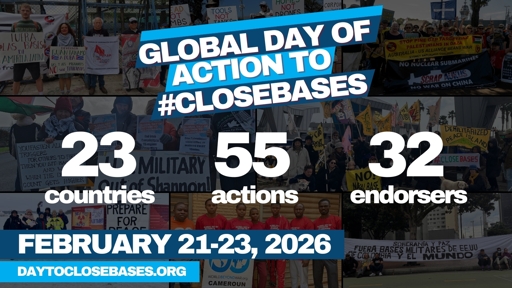
Reports from the 2026 Global Day of Action to Close Bases
On February 21-23, 2026, individuals and organizations around the world took coordinated action in their communities to call for the closure of all military bases as part of the Global Days of Action to Close Bases. Details about plans for the day, participants, motivations, and goals are at DayToCloseBases.org.
Over 50 events took place in Australia, Burundi, Cameroon, Denmark, DRC, England, Finland, Germany, Greece, Ireland, Italy, Japan, Lithuania, Mauritius, Norway, Philippines, Puerto Rico, Scotland, South Korea, Sweden, United States, Venezuela, and Wales.
Below is a sampling of reports, videos, and photos from a variety of locations.
Over 30 organizations endorsed.
Simultaneously, WBW published a report on Canadian foreign bases, did webinars on bases in Latin America, released statements on plans for a U.S. base in Gaza, and previewed the coming actions with a walk on a frozen lake in Wisconsin, U.S.
Australia
Brisbane
Michael Henry reports:
Just Peace QLD organised a vigil in King George Square, Brisbane, whose objective was to bring the attention of residents of our city to the large number of military bases in Australia. Almost all these facilities are used by the United States of America. This situation means that Australia is closely bound to the espionage, personnel training, and weapons testing activities of the USA. And one way or another facilitates wars and civil unrest all over the world. Furthermore, these bases are the source of intense pollution of Australia’s land, waterways, and air. The global footprint of America’s military in this regard is powerfully documented in the film Earth’s Greatest Enemy, directed, and produced by internationally renowned journalists Abby Martin and Mike Prysner.
The film will be shown in Brisbane on Friday June 5th at 6:30pm at the New Farm Cinemas.
The vigil was attended by about 25 people from many groups in Brisbane who are deeply concerned about this issue.

Melbourne
Margaret Williamson reports on behalf of The Committee Melbourne Unitarian Peace Memorial Church
Please find below a photo of the congregation who attended the service for the Melbourne Unitarian Peace Memorial Church last Sunday 22nd February. Our service was dedicated to the global campaign to close bases. For us that includes the closing of USA bases on Australia, including Pine Gap, North West Cape, and others arising from the AUKUS military pact, for the $368Billion sale of eight (8) nuclear powered submarines to the Australian navy.

Sydney:
Also see this report with photos on Facebook.
Denis Doherty reports:
The weekend of 21 and 22nd February was chosen as the global day of action to close bases. The idea originated with the global organization World BEYOND War which has appealed to many across the world to come out on that weekend with actions to close bases — either local ones or foreign bases. In the Australian context for a long time it looked like the response would be small, but it grew significantly over the last few days. Actions and demonstrations were held in Brisbane, Canberra, Sydney, Melbourne, Adelaide, Fremantle, Alice Springs, Newcastle and Wollongong.
The global days of action to close bases marks the day the USA took over Guantanamo Bay from Cuba in 1903, starting the modern era of overseas military bases as a key tool of expansionism and empire building. Actions are designed to draw local and global attention to the environmental and social harms of overseas military bases.
“The sheer scale of global participation this weekend will send an unmistakable message: the physically massive, yet remarkably hidden, problem of military bases can no longer be ignored,” asserted David Swanson, Executive Director of World BEYOND War, a driving force behind this monumental day of action.
There are many reasons to close U.S. bases in Australia but the principal ones are currently as U.S. forces gather off Iran to force ‘regime change’, that the U.S. uses bases here to attack other countries and makes us complicit in war crimes as it has done by the use of Pine Gap for Israeli attacks on Gaza and surrounding countries. Of course, we acknowledge that the bases take up Aboriginal Land. Military bases are instruments of dispossession, routinely seizing Indigenous lands without consent or restitution.
The Sydney event at the gates of the Australian Navy Base in Sydney HMAS Kattabul was a well-attended day with an anti AUKUS theme. These nuclear submarines will require the establishment of more bases in Australia. The speakers were: Ms Abigail Boyd (Greens MLC) and Mr Matt Murphy (ETU National Office), Pip Hinman (Socialist Alliance), Peter Murphy (AWPR), Catherine Dobbie Knitting Nanas, Sha Reilly Labour against War, Olvia Barlow Greens councillor inner west, Denis Doherty Anti-Bases.
The basic themes were the needs of Australia far outweigh the need for submarines, these bases are facilitating war and the imminent war about to erupt in Iran. We in Australia need to wrestle with our status as a vassal of the U.S. and unable to be independent, we need to extricate ourselves from under the thumb of the U.S.


Northern Australia:
Billee McGinley reports:
I am from Garramilla (Darwin) in the Northern Territory of Australia. We did an action for the Global Days of Action to #closebases but didnt publicise our event prior to it happening.
View this post on Instagram
Burundi
Lorem ipsum dolor sit amet, consectetur adipiscing elit. Ut elit tellus, luctus nec ullamcorper mattis, pulvinar dapibus leo.
Cameroon
En français plus bas
Institutional Dialogue to Close Foreign Military Bases in Cameroon
By Roméo Tekoudjou Sonkeng, Co-Coordinator of the Cameroon Chapter of WBW
February 23, 2026 – Yaoundé, Cameroon
On February 23, 2026, on the occasion of the Global Day to Close Military Bases, the Cameroon chapter of World BEYOND War organized an exchange and awareness-raising meeting in Yaoundé inviting representatives of public administrations, diplomatic missions and civil society organizations. The idea was to draw attention to the impacts of foreign military bases on peace, sovereignty and security of populations, while promoting alternatives based on international cooperation, diplomacy and demilitarized security. In an African context marked by a significant foreign military presence and complex security dynamics, the Cameroon chapter of WBW considered it essential to open a space for constructive dialogue on this sensitive issue.
Administrations and missions had been invited but did not come, including the ministries concerned with issues of defense, as well as various embassies present in Cameroon, including the embassy of the United States of America, which has four military bases. While institutional mobilization remained limited, the presence of only two representatives of the Ministry of Foreign Affairs was an important signal of openness to dialogue.
The representatives of the Ministry of Foreign Affairs clearly indicated that they were not mandated to express an official position of the Cameroonian government on the subject discussed. Their participation was part of a process of listening and understanding, aimed at getting to know World BEYOND War and its national chapter better. In particular, they asked questions about the legal existence and mode of operation of the WBW Cameroon chapter, while providing advice on better alignment with the national legal framework. This exchange made it possible to clarify the non-partisan, non-violent and civic positioning of the movement, as well as its international affiliation and its mode of operation as a network.
Presentation of the chapter and the Global Day to Close Bases
The meeting began with a presentation of the Cameroon chapter of WBW, its vision and its main achievements. Participants were introduced to World BEYOND War’s global mission: to abolish the institution of war and promote its replacement with nonviolent alternatives to militarization. Particular emphasis was placed on the chapter’s participation in Global Day to Close Bases. This presentation made it possible to place the Cameroon chapter’s initiative in a broader global movement, while stressing the importance of a progressive dialogue with national institutions. The map of WBW’s military bases was presented, in order to introduce the participants to the location of the military bases in Cameroon attributed to the United States of America.
The civil society organizations present, including WILPF Cameroon, Women’s Peace Initiatives and Youth For Peace, welcomed the initiative and underlined the relevance of the theme. Their contributions to the exchanges highlighted the importance of approaching militarization through the lens of human rights, human security, and feminist peace. Participants stressed the need to strengthen synergies between organizations committed to peace, in order to pool awareness-raising and advocacy efforts. This meeting thus contributed to consolidating strategic alliances between national actors committed to the promotion of security centered on populations rather than on military logics.
Lessons and perspectives
The effective organization of this activity, despite the politically sensitive nature of the theme, is in itself a significant result. It has made it possible to initiate an institutional dialogue, to clarify the legitimacy of the chapter to ask these questions and to strengthen partnerships with peace organizations.
Among the main challenges observed are the low level of mobilization of invited diplomatic administrations and missions, as well as the inherent sensitivity to issues of international military cooperation. These elements underline the importance of more structured institutional communication upstream, in particular through bilateral preparatory meetings. The Ministry of Foreign Affairs said that in order to have an effective participation of diplomatic missions, it is recommended to go through them. Experience also shows that on issues relating to sovereignty and national security, a progressive approach that respects institutional frameworks is strategic.
The Global Day to Close Bases in Cameroon marks an important milestone in consolidating the Cameroon chapter of WBW in its commitment to demilitarized security. While institutional participation remained low, the activity opened up a space for dialogue with the Ministry of Foreign Affairs, strengthened partnerships with civil society organizations and placed the chapter in a broader continental dynamic. This initiative is part of a gradual process of awareness-raising and advocacy, based on dialogue, cooperation and the promotion of non-violent alternatives to militarization.
Dialogue institutionnel en vue de la fermeture des bases militaires étrangères au Cameroun
Par Roméo Tekoudjou Sonkeng, Co-coordinateur du chapitre camerounais de WBW
23 février 2026 – Yaoundé, Cameroun
Ce 23 février 2026, à l’occasion de la Journée mondiale pour la fermeture des bases militaires, le chapitre camerounais de World BEYOND War a organisé à Yaoundé une rencontre d’échange et de sensibilisation invitant des représentants d’administrations publiques, des missions diplomatiques et des organisations de la société civile. L’idée était d’attirer l’attention sur les impacts des bases militaires étrangères sur la paix, la souveraineté et la sécurité des populations, tout en promouvant des alternatives fondées sur la coopération internationale, la diplomatie et la sécurité démilitarisée. Dans un contexte africain marqué par une présence militaire étrangère significative et des dynamiques sécuritaires complexes, le chapitre du Cameroun de WBW a jugé essentiel d’ouvrir un espace de dialogue constructif sur cette question sensible.
Plusieurs administrations et missions diplomatiques avaient été invitées, bien qu’elles n’aient pas été présentes, notamment les ministères concernés par les questions de défense, de sécurité nationale, ainsi que différentes ambassades présentes au Cameroun, dont celle des États unis d’Amérique qui possèdent quatre bases militaires. Si la mobilisation institutionnelle est restée limitée, la présence de deux représentants du Ministère des Relations Extérieures (MINREX) a constitué un signal important d’ouverture au dialogue.
Les représentants du MINREX ont clairement indiqué qu’ils n’étaient pas mandatés pour exprimer une position officielle du gouvernement camerounais sur la thématique abordée. Leur participation s’est inscrite dans une démarche d’écoute et de compréhension, visant à mieux connaître World BEYOND War et son chapitre national. Ils ont notamment posé des questions relatives à l’existence légale, au statut juridique et au mode de fonctionnement du chapitre de WBW du Cameroun, tout en formulant des conseils en vue d’un meilleur alignement avec le cadre légal national. Cet échange a permis de clarifier le positionnement non partisan, non violent et citoyen du mouvement, ainsi que son affiliation internationale et son mode de fonctionnement en réseau.
Présentation du chapitre et de la journée mondiale
La rencontre a débuté par une présentation du chapitre du Cameroun de WBW, de sa vision et de ses principales réalisations. Les participants ont été introduits à la mission globale de World BEYOND War : abolir l’institution de la guerre et promouvoir son remplacement par des alternatives non violentes à la militarisation. Un accent particulier a été mis sur la participation du chapitre à la journée mondiale pour la fermeture des bases militaires étrangères. Cette présentation a permis d’inscrire l’initiative du chapitre camerounais dans un mouvement global plus large, tout en soulignant l’importance d’un dialogue progressif avec les institutions nationales. La carte des bases militaires de WBW a été présentée, afin de faire découvrir aux participants la localisation des bases militaires au Cameroun attribuées aux États Unis d’Amérique.
Les organisations de la société civile présentes, notamment WILPF Cameroon, Women’s Peace Initiatives et Youth For Peace, ont salué l’initiative et souligné la pertinence de la thématique. Leurs contributions aux échanges ont mis en lumière l’importance d’aborder la militarisation sous l’angle des droits humains, de la sécurité humaine et de la paix féministe. Les participantes et participants ont insisté sur la nécessité de renforcer les synergies entre organisations engagées pour la paix, afin de mutualiser les efforts de sensibilisation et de plaidoyer. Cette rencontre a ainsi contribué à consolider les alliances stratégiques entre acteurs nationaux engagés dans la promotion d’une sécurité centrée sur les populations plutôt que sur les logiques militaires.
Enseignements et perspectives
L’organisation effective de cette activité, malgré le caractère politiquement sensible de la thématique, constitue en soi un résultat significatif. Elle a permis d’initier un dialogue institutionnel, de clarifier la légitimité du chapitre à poser ces questions et de renforcer les partenariats avec des organisations de paix.
Parmi les principaux défis observés figurent la faible mobilisation des administrations et missions diplomatiques invitées, ainsi que la sensibilité inhérente aux questions de coopération militaire internationale. Ces éléments soulignent l’importance d’une communication institutionnelle plus structurée en amont, notamment à travers des rencontres bilatérales préparatoires. Le Minrex a notamment indiqué que pour avoir une participation effective des missions diplomatiques, il est recommandé de passer par eux. L’expérience montre également que sur des sujets touchant à la souveraineté et à la sécurité nationale, une approche progressive et respectueuse des cadres institutionnels est stratégique.
La Journée mondiale pour la fermeture des bases militaires étrangères au Cameroun marque une étape importante dans la consolidation du chapitre de WBW du Cameroun dans son engagement en faveur d’une sécurité démilitarisée. Si la participation institutionnelle est restée faible, l’activité a permis d’ouvrir un espace de dialogue avec le Ministère des Relations Extérieures, de renforcer les partenariats avec des organisations de la société civile et d’inscrire le chapitre dans une dynamique continentale plus large. Cette initiative s’inscrit dans un processus graduel de sensibilisation et de plaidoyer, fondé sur le dialogue, la coopération et la promotion d’alternatives non violentes à la militarisation.


Denmark
Lorem ipsum dolor sit amet, consectetur adipiscing elit. Ut elit tellus, luctus nec ullamcorper mattis, pulvinar dapibus leo.
DRC
Lorem ipsum dolor sit amet, consectetur adipiscing elit. Ut elit tellus, luctus nec ullamcorper mattis, pulvinar dapibus leo.
England
Lorem ipsum dolor sit amet, consectetur adipiscing elit. Ut elit tellus, luctus nec ullamcorper mattis, pulvinar dapibus leo.
Finland
Mikael Book reports:
“Finland must remain outside the war. —But is the best way for Finland to remain outside the war to allow the United States to establish fifteen military bases in Finland?—Are we safe now that we have given US military forces free access to Finnish military airfields, naval bases, garrisons, and the Ivalo border guard barracks?—Did Finland do the right thing in 2023 to preserve peace when it signed a base agreement called DCA with the United States?
With these questions, Mikael Böök opened a demonstration at the center of Helsinki City on Monday, February 2026. The manifestation was part of the international “Close Bases Day” 2026.
Approximately seventy persons from various peace groups gathered to express their views on the Defense Cooperation Agreement between Finland and the United States at the Three Smiths statue, a highly public location in the heart of Finland’s capital, Helsinki.
The number of protesters may seem surprisingly small, considering that the demonstration was supported by Finland’s traditionally quite large and influential peace organizations.
However, Finland’s government and political establishment unanimously support the DCA agreement, as do all major newspapers and the state-owned broadcasting company YLE.
This means that there has never been any public discussion of the DCA agreement and its contents. As a result, the Finnish people still do not understand that“The DCA agreement represents the greatest transfer of power to a foreign state that has ever taken place in Finnish history,” to quote Ms. Gashaw Bibani’s speech during the demonstration.
Bibani is one of the very few politicians in Finland who takes a clear stand against the DCA agreement.
Among the speakers at the demonstration was Thomas Wallgren, professor of philosophy at the University of Helsinki. Wallgren criticized the prevailing militarism and arms race policy in Finland and Europe. He quoted the Norwegian peace activist Ingeborg Breines: ——“If weapons could bring peace, we would have had peace long ago.”
Among those participating in the demonstration was the group “Women in Black.” Their banners and placards reminded people of the risk of nuclear war and the necessity of nuclear disarmament—a very topical issue in Finland, the Nordic countries, and Europe. Veteran peace actvist Marianne Laxén spoke for the WiB group. She begun her speech with these words: ——”Yankees Go Home! In my youth I shouted these words in protest against the US war in Vietnam. I did not then think that I would have to shout these words again at the age of 80. But now it’s not about Vietnam, it’s about Finland!”
The group “Workers’ Antimilitarists” recorded the demonstration on video. Watch the video at Youtube here.
After the demonstration at the Three Smiths statue, The Finnish Peace Union and The Finnish Peace Committee organized a discussion entitled “Was the DCA agreement a big mistake?” at the Rosebud bookstore in the old post office. The discussion was led by Professor Markku Kangaspuro and author Veronica Pimenoff. The lively discussion attracted about a hundred participants.

Germany
Stuttgart:
Heike Hánsel reports:
Here are some photos of our protest in front of the US EUCOM in Stuttgart-Vaihingen, Germany, on 21 February 2026. Unfortunately it was a rainy day but we got some activists together.
—Society Culture of Peace


Greece
Lorem ipsum dolor sit amet, consectetur adipiscing elit. Ut elit tellus, luctus nec ullamcorper mattis, pulvinar dapibus leo.
Ireland
No Bases at Shannon Airport
Barry Sweeney reports:
The event had two parts to it. This first part was a large projection action on Saturday night in collaboration with Ciaran Dunlevy, an activist artist. The projections included images specific to Shannon Airport; others were WBW Close Bases graphics; others highlighted the similarity between the genocide and famine in Palestine and Ireland; others were about the vassal nature of Irish politicians; and finally others were about the Epstein files. The action went well and gave us the ability to post this material during the night so that people woke up on Sunday morning to a nice surprise.
On the Sunday itself, people began gathering at about noon. Some time was spent chatting and networking. Then we prepared the space. There were symbolic coffins which were laid out between the Peace Roundabout and the entrance to the airport where the police erected their blockade. Many banners were hung around, as well as planted in the ground. About 60 people attended in total.
After spending some time at the roundabout, where we received much support from passing cars, buses, and taxis, we walked to the blockade. There Ed Horgan made a speech about Shannon Airport, Miriam Ryan spoke about some of the atrocities committed in Palestine, and finally Barry Sweeney spoke about the reasons why military bases should be closed in general.
After it was all done, everything was put away and the members of WBW Ireland had a one hour meeting in a local coffee shop. Overall it was a successful weekend.


Italy
Lorem ipsum dolor sit amet, consectetur adipiscing elit. Ut elit tellus, luctus nec ullamcorper mattis, pulvinar dapibus leo.
Japan
Okinawa

Lithuania
Vilnius
Olga Karatch of Our House reports:
Women activists from Our House Centre for Human Rights and Relief joined the global initiative Global Days of Action to #CloseBases, an international campaign coordinated by the peace movement World BEYOND War, aimed at drawing public attention to the risks created by foreign military bases around the world.
As part of the global day of action, women from Our House organized a public demonstration in Vilnius expressing opposition to Russian military bases in Belarus. Participants came with posters and messages calling for peace, demilitarization, and civilian security. The action highlighted growing concern about increasing militarization in the region and the role of foreign military infrastructure in escalating tensions.
The activists stressed that military bases — especially foreign ones — are not neutral infrastructure. They shape political decisions, contribute to confrontation dynamics, and often transform host territories into geopolitical frontlines. In the context of Belarus, the expanded military use of territory by Russia raises serious concerns about regional stability and the safety of civilians.
By joining the Global Days of Action to #CloseBases, the women of Our House connected local civic action in Vilnius with a wider international peace movement. The campaign brings together activists across different countries who advocate for alternatives to militarization and emphasize human security, dialogue, and nonviolent solutions to conflicts.
For Our House, participation in this action is part of a broader commitment to peacebuilding, protection of civilians, and support for nonviolent approaches to security. Public visibility, civic engagement, and international solidarity remain essential tools for resisting militarization and keeping discussion about peace and safety present in public space.


Mauritius
Alain Ah Vee reports:
On the 23rd February a delegation from a collective of 20 trade unions, and social, women, student, and political organisations submitted a petition to the Prime Minister of the Republic of Mauritius calling for the closure of U.S. military base on Diego Garcia.
Members of the delegation stood in front of the Prime Minister’s Office holding a banner with the slogan in Mauritian Creole (SOVEREIGNTY IS NOT FOR SALE. CLOSE DIEGO BASE).
Please find below the Petition with the names of the 20 organisations signatories and a photo of the action.
To Hon. Navin Ramgoolam, Prime Minister, Republic of Mauritius.
PETITION FOR MILITARY BASE CLOSURE
It has been one year since our call to you as Prime Minister. Today on the occasion of the 2nd Global Day of Action to Close Military Bases all over the world, we, who represent the undersigned organizations, re-iterate our call to you, as Prime Minister to seize the moment, when the Republic of Mauritius has proven its sovereignty over all its territory, to insist upon the closure of the military base on Diego Garcia, and to amend the Constitution to abolish foreign military bases from our country, while instituting a demand from the British ex-colonizers and American occupiers for rental arrears from the moment of Independence in 1968 to the date of base closure, as well as reparations for Chagossians for the harm they have suffered by their forcible removal, and reparations to the State of Mauritius for prolonged illegal military occupation of so much of Mauritius’ land and sea.
– This will ensure effective exercise of Mauritian sovereignty over the whole of Chagos.
– This will ensure that the military base no longer represents a permanent threat of war, and that war and genocide are not ever again perpetrated from the land we are responsible for.
– This will ensure the land for which we are responsible is not ever again used for illegal imprisonment or torture, either.
– This will ensure that Chagossians have the right to return to the Island most of them came from, Diego Garcia, as well as all the other Chagos Islands, and all Mauritians have the right of free movement, over the whole of Mauritian territory.
– This will ensure that the state of Mauritius is not in violation of the Pelindaba Treaty for a Nuclear Arms Free Africa to which we are a signatory.
– This will ensure an end to the “military base pollution”– a major source world-wide of degradation of air, land and sea – and make possible a proper Marine Protected Area there.
– This will ensure that our country does not become the target for dangerous retaliation if war is ever waged from our territory against a country with which we are not at war.
– This will empower us, the people of the country, to enjoy our “sovereign democratic state”, as enshrined in Section 1 of the Constitution of Mauritius.
– This will help ensure peace on the basis of international law and justice.
In this way we will avoid being part of the military arm of the recently created supposed Board of Peace controlled by Trump and Israel.
Names of signatories
Reeaz Chuttoo, President Confederation des Travailleurs des Secteurs Publique et Privé (CTSPP)
Haniff Peerun, President Mauritius Labour Congress (MLC)
Deepak Benydin, President Federation of Parastatal Bodies and Other Union (FPBOU)
Atma Shanto, President Federation des Travailleurs Unis (FTU)
Clency Bibi, President General Workers Federation (GWF)
Narendranath Gopee, President National Trade union Confederation (NTUC)
Randheer Bundoo, Treasurer Governmant Teachers Union (GTU)
Dain Jahajeeah, Secretary Union of Private Secondary Education Employees (UPSEE)
Jocelin Louis, for Rodrigues Private Industries and Allied Workers union (RPIAWU)
Avinash Bundhun, Telecommunications Workers Union
Ram Nowzadick, President Nursing Association
Russhid Golamaully, for Senior and Other Nursing Staff Union
Lindsey Collen, Ledikasyon pu Travayer (LPT)
Bhollah Salaahud Diin, Students for Palestine
Norman Tambanivoul, for Dr. Idrice Goomany Treatment Centre
Danielle Turner, for Leve Fam!
Rajni Lallah, for Muvman Liberasyon Fam(MLF)
Marousia Bouvery, for ABAIM
Tania Haberland, for Never Again-Olive Resistance
Alain Ah Vee, for LALIT

Norway
Bergen
Terje Alnes reports for Anti-war Initiative Norway:
Here is a report and photos from our demontration in Bergen, Norway against the 12 U.S. bases we have in this country. Sixteen organisations/political parties joined.


Philippines
Lorem ipsum dolor sit amet, consectetur adipiscing elit. Ut elit tellus, luctus nec ullamcorper mattis, pulvinar dapibus leo.
Puerto Rico
Lorem ipsum dolor sit amet, consectetur adipiscing elit. Ut elit tellus, luctus nec ullamcorper mattis, pulvinar dapibus leo.
Scotland
Lorem ipsum dolor sit amet, consectetur adipiscing elit. Ut elit tellus, luctus nec ullamcorper mattis, pulvinar dapibus leo.
South Korea
Jeju:
Kaia Vereide reports:
Global Days of Action to #CloseBases in Gangjeong Village, Jeju Island, South Korea on February 21, 2026
Nearing 10 years since the Jeju Naval Base construction was completed, a floating rocket-launch platform docked in the Jeju Naval Base. We can see how the Hanwha Space Center, which opened in 2025 just uphill from Gangjeong Village, is accelerating the militarization of Jeju Island. But the movement for Life and Peace continues to grow and counter the effects of the base. Daily actions (Monday through Saturday) include 100 Bows for Life and Peace at the gates of the base at 7 AM and a Catholic mass in a tent across the street at 11 AM. These actions counter the military’s war preparations with prayers for peace, and occupy the land outside of the base as a safe and life-affirming place. The Gangjeong Human Chain is a daily cultural festival at noon outside the Jeju Naval Base. Born out of the struggle to stop the construction of the Jeju Naval Base, the human chain has continued to welcome visitors who come to learn about the history of the anti-base struggle and to stand in solidarity for life and peace and against the continued militarization of Jeju Island. The human chain starts each day with these words: “The human chain is a space for people who oppose the violent imposition of a military base on Jeju, the Island of Peace, people who want Jeju to be a demilitarized peace island, to share their hearts through song and dance. It’s also a space to remember and stand in solidarity with all who have experienced and are still struggling against state violence in Korean society in the past and in the present. And it is a place to hope that peace will come quickly to all the innocents who lost their lives and homes, who are suffering from war across the world.”
See more about the Jeju peace movement at savejejunow.org


Sweden
Lorem ipsum dolor sit amet, consectetur adipiscing elit. Ut elit tellus, luctus nec ullamcorper mattis, pulvinar dapibus leo.
United States
Baltimore
Binghamton, New York
Another (unembeddable) media video report is here.
A third video is here:
Hawaii
Jim Albertini reports:
Close Bases Protest at Pohakuloa on Hawaii Island: Photos from Sunday, Feb. 22, 2026, Protest at Pohakuloa Main Gate.
Lots of helicopter machine-gun fire, air-to-ground missiles fired, and explosions were heard from outside the main gate.

Las Vegas:
New York City
Rosemarie Pace reports:
Pax Christi New York State, along with our co-sponsors NYC Metro Raging Grannies, NYC War Resisters League, Veterans For Peace – NYC Chapter 34, and We Are Not Your Soldiers, stood vigil outside the Times Square Recruiting Center in New York City on Saturday afternoon, February 21st. (Peace Action NYS also co-sponsored, but were unable to attend.) We stood with signs and banners. We also handed out leaflets explaining why close bases, and the Raging Grannies sang almost non-stop. It was clear the many people passing by saw us, though only a minority took the leaflet. A few did engage in brief conversation to learn more, even when they didn’t take the leaflet. I heard one mother telling her two small children, as they walked by, these people are saying no war, and she repeated it a few times. Some others gave a sign of agreement without saying a word. Not sure how many leaflets we succeeded in giving out, but I’ll estimate about 100. Far more people saw us and took note.
Below are some photos. All my photos are on the Pax Christi New York State Facebook page. You can see Hideko Otake’s photos at this link: https://photos.app.goo.gl/XdgrGEHtP6mV9dz5A
Palo Alto
Cherrill Spencer reports:
Members of the Peninsula/Palo Alto (California, USA) branch of the US section of the Women’s International League for Peace and Freedom (WILPF US) set up an information table just outside the Palo Alto Downtown Farmer’s Market on Saturday 21st February morning. During two hours we interacted directly with over 200 members of the public, handing them printed copies of the “Top 5 Reasons Why We’re Calling for the Global Days of Action to #CloseBases”, and when we ran out of those handouts we called loudly to passers-by that 900 military bases were way too many and their $80billion per year cost was outrageous- and that was US taxpayers money. Everyone nodded in agreement that they would prefer their tax money be spent on healthcare insurance, Head Start and SNAP etc.
Because President T. was threatening to bomb Iran we also had signs about avoiding war with Iran and a QR code leading people to a petition to their Congressional reps to pressure the White House to desist from attacking Iran.
See the photo below.
Report submitted by Cherrill Spencer, Member of the Peninsula/Palo Alto branch of WILPF US.
Also co-chair of the DISARM/End Wars Issue Committee of WILPF US.

San Diego
Nathan with CODE PINK San Diego reports:
Below are a few photos from today’s San Diego event as part of the Day to Close Bases. And surprisingly even a couple local news reporters covered it:


Venezuela
Lorem ipsum dolor sit amet, consectetur adipiscing elit. Ut elit tellus, luctus nec ullamcorper mattis, pulvinar dapibus leo.
Wales

The post What Happened on the 2026 Global Days of Action to Close Bases appeared first on World BEYOND War.
From World BEYOND War via this RSS feed
You must log in or # to comment.