

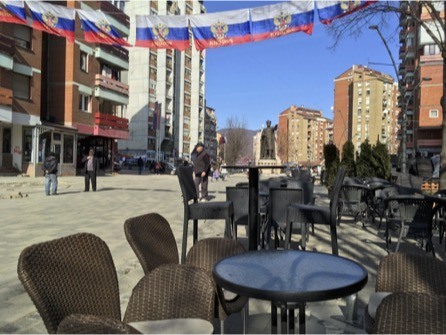
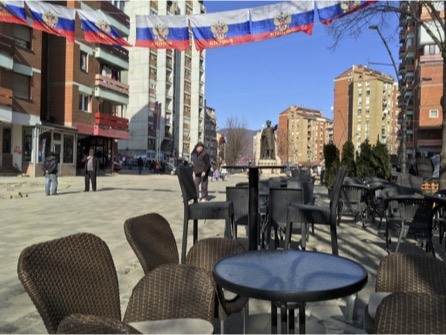
The Serbian enclave in North Mitrovica, Kosovo: the end of the line of many empires. Photograph: Matthew Stevenson.
On a visit to Kosovo in 2007, I decided against renting a car and instead found a local doctor who, in exchange for western currency, was all too happy to drive me around. We went west to Prizren, a lovely Turkish city near the North Macedonian border, and drank coffee in the main square with one of his friends, who was a professor of history.
Chatting in the shadows of the minarets that give Prizren its dramatic feel of the 19th century, if not the tides of the Ottoman Empire, I asked the professor friend what would happen to the Serbian monasteries that had been, so to speak, “left behind” when most of the Serbs departed Kosovo for neighboring countries after the 1999 war.
The professor, who was wearing a suit and tie for our meeting, spat on the ground of the café and said: “With any luck we can burn them to the ground”—a sentiment that has kept KFOR (Kosovo Force NATO troops) on guard outside most of the Serb monuments around Kosovo.
On my last visit to Kosovo in 2019, I sensed the region’s growing prosperity. On that occasion, I took a local Serbian train from the city of Novi Pazar (once called the Sanjak of Novi Pazar, a wedge of the Ottoman empire to prevent Serbia from reaching the sea) to Mitrovica, technically in Kosovo but on the northern banks of the Ibar River.
Before setting out, I had thought—from my rail maps—that the train line went from Serbia all the way through to Pristina and then on to Skopje, in North Macedonia. (After all, in some respects of international law, it was all still one country.) Then the train conductor explained that the “end of line” came in a Mitrovica suburb, from which I could walk to the New Bridge to continue my journey south.
At the last station, I followed the other passengers who in the cold weather trudged toward the city center, where painted on the sides of abandoned buildings I found Russian flags, tributes to the Russian President Vladimir Putin, and angry denunciations of Serb politicians who were selling out both Serbia and history by allowing Kosovo to follow its course to independence.
On the main street, I could look south to the modern steel bridge that spanned the Ibar River to south Mitrovica—except that concrete barriers blocked car traffic from crossing.
Not sure what the barriers meant for my onward passage, I stopped in a café and asked the waiter if I could get across bridge. He said, somewhat bitterly: “You can; I can’t.” Meaning: it was a no-go zone for Serbs in Kosovo, relegated to their enclave and anger.
+++
I drank a cup of €1 coffee, shouldered my backpack, and headed to the bridge, expecting to hear whistles or see signs barring my progress. Instead I went across unmolested and on the far side (after handing over my passport for inspection) found another Mitrovica, one absent of Putin agitprop and thriving on money sent from abroad into Kosovo.
I don’t want to imply that Mitrovica had the wealth of Dortmund or Vienna, but there were new houses, shiny cafés, and a few elegant shops—unlike the Pyongyang air on the north side. In no time, I found a mini-van that would take me to Pristina, the capital, about an hour to the south.
Kosovo proclaimed independence in 2008, and now is recognized by more than 100 countries, although not Russia, China, India, Spain, Greece, Slovakia, Romania, or Cyprus. (Russia and China have barred its admission into the UN.)
In 2019, Pristina had a busy and prosperous air—no longer the haunt of angry men with ox carts and pitchforks. I found the Bill Clinton statue (waving, he looks like he’s hailing a taxi) and Tony Blair Boulevard. (All Hillary Clinton got was a dress shop named in her honor.)
At the university and around the government center, I found many new buildings, not to mention local memorials and exhibits that denounced the Serbs as imperialists and celebrated NATO warplanes for delivering self-rule.
+++
On this occasion, I decided against a return engagement in Pristina, and once I had rented a car at the airport, I set off for the regional city of Peja, in the northwest corner of Kosovo, where the plains meet the Rugova mountains, towering peaks of alpine dimensions.
I had booked a hotel for the night in the old town center, but first I had to find it, a task made more difficult when neither the eSim on my phone nor an offline app that I use locked onto the local beams. As an emergency fallback, I still had my roadmap from summer 1976. I could also easily follow signs from the airport toward Peja. But once in the city, I became lost in the labyrinthine darkness of the old town’s narrow, winding streets.
In the end, I pulled into what my father would have called a filling station (he never made the leap to GPS) and asked directions from the cheerful attendants.They didn’t know the hotel, but hot-spotted my phone, which indicated I was less than 400 meters from Doa Boutique Hotel.
Not only did I find the hotel, but around the corner was a reserved parking space for my car. And, as it was late, my room key was tucked away in a lockbox by the front door.
Once I had negotiated entrance with a stray dog sleeping on the doorstep, I walked into a beautifully furnished hotel with dramatic views of the mountains and the plains, plus a lively restaurant next door.
For a light dinner before bed, I had a small dish of risotto and the local beer, brand-named Peja. Clearly both Rebecca West’s Old Serbia of the 1930s and Yugoslavia’s Autonomous Province of Kosovo and Metohija had moved on.
+++
The next morning, as always happened in cities after a night arrival, Peja was transformed from a dark Balkan cul-de-sac into provincial city of some charm.
After breakfast, I followed a prescribed walking tour from a map I had found in the hotel lobby. It showed the disposition of various mosques and historic buildings from the era of Turkish rule (which ended in 1913), including an old hamman in a stone building and several schools. Mostly the historic part of Peja is a covered market selling both jewelry and track suits.
Because I have the soul of a railway official (my solution to most geopolitical problems involves running a new line of track somewhere, in the spirit of trade and harmony), I ended my old-town walk down by the Peja station, which is on the edge of the old town.
Needless to say, no one there was “waiting on a train.” The imposing station looked abandoned, with broken concrete on its platforms and bricks falling from its once dignified façade.
That said, Peja is still served both by a morning and afternoon train, although from the look of things, I doubt whether many arriving or departing passengers spend much time trying to find a meal at the station restaurant.
Later I calculated that the line from Kosovo Polje (Kosovo’s main station when Pristina was little more than a village) was extended here in 1936, as part of Marshal Tito’s Yugoslav plan to federate all the countries of the Balkans, including Albania.
Four years later the Germans and Italians invaded Yugoslavia and, hoping to distance themselves from the Orthodox Serbs, Croats, and Slovenes, the Albanians in the area took up the invading cause of the Nazis (something the long memories of the Serb still dwell upon).
After World War II, when Tito and his partisans found themselves on the crossroads of two winning sides (the Western Allies and the Russians), Yugoslavia was awarded nearly all the lands between the Austrian border and Greece, including Kosovo, which previously had been a Serbian spoil from the 1912-13 Balkan Wars.
+++
A Serbian irony is that for most of its modern history (at least from the 14th century onward) the land most associated with its Renaissance re-awakening, Kosovo, has belonged to other empires (notably the Ottomans).
For that reason, the historian Stevan K. Pavlowitch wrote at the beginning of his excellent book, Serbia: The History of an Idea: “Serbias have come and gone, and they have moved about.” (And if you go to Prizren in Kosovo, and in particular to the Albanian League of Prizren Museum Complex, you can see on the wall a huge map of the Balkans, in which Albanians lay at least emotional claims against lands not just in Albania and Kosovo but also large tracts of Montenegro, Serbia, and Greece.)
After the Treaty of Berlin in 1878, Serbia “moved” (so to speak) to the area around Belgrade while the Ottomans remained in control of Kosovo, one of its vilayets in the southern Balkans along with Scutari, Monastir, and Janina. Thus when Yugoslavia reclaimed this region—first in 1913, and then again in 1919 and 1945—it found in historic “Old Serbia” a population that was largely muslim and alienated from Belgrade.
+++
In 1999, when Prime Minister Tony Blair and President Bill Clinton sent NATO bombers into the skies over Belgrade to carve out Kosovo’s independence, little did they know that they were entering an argument that has gone on for six hundred years and has involved almost all the major European powers, including the Ottomans, Russia, Austria-Hungary, Prussia, France, and Great Britain.
And it probably would have come as a surprise to both men—busy with their affairs of state—that, almost more than the assassination in Sarajevo in 1914, what led to the outbreak of the Great War was Austria’s decision to extend its rail line from Bosnia (that which I had taken from Novi Pazar through Mitrovica) across Kosovo to the sea at Salonica.
In liberating Kosovo, Blair and Clinton cost the West good relations with Russia and might well have laid the seeds for a Soviet risorgimento in the Caucasus and now Ukraine; but what’s that compared with a boulevard named in your honor.
This is the second in an occasional series about travels through the Balkans to and from the Green Line in Cyprus.
The post Letter From Peja, Kosovo appeared first on CounterPunch.org.
From CounterPunch.org via this RSS feed