


Spring by Pablo Picasso
Hello,
Welcome to Cultural Capital!
The last winter edition of the newsletter. I’ve spent the last few months working harder than I’ve ever worked in my life on finishing the book. Now it’s all almost over and the sun is (tentatively) coming out from behind the clouds. I feel I am returning blinking into the light.
Thanks for reading Cultural Capital! Subscribe for free to receive new posts and support my work.
How far back in time can you understand English?This piece travels back in time through the history of the English language at the rate of one paragraph per century. So the first paragraph is in the English of 2000 and the next in the of 1900 and the next in the English of 1800 etc until you get to this in the language 1100:
And þæt heo sægde wæs eall soþ. Ic ƿifode on hire, and heo ƿæs ful scyne ƿif, ƿis ond ƿælfæst. Ne gemette ic næfre ær sƿylce ƿifman. Heo ƿæs on gefeohte sƿa beald swa ænig mann, and þeah hƿæþere hire andƿlite wæs ƿynsum and fæger.
Most readers lose track between 1300 and 1200:
Somewhere in this section — and if you’re like most readers, it happened around 1300 or 1200 — the language crossed a boundary. Up to this point, comprehension felt like it was dropping gradually, but now it’s fallen off a cliff. In one section, you could get by by squinting and guessing; in the next you were utterly lost. You have hit the wall.4
There are two reasons for this. The first is vocabulary. As you move backwards in time, the French and Latin loanwords that make up an enormous proportion of the Modern English vocabulary grow fewer and fewer. When you pass 1250, they drop off almost altogether. Where a modern writer would say he underwent torture, a 1200-era writer must say that he suffered pinunge instead.5
The farther back you go, the more the familiar Latinate layer of English is stripped away, revealing the Germanic core underneath: a language that looks to modern eyes more like German or Icelandic than anything we’d call English.
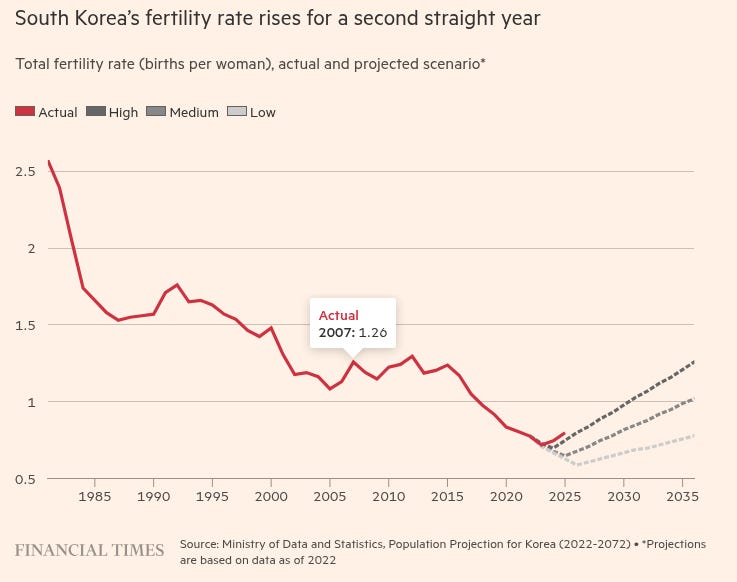
South Korea baby bumpThe birth rate has ticked up in South Korea (famous for its very low birth rate) for the second year in a row. But there are still only a tiny number of babies being born relative to the size of the country:
Korea’s total fertility rate — the average number of children a woman is expected to have over her lifetime — climbed to 0.8 last year, up from 0.75 in 2024 and an all-time low of 0.72 in 2023, official data released on Wednesday showed. The figure was better than even the government’s most optimistic projections for 2025 but remains far below the 2.1 threshold that demographers consider necessary to maintain a stable population, absent net immigration. Births climbed in 2025 to 254,500, up 6.8 per cent from the year before and the highest figure since 2021.
Is war over?This is such an interesting piece Janan Ganesh in the FT arguing that land war is no longer effective. It’s really quite mad to me how many good column ideas he constantly has. He argues that the lesson of the fifty years is that land wars tend to be inconclusive and ineffective. This is probably partly because of Nuclear proliferation means no state is willingness to go all-out in a war. Technologies like drones also mean that even small and poor combatants can project power very effectively:
When did a major state last unambiguously win a land war on a significant scale? Desert Storm in 1991, perhaps, but it was settled to a great extent from the air. The Iran-Iraq war was inconclusive. The Soviets lost in Afghanistan before the west did. France gave up on Operation Barkhane, its counterinsurgent mission in the Sahel, in 2022. You are left to cite Russia’s invasion of Georgia (population 4.4mn at the time), the still-evolving situation in Gaza and the Falklands war, which happened nearer to the second world war than to the present.
The world seems to be living through a trend that, if it holds, could scarcely be more profound: the increasing ineffectiveness of war. There is a pattern of military failure, or at least frustration, which covers democratic aggressors and autocratic ones, wars close to home and wars on distant continents, wars against other sovereign states and wars against irregular forces. Vietnam used to be the reference point for the military humbling of a major power. It was such a unique shock as to inform a generation of rather good movies and even a “syndrome”. Now it seems unexceptional.
James Wood on George SteinerThis is one of the greatest hatchet jobs of all time: James Wood takes down the pretentiousness of George Steiner. I have a vague half-feeling I have read it somewhere before but I saw it pop up on Substack recently. It’s just an amazing piece of writing. How is this for an opening paragraph:
George Steiner’s prose is a remarkable substance; it is the sweat of a statue that wishes to be a monument. Readers of his essays in The New Yorker will be familiar with that prose’s laborious imprecisions and melodramas; the platoon-like massing of its adjectives, its cathedral hush around the great works. Nabokov once complained that one of Steiner’s essays was “built on solid abstractions and opaque generalisations”; but things are worse than that, as this new book of essays shows.
Now that I have a book coming out I find myself increasingly morally opposed to hatchet jobs. But I do think a really unsparing hatchet job (especially one by James Wood) can teach you a lot about writing. Often extreme un-generosity can get at a truth about writing it’s hard to express otherwise. I think hostile biographies are sometime the best and most revealing. It’s for this reason I love Andrew Motion on Philip Larkin and Anne Stevenson on Sylvia Plath (both obviously controversial books in their own ways).
Ed West in America and UkraineI love ’s travel writing — he’s always very sharp on cultural differences. Here he is on America. I agree with him that going to America makes you realise how European you are. He’s also very interesting on how living in a country that is just so big affects the way Americans behave:
The country’s vast size also allows people to separate themselves from people whose worldview they disagree with, another driver of intolerance, whereas the main function of British life – something reflected in our comedy – is the need to keep quiet about how much you can’t stand everyone around you. Our country is far too densely populated to do otherwise; the idea of advertising your political beliefs on your car goes against that unspoken social rule, although it is cracking in the face of American influence.
He’s also been in Ukraine and summons the strangeness of the atmosphere of being in a modern country that is at war:
Certain things function as normal. Our nearest supermarket was very well stocked, fancy even, like a Waitrose or one of those posh regional supermarkets like Booths. Tucker would be very impressed. But the corridors of the shopping centre in which it sits are all dark, as are most buildings.
Other aspects of life are no different to western cities. On one occasion I was walking back from the station, along a sort of urban A-road where people drive at crazy speeds, and saw an Uber delivery driver struggling up a hill on his moped through blankets of snow. This is why neoliberalism will win - because we love convenience more than they love death.
The secret history of smokingWill Storr is very interesting on the psychology of social status. Here is on how smoking became low status. He argues that smoking losing its social cachet has been far more powerful to its decline than warnings about disease and death. The packages should have pictures of loners on them not diseased organs:
For years, campaigners and legislators tried to tackle the gigantic problem of smoking with appeals to survival. Despite research that found people were more likely to quit when told it causes others to ‘reel back in disgust from the smoker’s putrid odour’ than when learning about its health impacts, they covered packets with warnings about addiction and death and photos of diseased organs. They didn’t understand what the incredible persistence of people taking up smoking was clearly telling them: that humans in the story-world can easily value identity more than life. The way to make it stop, then, was not to scare people about dying, but to change the story smoking told by dismantling its ability to provide status.
Are dragons real?This is a great piece by on the conspiracy theories around the spread of AI generated images of dragons and other mythical creatures. She writes:
TikTok is flooded with dragon sighting videos, for example—dragons in the clouds, AI-generated dragons, dragons lurking on the blurry edges of photographs—and the people posting them aren’t joking or grifting. Same goes for the mermaid videos that circulate every few months. Scroll through the comments and you’ll find thousands of people who do believe it. Plus, tens of millions of Americans are young earth creationists, which, yes, includes a belief in what we’d ordinarily consider “cryptids.” But the texture of belief, the way the material circulates, the feel of it, has also changed.
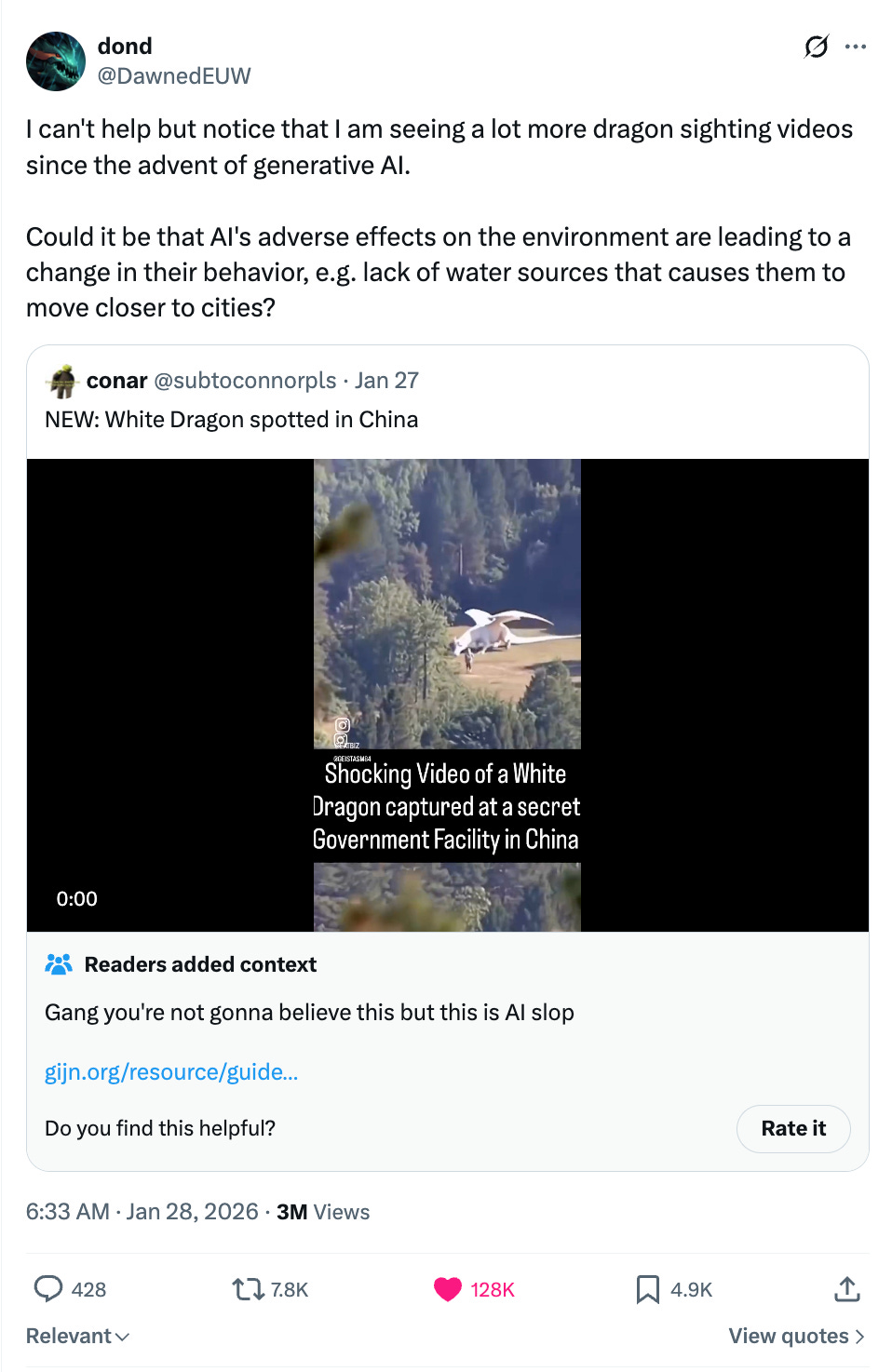
Dee says a lot of these “conspiracies” have an odd mix of believing/not believing about them. People don’t think these things are “literally true, but it’s a type of true, a truth that a lot of people are increasingly willing to accept”.
I remember somebody once telling me about a study of belief in hunter gatherer tribes which apparently has this same quality of ambiguity. It’s quite possible to think the shaman is a bit of a fraud but also think well, maybe he’s onto something.
I think there is an argument that the certainty we tend to associate with “belief” is a quality of a written culture — this is an argument a lot of people have made about printing. The idea is print made facts “hard”. Religions of the book tend to be more dogmatic than traditional polytheisms. Perhaps this weird belief/unbelief is a symptom of post-literacy. Facts are getting soft again. But then perhaps I just think everything is a symptom of post-literacy.
Samuel Johnson on podcastsEvidence that Dr Johnson would have disapproved of podcasts from Boswell’s life:
[Johnson] then took occasion to enlarge on the advantages of reading, and combated the idle superficial notion, that knowledge enough may be acquired in conversation. ‘The foundation (said he,) must be laid by reading. General principles must be had from books . . . In conversation you never get a system . . . The parts of a truth, which a man gets thus, are at such a distance from each other that he never attains to a full view.’
Until next week!
James
From Cultural Capital via this RSS feed