

Editor’s note: The story has been updated with additional details.
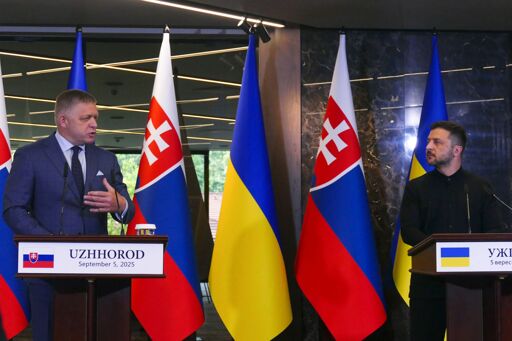
President Volodymyr Zelensky invited Slovak Prime Minister Robert Fico to visit Ukraine in a phone call on Feb. 27, amid a row between Kyiv, Budapest, and Bratislava over a key oil pipeline.
The dispute erupted after a section of the Druzhba pipeline — a major network funneling Russian crude to Hungary and Slovakia through Ukrainian territory — went offline in late January after a Russian attack in western Ukraine.
Budapest and Bratislava, widely regarded among the most Kremlin-friendly governments in the EU, accused Ukraine of deliberately halting the supplies and threatened retaliation.
The two EU members halted diesel exports to Ukraine, blocked the 20th package of EU sanctions, and Budapest is obstructing a 90 billion-euro ($106 billion) loan to Ukraine, a crucial financial lifeline for the country facing the Russian invasion.
The phone call between Zelensky and Fico was reported shortly after Hungarian Prime Minister Viktor Orban urged Ukraine to grant Slovak and Hungarian inspectors access to the pipeline, a request that Kyiv has yet to respond to.
“I agreed with Robert Fico that we will set up a Hungarian-Slovakian investigation committee to clarify the status of the Druzhba oil pipeline,” Orban said on Facebook.
After his call with Orban, Fico claimed that, according to his information, “the pipeline is functioning from a technical standpoint” and again accused Ukraine of delaying deliveries.
“Therefore, we propose establishing a joint inspection group — Slovakia, Hungary, and the European Commission — to verify on site what the truth is,” Fico said on X prior to his call with Zelensky.
Ukraine factor in Hungary’s election
Orban, whose party, Fidesz, is trailing in polls behind the opposition party Tisza ahead of the April parliamentary elections, has adopted increasingly combative rhetoric toward Ukraine amid a heated election campaign.
The Hungarian leader published an open letter to Zelensky on Feb. 26, accusing him of “working to force Hungary into the war” and attempting to “bring a pro-Ukraine government to power.”
“Orban is building his entire campaign on making up anti-Ukrainian narratives,” Andras Racz, an expert in Hungarian politics, told the Kyiv Independent, calling claims that Ukraine is intentionally holding up Druzhba supplies “just stupid.”
While providing access to Hungarian and Slovak inspectors, in particular, bears “counterintelligence risks,” it would be beneficial for Ukraine to allow in international observers and EU officials, the expert noted.
Both Hungary and Slovakia previously called upon Brussels to launch an investigation into the pipeline’s status.
Earlier this week, Orban also announced the deployment of Hungarian troops to protect the country’s energy infrastructure against a purported Ukrainian threat.
Peter Magyar, the leader of Tisza, accused Orban of fearmongering and said that if the Hungarian government has credible security concerns, it can raise them during consultations with NATO allies rather than communicating them “through social media or propaganda channels.”
“Does anyone truly believe that Ukraine — which has been at war with Russia for four years and is seeking to join NATO — would now threaten NATO?” Magyar said on X.
Read also: Orban’s election campaign strategy — blackmail EU, Ukraine over Russian oil and hope for a fight
Restoring oil supplies
Despite four years of full-scale war, Slovakia and Hungary, both landlocked countries, have resisted calls to halt Russian crude imports via the Druzhba pipeline, arguing they are vital to their energy security.
Both nations have been granted an EU exemption from sanctions on Russian pipeline oil.
“Hungary and Slovakia fell victim to their own misjudgment of the Kremlin… whereas the rest of the European continent realized that it’s impossible to rely on the (Russian) supplies of fuel,” Pavel Havlicek, a research fellow at the Association for International Affairs in Prague, told the Kyiv Independent.
Last year, the Ukrainian section of Druzhba transported over 9 million tons of oil to Slovakia and Hungary, according to ExPro Consulting data.
According to Reuters’ industry sources, Ukraine also used the pipeline to export its own oil to the two EU countries, though in much smaller volumes than Russian crude.
The suspension could even force Ukraine to pause its oil production, the news agency reported, a development that indicates Kyiv has a vested interest in restoring the operations.
While the EU appealed to Ukraine to quickly repair the damaged Druzhba section, Zelensky said that the progress is slow amid broader Russian attacks against Ukrainian energy infrastructure.
In the meantime, Kyiv has offered alternatives to Bratislava and Budapest, including the Odesa-Brody pipeline running from the Black Sea to western Ukraine and then further into Central Europe.
Croatia’s Prime Minister Andrej Plenkovic has also proposed to facilitate oil transfers to Hungary and Slovakia via its Adria pipeline, saying that its annual capacity of 15 million tons can meet the two countries’ needs.
Oleksiy Sorokin has contributed reporting in the article.
Read also: Fact-check: No, Ukraine’s attack on Russian oil pumping station is not an ‘attack on NATO’
From The Kyiv Independent - News from Ukraine, Eastern Europe via this RSS feed