

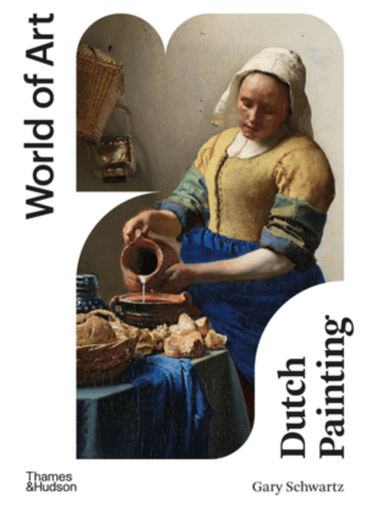
I opened the PDF for Dutch Painting expecting to find yet another book about Hals, Rembrandt, and Vermeer— the familiar canonical Dutch figures. No doubt, so I anticipated, the ever-reliable art writer Gary Schwartz will have some welcome new thoughts about these much-written-about artists. And so I was not surprised when the introduction cites Hegel’s famously suggestive account of painting in this Protestant businessman’s Republic. The art from that small country, he argued, is highly distinctive. A recent, very influential book by Svetlana Alpers has taken up this theme, supported by novel theorizing. But Schwartz’s revelatory discussion, written in light of recent research, radically undercuts these venerable received ideas. And as for Riegl’s renowned book on group portraits, his theorizing, too, so Schwartz remarks in passing, is no longer entirely satisfying. With 150 paintings illustrated, this book shows the difficulty of truthfully generalizing about Dutch art. And so, the story Schwartz tells is altogether more challenging than the older accounts. 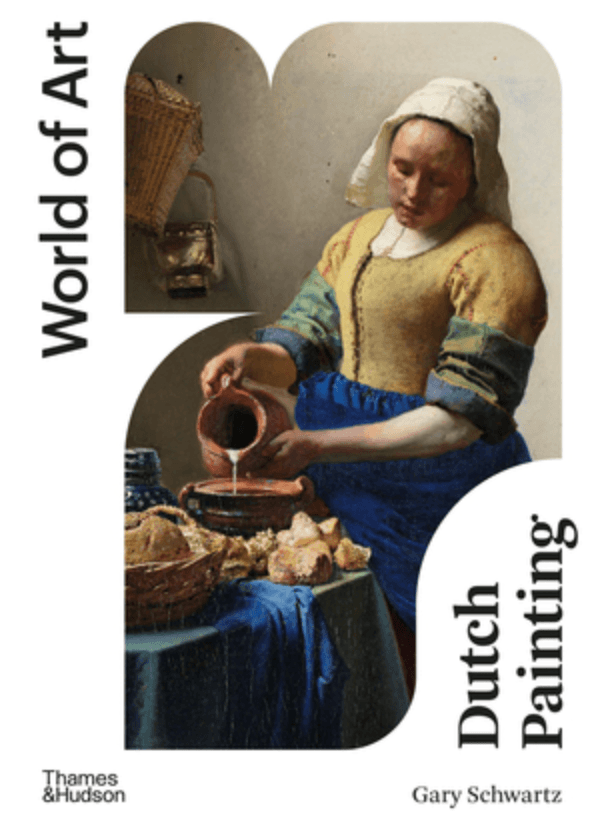
In this predominantly Protestant country, where many Catholics had concealed churches, a great deal of painting was done. Dutch Painting has chapters on patronage, city environments, female Dutch artists, and Dutch painters abroad. In this market economy, being an artist was difficult. “More Dutch painters died in poverty than in prosperity.” Why were there so many Dutch painters—and why such a demand for paintings? Because of urbanization, Schwartz argues, painting is an activity for city kids. Some Dutch artists traveled, and so if they got to Rome, Caravaggio had a major influence on their art. Thanks to the vast colonial empire, there were Dutch painters in Brazil. In interesting ways, the artists’ contemporary reputations have changed. Until the mid-nineteenth century, a group portrait by Bartholomeus van Der Helst, not nowadays a canonical figure, was more popular than Rembrandt’s Night Watch.
Not that the masterpieces are neglected here. Schwartz’s magical account of Rembrandt’s portrait of Jan Six is worth the price of admission. The closer you look, the more difficult it is to generalize about Dutch art. The artists showed the countryside, flowers, and wars. They depicted hunting, which was an aristocratic activity. And love was a frequent Dutch subject, but these artists never depicted sexual intercourse or gay love. You learn that your received ideas about Dutch painting are mostly false or misleading. How distinctive, then, is Dutch art? It’s worth asking, how many of the pictures in this very fully illustrated book could have been made in Italy or Germany? This book is altogether more challenging than the older accounts. Really is a masterpiece, a brilliantly original synthesis, often revelatory, miraculously condensed, and always readable.
Imagine that someone from our present world, who knows nothing about Dutch art history, were to read this book. They would find many similarities with our art world. Like the Dutch, we too struggle with radical economic inequalities. And in our art world, too, although there are many talented artists, it is hard for all but a few superstar artists to make a living. That said, there is one striking difference. Nowadays, we expect that artists will provide a critical perspective on gender, politics, and race. When the Pop artist Peter Saul redoes Nightwatch (2017), for example, he turns Rembrandt’s dignified militia characters into buffoons. So far as I can see, none of Rembrandt’s contemporaries imagined doing that, at least in works that they exhibited. His book, Schwartz says at the start, “is about the subjects that painters thought fit to depict . . . . “ What they all lacked, I would add, was not Saul’s skills, but the desire to depict their subjects in his sardonic manner. For this reason, when we present Dutch painting in our museums, as much as we admire the artists’ skills and the variety of their subjects, it’s hard not for us to feel that their aesthetic values differ drastically from ours. Historians, Schwartz remarks, no longer speak of this as a Dutch ‘Golden Age’, for we are too aware of the dramatic economic inequalities, and the importance of colonialism and slavery in this period. True enough, and since much of the great Dutch art is greatly admired, the necessary task of scholarship is to reconstruct the world view of the society in which it was created. How, I would ask, can we understand the art of a culture whose aesthetic is so distant, in some ways, from ours? This book is an exemplary contribution to that complex task.
The post World of Art Dutch Painting appeared first on CounterPunch.org.
From CounterPunch.org via this RSS feed