


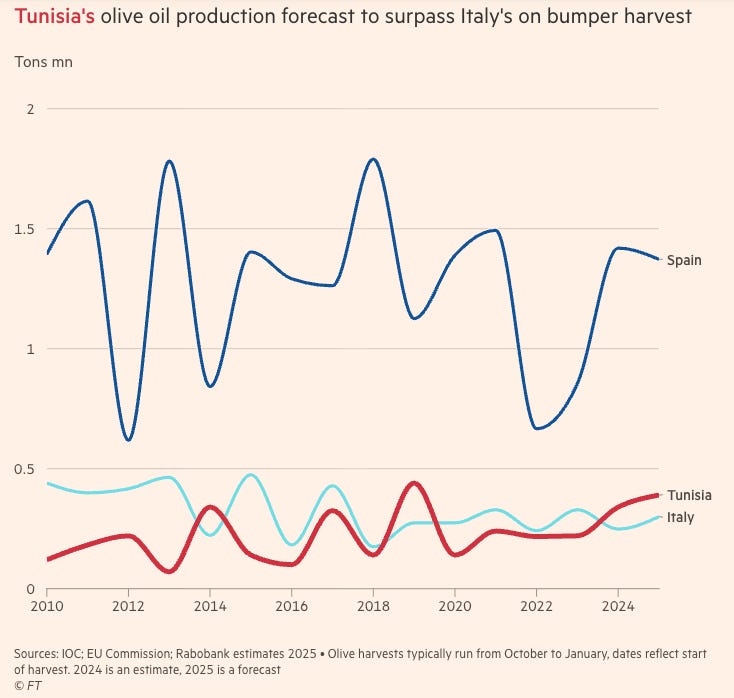
Did you know that some of your favorite olive oil may come with a bitter colonial aftertaste? Allow me to explain. Tunisia is one of the world’s leading olive oil producers. In strong harvest years, it ranks among the top global producers and is consistently the largest producer outside the European Union. According to the International Olive Council (IOC), global olive oil production fluctuates between roughly 2.6 and 3.6 million tonnes depending on climatic cycles (IOC, January 2026). This year, thanks to decent rain season after years of droughts and heat waves, Tunisia’s production may reach half a million tonnes, placing it as the second largest producer globally behind Spain. Yet if you walk into a supermarket in Paris, Berlin, or New York, Tunisian brands are almost invisible. This is not a branding failure. It is the predictable outcome of the EU’s well-oiled colonial machine of global value chain hierarchies that plagues the Global South for decades.
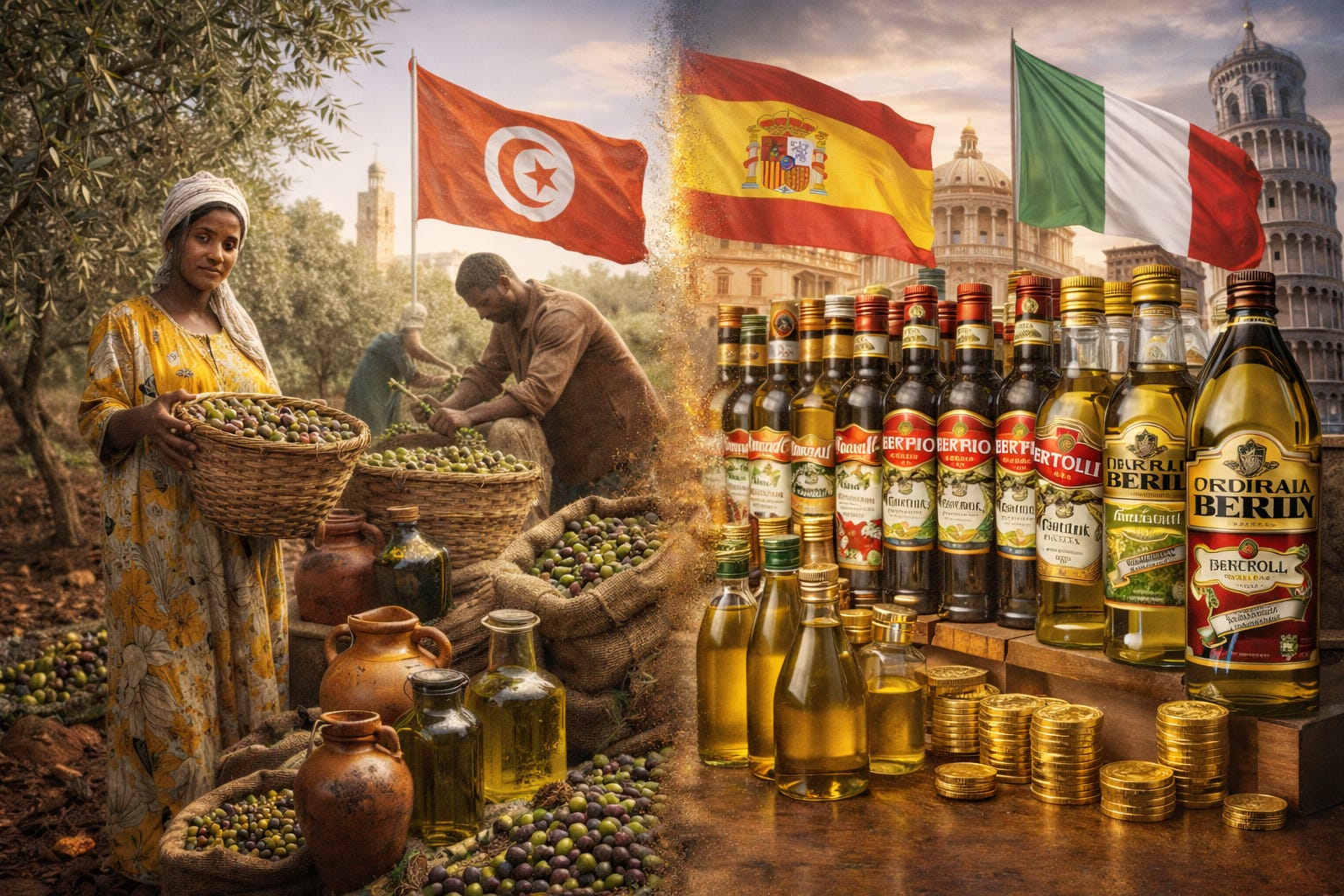
A recent article in the Financial Times (January 1, 2026) documents how Tunisia exports much of its olive oil in bulk to Europe, where it is blended, bottled, and marketed under Italian or Spanish labels. Tunisia supplies the oil. Europe supplies the label. The value is not in the olive. It is in the brand, the bottle, the distribution contract, and the shelf space. And of course, what I’m exposing here applies to other Global South olive oil producers such as Morocco, Algeria, Libya, Egypt, Jordan, Lebanon, Syria, and Palestine.
Share Global South Perspectives ~ by Fadhel Kaboub
Managed Access, Not Market Access
Tunisia’s integration into the EU market is governed by quotas. Under the EU–Tunisia framework, Tunisia benefits from a standing duty-free quota of 56,700 tonnes per year for olive oil exports. Beyond that level, tariffs apply. Following Tunisia’s tourism collapse after the 2015 Sousse attacks, the EU temporarily granted an additional 35,000 tonnes annually for 2016–2017 under Implementing Regulation 2016/605.
More recently, in January 2026, the European Commission confirmed that Tunisia’s zero-duty quota was fully allocated for the ninth consecutive year in the 2025/26 season.
This tells us two things:
Tunisia is competitive and indispensable.
Tunisia’s role is capped and administratively managed.
That is not free trade. That is a neocolonial controlled integration.
Who Captures the Value?
The downstream segments of the olive oil market are dominated by a small group of European firms that control bottling, blending, private-label contracts, and supermarket access in the Global North.
Deoleo (Spain) is widely described as the world’s largest olive oil bottler and owns major brands including Bertolli, Carapelli, Carbonell, and Sasso (OFI Magazine, March 26, 2025).
Sovena (Portugal) markets itself as the world’s largest supplier of private-label olive oil and supplies supermarket store brands across Europe and North America.
Acesur (Spain) operates across refining, bottling, and export markets with brands such as Coosur and La Española.
Salov (Italy), owner of Filippo Berio, is one of the largest global players in branded olive oil.
These companies control relationships with large supermarket chains. They manage blending across origins. They determine labeling strategies. They dominate private-label pipelines. In other words, they sit at the command nodes of the global value chain of the olive oil market.
Olive Oil as a Case Study in Structural Dependency
What we see in olive oil is the classic pattern of Global South commodity dependency:
The Global South produces raw material.
The Global North controls processing and branding.
Market access is quota-bound.
Value capture happens downstream.
Tunisia is at the top of the production system by volume. but it is locked at the bottom of the hierarchy because it lacks control over the architecture of value extraction.
The olive oil case mirrors broader structural realities across Africa: Cocoa in West Africa. Coffee in East Africa, Lithium in Southern Africa, Rare earths in the Sahel, and the same pattern of colonial extraction continues to this day. The Global South produces the real value, but the Global North confiscates and retains the commercial value.
Can Tunisia break this cycle?
Global South countries must move from being price-takers in fragmented commodity chains to becoming bloc-level negotiators in integrated value systems. Tunisia’s olive oil dilemma illustrates why.
Incremental reform of the kind that would give it slightly larger quotas, marginal branding campaigns, and donor-funded export promotion, will not alter the structure. What is required is systemic repositioning:
Regional Value Chain SovereigntyAfrican producers should coordinate to build continental bottling, branding, and distribution networks under the AfCFTA framework, rather than competing for marginal EU quota expansions.
Sovereign Development Finance for Downstream IntegrationPublic development banks must finance bottling plants, storage facilities, logistics hubs, and marketing infrastructure by treating value-chain upgrading as strategic industrial policy, not as private entrepreneurial risk.
South–South Retail AlliancesWhy should African olive oil depend exclusively on EU supermarket chains? Emerging markets in Asia, Latin America, and intra-African urban centers offer alternative demand poles.
Collective Bargaining PowerA coordinated bloc of Global South olive oil producers—North African and beyond—could negotiate better trade terms, branding recognition, and standards more effectively than isolated national exporters that are too small to make a difference in a global market that is hardwired against them. .
Tunisia produces world-class olives, but unless Tunisia and its Global South peers coordinate their control over bottling, branding, distribution, and retail access, they will continue to supply upstream value while others capture downstream rents. The olive oil aisle in a European supermarket is not just a consumer choice space. It is a visual display of neocolonial power and trade hierarchies.
Stay tuned for my next post about cocoa and the global market for chocolate. A different crop, but the same neocolonial system of extraction.
Fadhel Kaboub is an associate professor of economics at Denison University, and the president of the*Global Institute for Sustainable Prosperity.* He is the author of*Global South Perspectives* on substack. In 2025, Dr. Kaboub was recognized by the New African Magazine in the Top 100 Most Influential Africans under the Thinkers & Opinion Shapers category. He is a board member of the United Nations High-Level Advisory Board on Economic and Social Affairs at UN-DESA. He is also a member of the*Independent Expert Group on Just Transition and Development, an expert group member with theGlobal Solidarity Levies Task Force, a member of theEarth4All 21st Century Transformational Economics Commission, a Steering Committee member with theFossil Fuel Non-Proliferation Treaty Initiative*, and a member of the Independent Expert Group on Just Transition Finance. He has recently served as Under-Secretary-General for Financing for Development at the Organisation of Southern Cooperation in Addis Ababa, Ethiopia. Dr. Kaboub is an expert on designing public policies to enhance monetary and economic sovereignty in the Global South, build resilience, and promote equitable and sustainable prosperity. His recent work focuses on Just Transition, Climate Finance, and transforming the global trade, finance, and investment architecture. His most recent co-authored publications include “A Coherent Framework for Sovereign Debt and Economic Transformation: Towards a Global South Debtors’ Coalition,” (Institute for Economic Justice, 2025), and Just Transition: A Climate, Energy, and Development Vision for Africa (May 2023). He has held a number of research affiliations with the Levy Economics Institute (NY), the John F. Kennedy School of Government at Harvard University (MA), the Economic Research Forum (Cairo), Power Shift Africa (Nairobi), African Forum on Climate Change, Energy and Development (Abuja), and the Center for Strategic Studies on the Maghreb (Tunis). Dr. Kaboub is currently working on a book manuscript tentatively called The Geopolitical Bargain of the Century: Towards a New International Economic Order of Peace, Justice, and Sustainable Prosperity (forthcoming).
You can follow him on LinkedIn, X/Twitter, Bluesky, YouTube, and TikTok @FadhelKaboub.
Global South Perspectives ~ by Fadhel Kaboub is a reader-supported publication. To receive new posts and support my work, consider becoming a free or paid subscriber.
From Global South Perspectives ~ by Fadhel Kaboub via this RSS feed