


Editor’s Note: Apologies if you received this email twice - we had an issue with our mail server that meant it was hitting spam in many cases!
Hi! If you like this piece and want to support my work, please subscribe to my premium newsletter. It’s $70 a year, or $7 a month, and in return you get a weekly newsletter that’s usually anywhere from 5000 to 185,000 words, including vast, extremely detailed analyses of NVIDIA, Anthropic and OpenAI’s finances, and the AI bubble writ large. I just put out a massive Hater’s Guide To Private Equity and one about both Oracle and Microsoft in the last month.
I am regularly several steps ahead in my coverage, and you get an absolute ton of value, several books’ worth of content a year in fact!. In the bottom right hand corner of your screen you’ll see a red circle — click that and select either monthly or annual. Next year I expect to expand to other areas too. It’ll be great. You’re gonna love it.
Soundtrack - The Dillinger Escape Plan - Unretrofied
So, last week the AI boom wilted brutally under the weight of an NVIDIA earnings that beat earnings but didn’t make anybody feel better about the overall stability of the industry. Worse still, NVIDIA’s earnings also mentioned $27bn in cloud commitments — literally paying its customers to rent the chips it sells, heavily suggesting that there isn’t the underlying revenue.
A day later, CoreWeave posted its Q4 FY2025 earnings, where it posted a loss of 89 cents per share, with $1.57bn in revenue and an operating margin of negative 6% for the quarter. Its 10-K only just came out the day before I went to press, and I’ve been pretty sick, so I haven’t had a chance to look at it deeply yet. That being said, it confirms that 67% of its revenue comes from one customer (Microsoft).
Yet the underdiscussed part of CoreWeave’s earnings is that it had 850MW of power at the end of Q4, up from 590MW in Q3 2025 — an increase of 260MW…and a drop in revenue if you actually do the maths.
In Q3 2025, CoreWeave had $1.36bn in revenue on 590MW of compute, working out to $2.3m per megawatt.In Q4 2025, CoreWeave had $1.57bn in revenue on 850MW of compute, working out to $1.847m per megawatt.
While this is a somewhat-inexact calculation — we don’t know exactly how much compute was producing revenue in the period, and when new capacity came online — it shows that CoreWeave’s underlying business appears to be weakening as it adds capacity, which is the opposite of how a business should run.
It also suggests CoreWeave’s customers — which include Meta, OpenAI, Microsoft (for OpenAI), Google, and a $6.3bn backstop from NVIDIA for any unsold capacity through 2032 — are paying like absolute crap.
CoreWeave, as I’ve been warning about since March 2025, is a time bomb. Its operations are deeply-unprofitable and require massive amounts of capital expenditures ($10bn in 2025 alone to exist, a number that’s expected to double in 2026). It is burdened with punishing debt to make negative-margin revenue, even when it’s being earned from the wealthiest and most-prestigious names in the industry. Now it has to raise another $8.5bn to even fulfil its $14bn contract with Meta.
For FY2025, CoreWeave made $5.13bn in revenue, making a $46m loss in the process. The temptation is to suggest that margins might improve at some point, but considering it’s dropped from 17% (without debt) for FY2024 to negative 1% for FY2025, I only see proof to the contrary. In fact, CoreWeave’s margins have only decayed in the last four quarters, going from negative 3%, to 2%, to 4%, and now, back down to negative 6%.
This suggests a fundamental weakness in the business model of renting out GPUs, which brings into question the value of NVIDIA’s $68.13bn in Q4 FY2026 revenue, or indeed, Coreweave’s $66.8bn revenue backlog. Remember: CoreWeave is an NVIDIA-backed (and backstopped to the point that it’s guaranteeing CoreWeave’s lease payments) neocloud with every customer they could dream of.
I think it’s reasonable to ask whether NVIDIA might have sold hundreds of billions of dollars of GPUs that only ever lose money. Nebius — which counts Microsoft and Meta as its customers — lost $249.6m on $227.7m of revenue in FY2025. No hyperscaler discloses their actual revenues from renting out these GPUs (or their own silicon), which is not something you do when things are going well.
Lots of people have come up with very complex ways of arguing we’re in a “supercycle” or “AI boom” or some such bullshit, so I’m condensing some of these talking points and the ways to counteract them:
OpenAI had $13.1bn in revenue in 2025! They only lost $8bn ! Did it? Based on my own reporting, which has been ignored (I guess it’s easier to do that than think about it?) by much of the press, OpenAI made $4.33bn through the end of September, and spent $8.67bn on inference in that period.Notice how I said “inference.” Training costs, data costs, and simply, the costs of doing business are in addition to that.OpenAI has 900m weekly active users! Yeah everybody is talking about AI 24/7 and ChatGPT is the one everybody talks about.Google Gemini Has 750m- Google changed Google Assistant to Gemini on literally everything, including Google Home, and force-fed it to users of Google Docs and Google Search.Claude Code is changing the world! It’s writing SaaS now! It’s replacing all coders! As I discussed both at the beginning of the Hater’s Guide To Private Equity and my free newsletter last week, software is not as simple as spitting out code, neither is it able to automatically clone the SaaS experience. Midwits and the illiterate claim that this somehow defeats my previous theses where I allegedly said the word “useless.” While I certainly goofed claiming generative AI had three quarters left in March 2024, my argument was that I thought that “generative AI [wouldn’t become] a society-altering technology, but another form of efficiency-driving cloud computing software that benefits a relatively small niche of people,” as I have said that people really do use them for coding.Even Claude Code, the second coming of Christ in the minds of some of Silicon Valley’s most concussed boosters, only made $203m in revenue ($2.5bn ARR) for a product that at times involves Anthropic spending anywhere from $8 to $13.50 for every dollar it makes.People Doubted Amazon But It Made Lots Of Money In The End! No they didn’t. Benedict Evans defended Amazon’s business model. Jay Yarow of Business Insider defended it too. Practical Ecommerce called Amazon Web Services “Amazon’s cash cow” in October 2013. In April 2013, WIRED’s Marcus Wohlsen managed to name one skeptic — Paulo Santos, based in Portugal, who appears to have dropped off the map after 2024, but remained a hater long after AWS hit profitability in 2009. I cannot find any other skeptics of Amazon, and I cannot for the life of me find a single skeptic of AWS itself.AWS Cost A Lot Of Money So We Should Spend So Much Money On AI! I’m sick and fucking tired of this point so I went and did the work, which you can view here, to find every single year of capex that Amazon spentWhen you add together all of Amazon’s capital expenditures between 2002 and 2017, which encompasses its internal launch, 2006 public launch, and it becoming profitable in 2015***, you get $37.8bn in total capex (or $52.1bn adjusted for inflation).***For some context, OpenAI raised around $42bn in 2025 alone.The fact that we have multiple different supposedly well-informed journalists making the “Amazon spent lots of money!” point to this day is a sign that we’re fundamentally living in hell.
Anyway, let’s talk about how much OpenAI has raised, and how none of that makes sense either.
OpenAI’s $15bn, $35bn , or $110bn Round, Where Amazon Only Invested $15bn, and NVIDIA and SoftBank Are Paying In Installments — Stop Reporting That It Raised $110bn, It Is Factually Incorrect
Great news! If you don’t think about it for a second or read anything, OpenAI raised $110bn, with $50bn from Amazon, $30bn from NVIDIA and $30bn from SoftBank.
Well, okay, not really. Per The Information:
OpenAI raised $15bn from Amazon, with $35bn contingent on AGI or an IPO.OpenAI got commitments from SoftBank and NVIDIA, who may or may not have committed to $30bn each, and will be paying in three installments. Please note that CNBC authoritatively reported in September that “the initial $10 billion tranche locked in at a $500 billion valuation was expected to close within a month” for a deal that was only ever a Letter of Intent. This is why it’s important not to report things as closed before they’re closed.As of right now, evidence suggests that nobody has actually sent OpenAI any money. Per NVIDIA’s 10-K filed last week, it is (and I quote) “…finalizing an investment and partnership agreement with OpenAI [and] there is no assurance that we will enter into an investment and partnership agreement with OpenAI or that a transaction will be completed.”It’s going to be interesting seeing how SoftBank funds this. It funded OpenAI’s last $7.5bn check with part of the proceeds from a $15bn, one-year-long bridge loan, and the remaining $22.5bn by selling its $5.83bn in NVIDIA stock and its $13.5bn margin loan using its ARM stock. Nevertheless, per its own statement, SoftBank intends to pay OpenAI $10bn on April 1 2026, July 1 2026, and October 1 2026, all out of the Vision Fund 2.Its statement also adds that “the Follow-on Investment is expected to be financed initially through bridge loans and other financing arrangements from major financial institutions, and subsequently replaced over time through the utilization of existing assets and other financing measures.
Yet again, the media is simply repeating what they’ve been told versus reading publicly-available information. Talking of The Information, they also reported that OpenAI intends to raise another $10bn from other investors, including selling the shares from the nonprofit entity:
OpenAI’s nonprofit entity, which has a stake in the for-profit OpenAI that’s now worth $180bn, may sell several billions of dollars of its shares to the financial investors, depending on the level of investment demand the for-profit receives in its fundraise, the person said. That would help other OpenAI shareholders avoid additional dilution of the value of their shares following the large equity fundraise.
It’s so cool that OpenAI is just looting its non-profit! Nobody seems to mind.
OpenAI’s Not-A-Ponzi-Scheme Revenues
Talking of things that nobody seems to mind, on Friday Sam Altman accidentally said the quiet part out loud, live on CNBC, when asked about the very obviously circular deals with NVIDIA, Amazon and Microsoft (emphasis mine):
ALTMAN: I get where the concern comes from, but I don’t think it matches my understanding of how this all works. This only makes sense if new revenue flows into the whole AI ecosystem. If people are not willing to pay for the services that we and others offer, if there’s not new economic value being committed, then the whole thing doesn’t work. And it would just it would be circular. But revenue for us, for other companies in the industry, is growing extremely quickly, and that’s how the whole thing works. Now, given the huge amounts of money that have to go into building out this infrastructure ahead of the revenue, there are various things where people, finance chips invest in each other’s companies and all of that, but that is like a financial engineering part of this and the whole thing relies on us going off – or other people going off and selling these products and services. So as long as the revenue keeps growing, which it looks like it is – I mean, demand is just a huge part of my day is figuring out how we’re going to get more capacity and how we’re allocating the capacity we have. Then, I don’t think it looks circular, even though the need to finance this, given the huge amounts of money involved, does require a lot of parties to do deals together.
Hey Sam, what does “the whole thing” refer to here? Because I know you probably mean the AI industry, but this sounds exactly like a ponzi scheme!
Now, jokes aside, ponzi schemes work entirely through feeding investor money to other investors. OpenAI and AI companies are not a ponzi scheme. There’s real revenues, people are paying it money. Much like NVIDIA isn’t Enron, OpenAI isn’t a ponzi scheme.
However, the way that OpenAI describes the AI industry sure does sound like a scam. It’s very obvious that neither OpenAI nor its peers have any plan to make any of this work beyond saying “well we’ll just keep making more money,” and I’m being quite literal, per The Information:
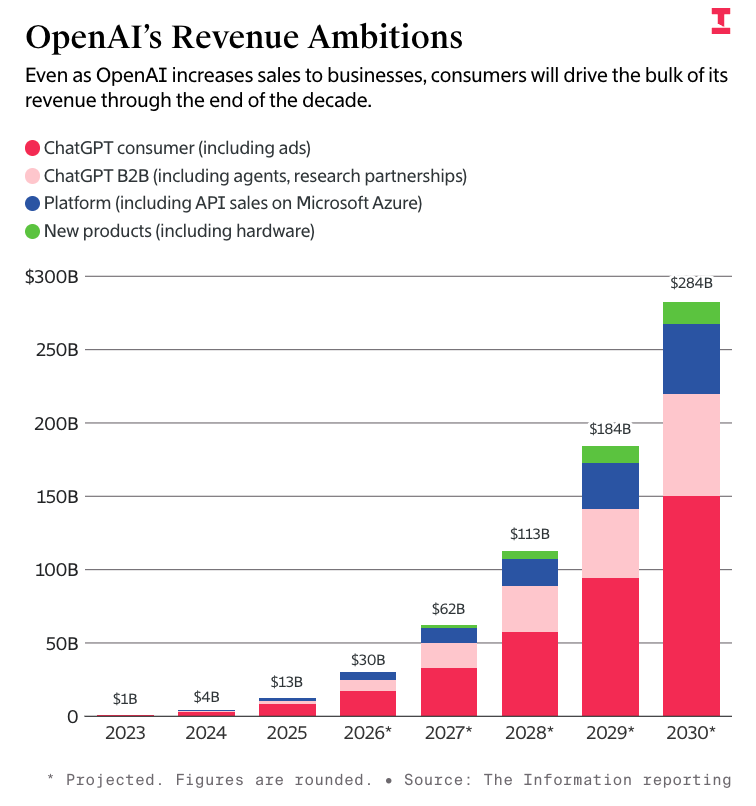
That’s right, by the end of 2026 OpenAI will make as much money as Paypal, by the end of 2027 it’ll make $20bn more than SAP, Visa, and Salesforce, and by the end of 2028 it’ll make more than TSMC, the company that builds all the crap that runs OpenAI’s services. By the end of 2030, OpenAI will, apparently, make nearly as much annual revenue as Microsoft ($305.45 billion).
It’s just that easy. And all it’ll take is for OpenAI to burn another $230 billion…though I think it’ll need far more than that.
Please note that I am going to humour some numbers that I have serious questions about, but they still illustrate my point.
Sidenote: In the end I think it’ll come out that sources were lying to multiple media outlets about OpenAI’s burnrate. Putting aside my own reporting, Microsoft reported two quarters ago that OpenAI had a $12bn loss in Q3 2025 — a result of its use of the equity method to take a loss based on the proportion of its stake in OpenAI (27.5%). Microsoft has now entirely changed its accounting to avoid doing this again.
Per The Information, OpenAI had around $17.5bn in cash and cash equivalents at the end of June 2025 on $4.3bn of revenue, with $2.5bn in inference spend and $6.7bn in training compute. Per CNBC in February, OpenAI (allegedly!) pulled in $13.1bn in revenue in 2025, and only had a loss of $8bn but this doesn’t really make sense at all!
Please note, I doubt these numbers! I think they are very shifty! My own numbers say that OpenAI only made $4.3bn through the end of September, and it spent $8.67bn on inference! Nevertheless, I can still make my point.
Let’s be real simple for a second: suppose we are to believe that in the first half of the year, it cost $2.5 bn in inference to make $4.3bn in revenue, so around 58 cents per dollar. For OpenAI to make $8.8bn — the distance between $4.3bn and $13.1bn — that’s another $5.1bn in inference, and keep in mind that OpenAI launched Sora 2 in September 2025 and done massive pushes around its Codex platform, guaranteeing higher inference costs.
Then there’s the issue of training. For $2.5bn of revenue, OpenAI spent $6.7bn in training costs — or around $2.68 per dollar of revenue. At that rate, OpenAI spent a further $23.58bn on training, bringing us to $28.6bn in burn just for the back half of 2025.
Now, you might think I’m being a little unfair here — training costs aren’t necessarily linear with revenues like inference is — but there’s a compelling argument to be made that costs are far higher than we thought.
Per The Information, OpenAI was at $17.5bn in cash and cash equivalents at the end of June 2025. It had just raised $10bn from SoftBank and other investors.OpenAI would raise another $8.3bn on August 1 2025, bringing that cash and equivalents pile to $25.8bn, assuming it remained untouched.OpenAI would raise another $22.5bn from SoftBank on December 31 2025, bringing up the total to $48.3bn.In the second half of the year, OpenAI would (allegedly) make another $8.8bn, which would bring us up to $57.1bn — with a total year loss of either $9bn or $8 bn depending on whether you believe The Information or CNBC.But wait, that doesn’t make sense as a total year loss! Let’s look at the first half numbers again. When we take the raw cost of inference ($2.5bn) and training ($6.7bn) and subtract revenue ($4.3 billion), we’re left with a $4.9bn loss just for the first half, and that’s before you include things like headcount, sales and marketing, and general operating expenses, which (per The Information) amounted to $2bn in the first half of the year.Now, let’s run these numbers again but with my napkin math estimates — $23.58bn in training costs and $5.1bn in inference costs, for a total of $28.42bn. Add another $2bn in sales and marketing costs, $1.76bn in revenue share to Microsoft (20% of $8.8bn), guesstimating the cash salaries of OpenAI’s staff (based on them being around 17.5% of the company’s revenue in 2024) at $1.54bn, SG&A costs (about 15% in 2024) of $1.32bn, data costs (12.5% in 2024) of about $1.1bn, and hosting costs (10% in 2024 of about $880, we’re at around $37bn — leaving OpenAI with about…$20bn in cash at the end of the year.
Now, I want to be clear that on February 20 2026, The Information reported that OpenAI had “about $40 billion in cash at the end of 2025,” but that doesn’t really make sense!
Assuming $17.5bn in cash and cash equivalents at the end of June 2025, plus $8.8bn in revenue, plus $8.3bn in venture funding, plus $22.5bn from Masayoshi son…that’s $57.1bn. If there were a negative cash burn of $8bn, that would be $49.1bn, and no, I’m sorry, “about $40 billion in cash” cannot be rounded down from $49.1bn!
In my mind, it’s far more likely that OpenAI’s losses were in excess of $10bn or even $20bn, especially when you factor in that OpenAI is paying an average of $1.5 million in yearly stock based compensation, per the Wall Street Journal.
There’s also another possible answer: I think OpenAI is lying to the media, because it knows the media won’t think too hard about the numbers or compare them. I also want to be clear that this is not me bagging on The Information — they just happen to be reporting these numbers the most. I think they do a great job of reporting, I pay for their subscription out of my own pocket, and my only problem is that there doesn’t seem to be efforts made to talk about the inconsistency of OpenAI’s numbers.
The AI Bubble Is An Information War Started By Two Companies — Anthropic and OpenAI — Who Use The Media To Mislead the Public and Investors
I get that it’s difficult too. You want to keep access. Reporting this stuff is important and relevant. The problem is — and I say this as somebody who has read every single story about OpenAI’s funding and revenues! — that this company is clearly just…lying?
Sure you can say “it’s projections,” but there is a clear attempt to use the media to misinform investors and the general public. For example, OpenAI claimed SoftBank would spend $3bn a year on agents in 2025. That never happened!
Anyway, let’s get to it:
In October 2024, The Information reported that OpenAI only burned $340m in the first half of 2024, that its “cash burn has been lower than previously thought,” that it “projected total losses from 2023 to 2028 to be $44 billion,” and that it would be EBITDA profitable (minus training costs, lol) in 2026. The piece also says OpenAI would make $14bn in profit in 2029, and somehow also burn $200bn by 2030.
Confusingly, this piece said net losses for 2024 were $3bn through the first half of 2024, but would go on to project a net loss for the year of $5.5bn, The Information reported that OpenAI would make $12.7bn in 2025, with $3bn of that coming from SoftBank spending $3bn a year on its “agents,” something that never happened and nobody talks about anymore. The same piece said OpenAI would burn $7bn in 2025, and now expected to spend $320bn on compute between 2025 and 2030. Burn for 2026 is estimated at $8bn, and $20bn in 2027. Revenue for 2026 is estimated at $28bn.
The maths does not make a lick of sense here.In April 2025, The Information reported that OpenAI projected $174bn in revenue through 2030 and said that gross margins were 40% in 2024, and would be 48% in 2025, and hit 69% in 2029. Confusingly, the same piece says that OpenAI expects to burn $46bn in cash between 2025 and 2029, which does not make sense if you factor in any of the previously-discussed compute costs.In early September 2025, The Information would report that — psyche! — OpenAI would actually burn $115bn through 2029, with the plan to burn $35bn in 2027 and $45bn in 2028, which is a lot higher than “$44bn in five years.” Revenue for 2026 is now $30bn, and burn for 2027 is now $35bn. In late September 2025, The Information would report that OpenAI had a net loss of $13.5bn in the first half of 2025 with revenue estimates of $30bn in 2026 and $62bn in 2027.On February 20, 2026, The Information reported that OpenAI would actually burn $230bn through 2030, cloud costs would be $665bn, and that gross margins got worse (33%! Down from the “46% it had set for itself,” or 48% if you count previous published projections), and that it would burn $26bn in 2026 alone, or more than half of the October 2024 projections for its burnrate between 2023 and 2028!
What I’m trying to get at is that OpenAI (and, for that matter, Anthropic) has spent the last two years increasingly obfuscating the truth through leak after leak to the media.
The numbers do not make any sense when you actually put them together, and the reason that these companies continue to do this is that they’re confident that these outlets will never say a thing, or cover for the discrepancies by saying “these are projections!”
These are projections, and I think it’s a noteworthy story that these companies either wildly miss their projections (IE: costs) or almost exactly make their projections (revenues), which is even weirder.
But the biggest thing to take away from this is that one of the classic arguments against my work is that “costs will just come down,” but the costs never come down.
That, and it appears that both of these companies are deliberately obfuscating their real numbers as a means of making themselves look better.
Well, leaking and outright posting it. On December 17 2026, OpenAI’s Twitter account posted the following:
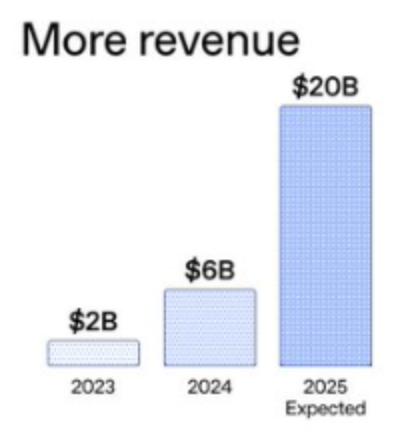
These numbers are, of course, bullshit. OpenAI may have hit $6bn ARR in 2024 ($500m in a 30 day period, though OpenAI has never defined this number) or $20bn ($1.67bn in a 30 day period) ARR in 2025, but this is specifically diagramed to make you think “$20bn in 2025” and “$6bn in 2024.” There are members of the media who defend OpenAI saying that “these are annualized figures,” but OpenAI does not state that, because OpenAI loves to lie.
Anthropic isn’t much better, as I discussed a few weeks ago in the Hater’s Guide. Chief Executive Dario Amodei has spent the last few years massively overstating what LLMs can do in the pursuit of eternal growth.
He’s also framed himself as a paragon of wisdom and Anthropic as a bastion of safety and responsibility.
Anthropic Is Fully Supportive Of The US Military Using Claude In The War In Iran, Wants To Help Governments Go To War And Kill People, And Wants You To Believe Otherwise
There appears to be some confusion around what happened in the last few days that I’d like to clear up, especially after the outpouring of respect for Anthropic “doing the right thing” when the Department of Defense threatened to label it a supply chain risk for not agreeing to its terms.
Per Anthropic, on Friday February 27 2026:
Earlier today, Secretary of War Pete Hegseth shared on X that he is directing the Department of War to designate Anthropic a supply chain risk. This action follows months of negotiations that reached an impasse over two exceptions we requested to the lawful use of our AI model, Claude: the mass domestic surveillance of Americans and fully autonomous weapons.We have not yet received direct communication from the Department of War or the White House on the status of our negotiations.We have tried in good faith to reach an agreement with the Department of War, making clear that we support all lawful uses of AI for national security aside from the two narrow exceptions above. To the best of our knowledge, these exceptions have not affected a single government mission to date.
Anthropic, of course, leaves out one detail: Hegseth said that “…effective immediately, no contractor, supplier, or partner that does business with the United States military may conduct any commercial activity with Anthropic.” If Hegseth follows through, Anthropic’s business will collapse, though Anthropic and its partners are ignoring this statement as a supply chain risk only forbids Anthropic from working with the US government itself.
When the US military attacked Iran a day later, people quickly interpreted Anthropic’s narrow (by its own words) and specific limitations with some sort of anti-war position. Claude quickly rocketed to the top of the iOS app charts, I assume because people believe that Dario Amodei was saying “I don’t want the war in Iran!” versus “I fully support the war in Iran and any uses you might need my software for other than the two I’ve mentioned, let me or support know if you have any issues!”
To be clear, these were the only issues that Anthropic had with the contract. Whether or not these are things that an LLM is actually good at, Anthropic (and I quote!) “…[supports] all lawful uses of AI for national security aside from the two narrow exceptions above.”
Sidenote: Last week, King’s College London published research that showed how LLMs could reason through a series of 21 simulated geopolitical or military war games where both sides possess nuclear weapons.The study pitted LLM against LLM, and in every single one of the simulations, at least one LLM exhibited “nuclear signalling” — which is when a party states that they have nuclear weapons and they are prepared to use them. In 95% of the simulations, both sides threatened nuclear annihilation — though actual use of the bomb, whether in a tactical or strategic attack, was rare. “For all three models, one striking pattern stood out: none of the models ever chose accommodation or surrender. Nuclear threats also rarely produced compliance; more often, crossing nuclear thresholds provoked counter-escalation rather than retreat. The models tended to treat nuclear weapons as tools of compellence rather than purely as instruments of deterrence,” explains King’s College.“The study challenges simple assumptions that AI systems will naturally default to cooperative or “safe” outcomes. It also challenges structural theories that emphasise material power alone: in simulations, willingness to escalate often mattered more than raw capability.” The researchers also noted that the imposition of a deadline within the wargame had a marked effect in increasing the likelihood that one or both parties would threaten nuclear action.Anthropic’s Claude Sonnet 4 was one of those models used in the study, along with OpenAI’s GPT-5.2 and Google’s Gemini 3 Flash.
The military’s demands were for “all lawful uses,” though I don’t think Anthropic really gives a shit about whether the war in Iran is legal, because if it did it would have shut down the chatbot rather than supported the conflict.
Just as a note: Anthropic is also the only AI model that appears to be available for classified military operations.
Let’s be explicit: Anthropic’s Claude (and its various models) are fully approved for use in the military, and, to quote its own blog post, “has supported American warfighters since June 2024 and has every intention of continuing to do so.”
To be explicit about what “support” means, I’ll quote the Wall Street Journal:
Within hours of declaring that the federal government will end its use of artificial-intelligence tools made by tech company Anthropic, President Trump launched a major air attack in Iran with the help of those very same tools.Commands around the world, including U.S. Central Command in the Middle East, use Anthropic’s Claude AI tool, people familiar with the matter confirmed. Centcom declined to comment about specific systems being used in its ongoing operation against Iran.The command uses the tool for intelligence assessments, target identification and simulating battle scenarios even as tension between the company and Pentagon ratcheted up, the people said, highlighting how embedded the AI tools are in military operations.
In reality, Claude is likely being used to go through a bunch of images and to answer questions about particular scenarios. There is very little specialized military training data, and I imagine many of the demands for “full access to powerful AI” have come as a result of Amodei and Altman’s bloviating about the “incredible power of AI.” More than likely, Centcom and the rest of the military pepper it with questions that allow it to justify acts that blow up schools, kill US servicemembers and threaten to continue the forever war that has killed millions of people and thrown the Middle East into near-permanent disarray.
Nevertheless, Dario Amodei gets fawning press about being a patriot that deeply cares about safety less than a week after Anthropic dropped its safety pledge to not train an AI system unless it could guarantee in advance that its safety measures were accurate.
Here’re some other facts about Dario Amodei from his interview with CBS!
On having political views: “We don’t-- we don’t have views-- we don’t think about general political issues, and we try to work together whenever there’s common ground.”On being “woke”: “So this idea that we’ve somehow been partisan or that we haven’t been evenhanded, we’ve been studiously evenhanded. And-- and again, we can’t control if someone, even-- even the president, you know, ha-- has an opinion about us. That’s not under our control. What’s under our control is that we can be reasonable. We can be neutral. And we can stand up for what we believe.”**On what Anthropic believes: “**We believe in-- defeating our autocratic adversaries. We believe in defending America. The red lines we have drawn, we drew because we-- we-- we-- we believe that crossing those red lines is-- is contrary to American values. And we wanted to stand up for American values.”**On the US government’s handling of the situation: “**And that’s why we’re committed to standing up to-- you know, actions that we think are not in line with the values of this country. It’s-- it’s not about any particular person. It’s not about any particular administration. It’s about the principle of standing up for what’s right.”
“What’s right,” to be clear, involves allowing Claude to choose who lives or dies and to be used to plan and execute armed conflicts.
Let’s stop pretending that Anthropic is some sort of ethical paragon! It’s the same old shit!
In any case, it’s unclear what happens next. Anthropic appears ready to challenge the supply chain risk designation in court, and said designation doesn’t kick in immediately, requiring a series of procedures including an inquiry into whether there are other ways to reduce the risk associated. In any case, the DoD has a six-month-long taper-off period with Anthropic’s software.
The real problem will be if Hegseth is serious about the stuff that isn’t legally within his power — namely limiting contractors, suppliers or partners from working with Anthropic entirely. While no legal authority exists to carry this through, seemingly every tech CEO has lined up to kiss up to the Trump Administration.
If Hegseth and the administration were to truly want to punish Anthropic, they could put pressure on Amazon, Microsoft and Google to cut off Anthropic, which would cut it off from its entire compute operation — and yes, all three of them do business with the US military, as does Broadcom, which is building $21 billion in TPUs for it. While I think it’s far more likely that the US government itself shuts the door on Anthropic working with it for the foreseeable future even without the supply chain risk designation, it’s worth noting that Hegseth was quite explicit — “no contractor, supplier, or partner that does business with the United States military may conduct any commercial activity with Anthropic.”
The reality of the negotiations was a little simpler, per the Atlantic. The Department of Defense had agreed to terms around not using Claude for mass domestic surveillance or fully autonomous killing machines (the former of which it’s not particularly good at and the latter of which it flat out cannot do), but, well, actually very much intended to use Claude for domestic surveillance anyway:
On Friday afternoon, Anthropic learned that the Pentagon still wanted to use the company’s AI to analyze bulk data collected from Americans. That could include information such as the questions you ask your favorite chatbot, your Google search history, your GPS-tracked movements, and your credit-card transactions, all of which could be cross-referenced with other details about your life. Anthropic’s leadership told Hegseth’s team that was a bridge too far, and the deal fell apart.
Now, I’m about to give you another quote about autonomous weapons, and I really want you to pay attention to where I emphasize certain things for a subtle clue about Anthropic’s ethics:
Anthropic had not argued that such weapons should not exist. To the contrary, the company had offered to work directly with the Pentagon to improve their reliability. Just as self-driving cars are now in some cases safer than those driven by humans, killer drones may some day be more accurate than a human operator, and less likely to kill bystanders during an attack. But for now, Anthropic’s leaders believe that their AI hasn’t yet reached that threshold. They worry that the models could lead the machines to fire indiscriminately or inaccurately, or otherwise endanger civilians or even American troops themselves.
[Content truncated due to length…]
You must log in or # to comment.