

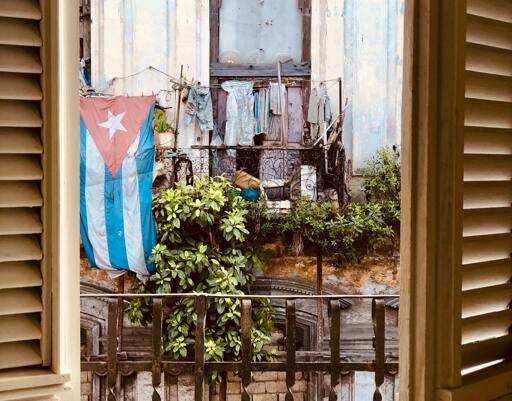
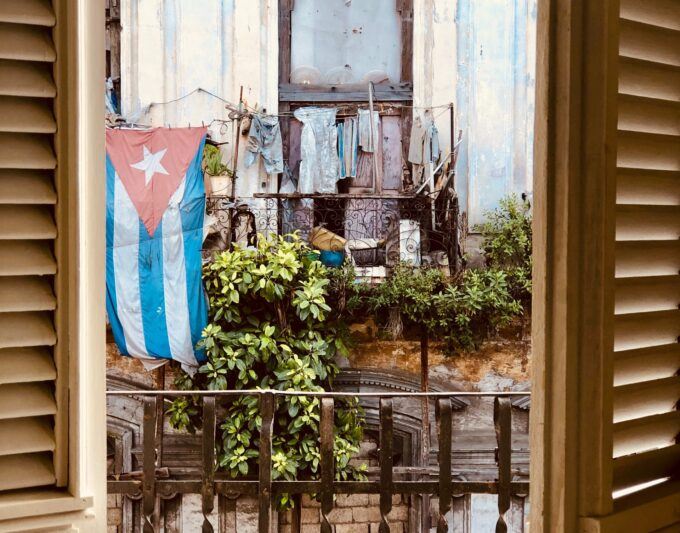
Photograph Source: Jason Gamble
Jules Dassin’s classic film noir of New York, The Naked City, was released in 1948. It’s a police investigation of a young woman’s murder and after the two perpetrators pay for their crime, the camera pans to shots of city streets and the skyline. A voiceover narrator intones these now-famous lines: “There are eight million stories in the naked city. This has been one of them.” Another of those stories involves Cubans.
In the wake of the 1959 Cuban Revolution – and the U.S.-backed failed 1961 Bay of Pigs invasion – many Cubans fled the island and, as of 2021, some 2.9 million Cubans are living in the U.S. In September 2025, CNN reported, “A US Immigration and Customs Enforcement flight returned 161 Cuban deportees to the communist-run island last week, the first time many of the men and women aboard had touched Cuban soil in years.”
Yet, as The Guardian reports, “Cubans have traditionally enjoyed a privileged position in the US compared with other Latin American immigrants, thanks to fast-track routes to residency and citizenship.” Going further, it notes “about 45,000 Cubans across the US are believed to have been issued with deportation orders, with another 550,000 vulnerable.”
The targeting of Cubans in the U.S. – and the island nation of Cuba – is led by Marco Rubio, whose parents came from Cuba in 1956, three years before the revolution.
After imposing ever-tighter sanctions on Cuba in January 2026, on February 27th, Trump went so has to suggest that the U.S. could carry out a “friendly takeover” of the island nation.
+++
Cubans have a far longer history of living in New York. The first Cubans began settling in the city in 1823, when NYC was the center of the sugar trade. That year, James Monroe proclaimed the Monroe Doctrine, which asserted the U.S.’s unofficial hegemony over the Western Hemisphere*,* warning European nations to halt any further efforts to colonize or install puppet regimes in the Americas*.*
In the following decades, many Cubans– notably white property owners–promoted the idea that the U.S. should annex Cuba as a way to free the island country from Spain. Annexation of Cuba, along with Mexico, Puerto Rico, Haiti and other nations of the Caribbean, was strongly backed by Southerners who supported secession to further slavery by creating a new Confederate nation.
These efforts culminated in the Cuban revolt of 1867 that led to the failed Ten Years’ War (1867–1878) and the ending of slavery on the island. The revolt fueled the migration of Cubans to New York, many working in the now-legendary cigar-rolling industry. By the mid-1890s, insurgency mounted under José Martí’s leadership, culminating in 1898 in the Spanish-American War.
It was furthered with the adoption of the 1902 Platt Amendment that turned Cuba into a U.S. protectorate and the U.S. seized Guantánamo Bay, as well as the Philippines and Puerto Rico. However, Cuba’s independence from Spain led to the imposition of an oppressive dictatorship that gave rise to émigré activism over the next half-century.
+++
Nancy Raquel Mirabal’s 2017 study, Suspect Freedoms: The Racial and Sexual Politics of Cubanidad in New York, 1823–1957, explores what she calls “the Cuban diaspora.” Mirabal, an associate professor at the University of Maryland, traces the lives of generations of Cubans who settled in the city as well as those who saw it as a valuable waystation to one day returning to their homeland. She places the lives of these Cubans, especially political radicals, against the defining issues of Cuba’s national identity, its independence from Spain, its relation to the U.S. and – after a couple of failed attempts – the victorious 1959 revolution. 
Mirabal’s labor of love is grounded in the profiles of Cuban Americans she presents, some accompanied by photos. Several of the people profiled are historical figures (e.g., José Martí and Antonio Maceo), but most are ordinary Cubans who committed valuable time and scarce resources to a cause they deeply believed in, thus helping define the issues of concern of the day. While history has mostly forgotten them, Mirabal returns these people to the historical stage. As evident in both the range of people discussed and the research cited in the footnotes, the author has done more than her homework; she has come to “know” her subjects.
Equally revealing, Mirabal’s study presents an invaluable chronicle of the political, cultural and service organizations that Cubans created to both further their homeland’s independence and better their lives in the rapidly growing New York. She carefully reconstructs the history of such groups as El Club Cubano Inter-Americao (CCI), Cuban Anti-Slavery Society and Partido Revolucionaro Cubano (Cuban Revolutionary Party, PRC). She scrupulously details the ideological positions that shaped – and sometimes broke – these groups.
Mirabal traces the experience of the Cuban American community, one separated by more than 90 miles from its homeland, over the course of a century and a half. She does so with an unflinching eye with regard to three underlying issues: race, gender, and class relations. The unstated but defining issues the holds the book together is simply: independence for what and for whom?
Mirabal’s book will be a valuable resource for those familiar with the history of Cubans in the U.S., but a challenging read for those seeking to understand the life of what today is a tiny community in New York. The 2020 U.S. Census reports that only 2.2 million people identified themselves as being of Cuban “origin or descent” in the U.S. and 42,377 living in the five boroughs.
+++
Northern New Jersey’s Hudson County is known as “Havana on the Hudson” and, in New York, Puerto Ricans, Mexicans, Dominicans and Colombians, among others, are now the defining Hispanic/Latino communities. Unfortunately, the author does not provide population estimates of the number of Cubans calling the city home during the major phases of immigration that she chronicles; they would have been helpful guideposts to appreciate the community’s changing fortunes.
Since 1959, a new — and very different — wave of Cuban immigrants came to the U.S. Ironically, they were fleeing a version of the revolution that so many earlier émigrés spent their lives struggling to realize: socialism in an underdeveloped Caribbean Island nation. The U.S. blockade of Cuba, imposed at the time of the Cuban missile crisis, has just begun to crack, but not enough to make a real difference.
Most importantly, today’s Cuban American community has been assimilated into American life. Many of them, especially among the millennials of second- and third-generation immigrants, support the Revolution and an independent Cuba. They are returning to their homeland to holiday, connect with relatives, and see how another society confronts the challenges of the 21st century.
New York has long been a city of – to use one of Walt Whitman’s favorite words – “multitudes,” and Mirabal’s Suspect Freedom is a revealing portrait of one segment of that multitude.
The post Cubans Face Twin U.S. Attacks appeared first on CounterPunch.org.
From CounterPunch.org via this RSS feed
The USA didn’t “try to annex Cuba”. The USA did take Cuba from Spain and then the US Congress ensured Cuba was allowed to self-govern.
