

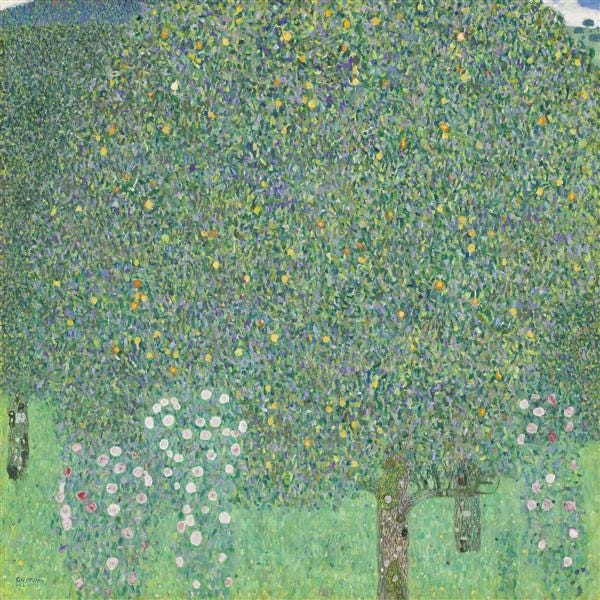
Roses Under the Trees by Gustav Klimt
Hello,
Welcome to Cultural Capital!
My column in The Times this week is about the virtues of doubt. I don’t know how anyone can feel dogmatically certain about anything in a world that is undergoing a series of profound economic, political and technological transformations:
Dogmatism is a luxury of easy times. We can all strike impressive attitudes when there’s nothing at stake. It’s why so many university students are Leninists. And I suspect it explains the vein of radicalism often encountered among comfortable pensioners
The first episode of my new Radio 4 series about reading and civilisation, How Reading Made Us, goes out at 11am on Monday. The three episodes deal with how literacy shaped our minds, our society and our politics.
This was the project that first got me thinking properly about reading and what it would mean to lose it. Amazingly, as I write this I realise I pitched this programme two years ago (things work very slowly at the BBC!) but it’s nice that it’s landing at a time when these issues are in the air.
Making a BBC radio programme is surprisingly gruelling. One 45 minute programme (you’d record a podcast that length after lunch without really thinking about it) requires rounds of script-writing, editing, interviewing. Amazing to think that almost every hour of Radio 4 has this much work put into it.
Anyway, it was a great excuse to speak to some of my favourite writers and thinkers. We’ve got Steven Pinker on the humanitarian revolution, Naomi Alderman on Walter Ong, Maryanne Wolf on the neuroscience of reading, Robert Darnton on reading in the eighteenth century, Joseph Henrich on individualism… and many more!
Episodes will appear here when they’ve aired.
My literary guilty pleasuresI was interviewed about my favourite books and authors by Matthew Lyons of the excellent Broken Compass Substack. I have potentially destroyed my intellectual credibility by admitting to a fondness for Yuval Noah Harari’s Sapiens:
Do you have a literary guilty pleasure?
My guilty pleasures are the kind of mega-bestselling “big ideas” books that a lot of people tend to sneer at. I unrepentantly love Yuval Noah Harari’s Sapiens, Jared Diamond’s Guns, Germs, and Steel and Daniel Kahneman’s Thinking, Fast and Slow. I think the mistake is sometimes to take these big popular books too seriously. We’ve always known big ideas that explain everything tend to age badly. I think these books should be taken as games or provocations. I also dislike the way we tend to look down on generalists in the hyper-specialist twenty-first century. We live in a big incomprehensible world and I’m very grateful for anyone who will have a stab at explaining it all to me.
I wrote a defence of big ideas books in The Times a couple of years ago.
The case of the disappearing secretaryBecause my natural bias is towards pessimism I’m trying to expose myself to positive news about AI. This very interesting article points out that we have already lived through a sweeping but non-disastrous automation of white collar work thanks to the personal computer which has all-but abolished the secretary:
Not so long ago, the work of secretaries – typing, filing, organising, administrating – was a cornerstone of the economy. By 1984, six years after the map below, there were around 18 million clerical and secretarial workers in the United States, roughly 18 percent of the entire workforce. This was totally normal. In the UK at the same time, between 17 and 18 percent of the workforce was some kind of secretary. In France it was 16 percent. Different economies with different economic policies; all ended up with one in five or six workers employed in clerical work.
The secretarial profession has been decimated since the 1980s. And yet we haven’t ended up with mass unemployment. The replacement of secretaries by computers was eventually far more dramatic than any experts originally predicted. But it also happened more slowly than they imagined. And in terms of the workforce it was a non-story.
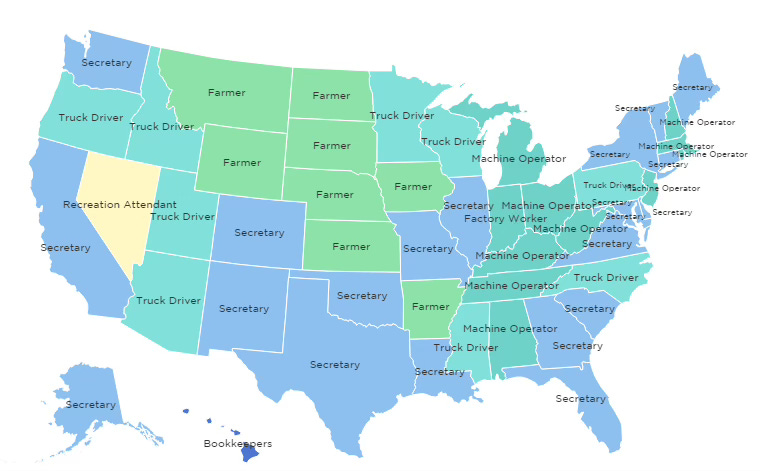
The most common jobs in America in 1978
Curiously, some bits of work which once seemed essential disappeared with secretaries.
One practice which faded as the typewriter era drew to a close: detailed minute-taking. When every manager had a secretary, it made sense to ask her to record meetings verbatim using shorthand. When they didn’t, this task became seen as an inefficient use of time. “In some ‘action’ meetings a few ‘flagged-up’ bullet points are seen as sufficient record, and these are often taken down by managers,” the Institute for Employment Studies noted in a tone of some surprise.
Taking detailed minutes seems more reasonable if you have someone hanging around to do it for you. Interesting lessons here for AI.
**Will AI save public discourse?**Dan Williams is one of my favourite writers on Substack. This is a great piece on AI as a kind of antithesis of social media. Williams argues that where social media promotes ignorance, tribalism and rudeness, AI promotes expert knowledge, impartiality and politeness. It could change our public discourse for the better:
Consider a topic: climate change, vaccines, immigration, crime, tariffs, wealth inequality, the Epstein files, whatever happens to be in the news. Fire up one of our leading large language models (LLMs)—ChatGPT, Gemini, Claude, even Grok—and ask for information about it. Now compare the response with the information you can find about the topic by scrolling on a major social media platform.
Even better, find a political take currently going viral on one of these platforms and ask an LLM to evaluate it.
If you do either of these things, I suspect that it will quickly become clear that the LLM’s responses are generally much more accurate, evidence-based, and in line with expert consensus than what you get from most social media posts. And when there is no expert consensus, you will typically get a good survey of the range of informed opinion on the topic.
This always strikes me when I do a Google search about the news. The AI-generated result at the top of the Google page is usually more reliable than the tabloid newspaper article beneath it.
But on the whole I’m not convinced the reliable answers of e.g. ChatGPT will outweigh the effects of incendiary, racist, tribal AI generated videos on TikTok. We still have social media algorithms that promote polarising content. And videos are more striking and emotionally powerful and therefore more influential and viral than text.
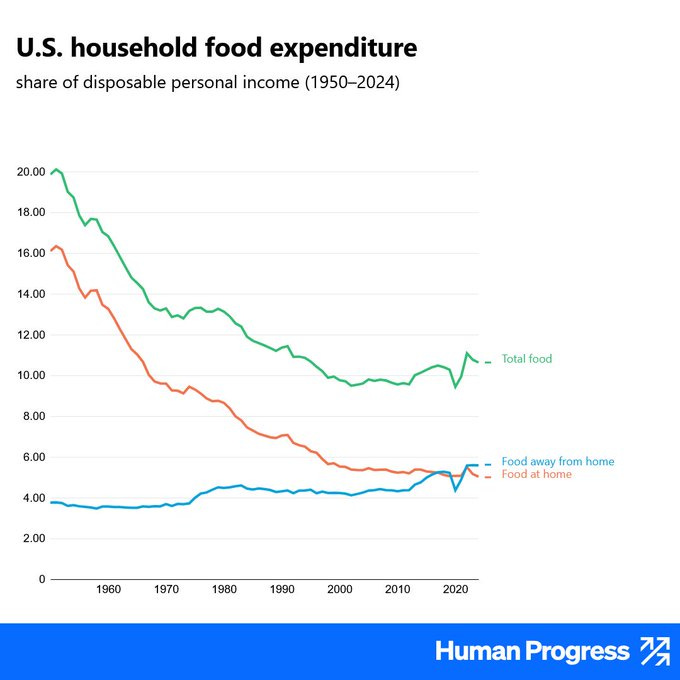
Food is getting cheaperThe price of food has dropped dramatically. In the pre-industrial era bread was often the major item of household expenditure. The depressing counterpoint to this graph would trace the massive rise of expenditure on housing.
The return of nepotismEnough positivity. Jack Davey writes that the graduate employment crisis and the rise of AI seems to be sparking a new age of nepotism. With so few jobs, so many highly qualified candidates to choose from and LLMs unleashing a deluge of identical applications it’s often easier to just pick somebody’s nephew:
As the job crisis continues and the mountain of unemployed or underemployed graduates grows, two things will — and are already — occurring. British society will become far more Spanish: personal links will be the only way of getting a graduate job. In Spain, this is called “enchufe”, literally meaning to be plugged in. When presented with a mass of indistinguishable candidates, the great unwashed mass of self-starters will be banished in favour of your very presentable godson.
The Times reports on the same phenomenon:
In response to this proliferation of applications, some exasperated bosses are falling back on friends, family members and old colleagues to fill vacancies.
“I’m trying to use a word other than nepotism because the connotations aren’t necessarily good, but businesses are exploring their own internal networks,” Harris concedes. “It’s always been a thing; there’s a saying that good people know good people.”
Lehne does not call it nepotism, but agrees that companies and recruiters want to work more with “known talent”. “Working with someone in the past or having multiple references [from people you know] is like gold dust nowadays.”
Cames believes “referrals go a long way, especially in this world that we’re navigating at the moment because [businesses] want to make sure they’re making the right choice”.
How metrics make us miserableThis is a good Derek Thompson interview on the tyranny of metrics. Famously, whenever we introduce a metric to measure something people inevitably end up obsessing over the metric rather than the thing it is supposed to improve.
Exams were introduced to incentivise students to acquire intelligence and knowledge but over time teachers focused on the much narrower skill of how to pass an exam.
Amusingly this also applies to pick up artists:
Pickup artists are people that compete for sexual success. It’s literally called scoring. They don’t compete for good relationships. They compete for numbers: sexual encounters, or the fastest speed from meeting someone to sexual encounter. A sociologist named Eric Hendricks said that one of the things he found when he embedded in pickup artist culture to research them was that a common refrain in pickup artist culture was that you had to stop caring about pleasure or happiness, because these would just get in the way of scoring higher. I had thought that pickup artists were evil but enjoying themselves. But it turns out that something much more insane and inhumane has happened. They’ve cut off their connection to pleasure and happiness in order to score higher on a meter.
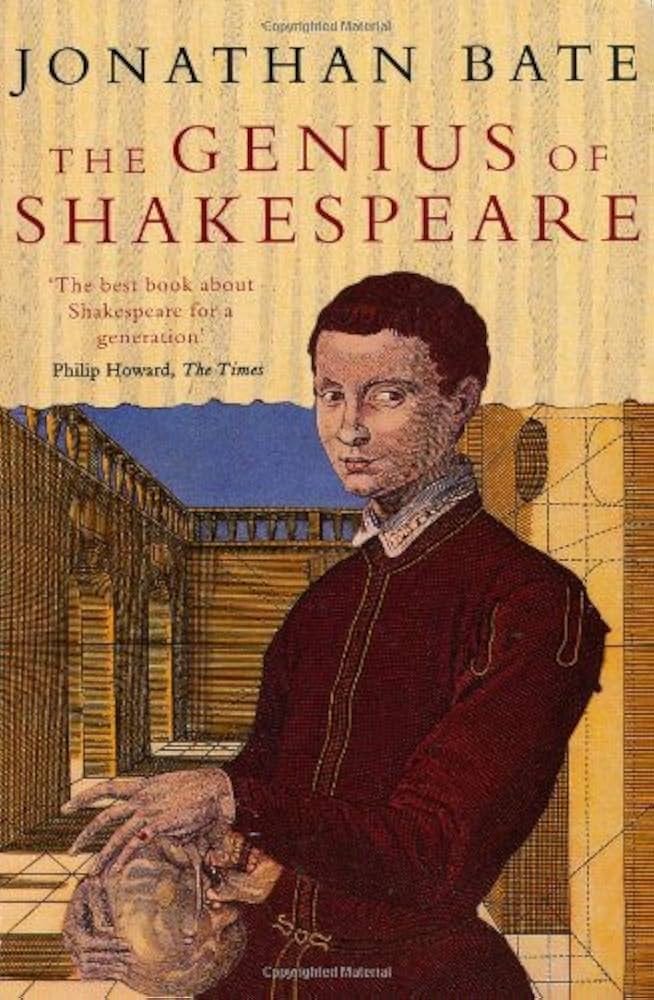
The Genius of ShakespeareIf last year was my year of the eighteenth century, this year seems to be my year of Shakespeare. Obviously Shakespeare — probably the greatest human genius of all time in any discipline — is fascinating in and of himself. He has also inspired a lot of great non-fiction writing.
Earlier this year I read James Shapiro’s great book 1599. I’m now onto Jonathan Bate’s The Genius of Shakespeare which I’m loving as well. It’s a fascinating case study of genius: what is it, where it comes from, what we make of it.
An interesting thought from Bate. All of Shakespeare’s great characters are actors (in more sense than one):
It is Iago who says ‘I am not what I am’ (Othello, 1.1.65). But Richard could have said it too. And so, as the critic Lionel Trilling has remarked, could almost every one of Shakespeare’s most memorable characters: Hamlet has no sooner heard out the Ghost than he resolves to be what he is not, a madman. Rosalind is not a boy, Portia is not a doctor of law, Juliet is not a corpse, the Duke Vincentio is not a friar, Edgar is not Tom o’ Bedlam, Hermione is neither dead nor a statue. Helena is not Diana, Mariana is not Isabella.
I may have to take next week off. We’ll see. So — until next week or the one after!
James
From Cultural Capital via this RSS feed