

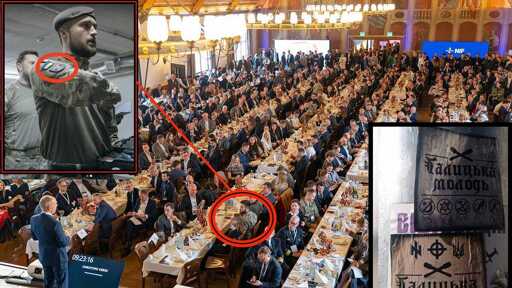
Mykola Zinkevich, a young commander from the Azov movement’s 3rd Army Corps, used to wear a modified patch of the Waffen-SS Dirlewanger Brigade, the insignia of his former unit. He is associated with the Azovite “Galician Youth” in Lviv, which glorifies the Waffen-SS Galicia Division. Last December, the German journalist Susann Witt-Stahl noticed that this neo-Nazi group had “recently praised [Zinkevich] as being ‘true to the cause.’”
In February, Zinkevich sat front and center at the Munich Security Breakfast, which kicks off the “leading international security forum.” He also participated in a Q&A session. The next evening, Zinkevich joined former CIA director and retired US general David Petraeus for a private event (co-organized by an Azovite think tank) that took place alongside the Munich Security Conference.
Zinkevich at the Munich Security Breakfast, and wearing his Dirlewanger patch at an award ceremony with the “White Fuhrer” of the Azov movement. Before the Russian invasion, the “Galician Youth” posted Nazi leaflets in Lviv.
In the meantime, the Munich-based European Defense Tech Hub (which has in the past collaborated with the Azovite think tank) organized a hackathon featuring “mentors” from the Azovite 3rd Army Corps and the 1st Azov Corps in the National Guard of Ukraine (NGU). A week later, representatives of the Azov Corps and another Nazi-infested NGU brigade (“Rubizh”) addressed Germany’s Air Force Union.
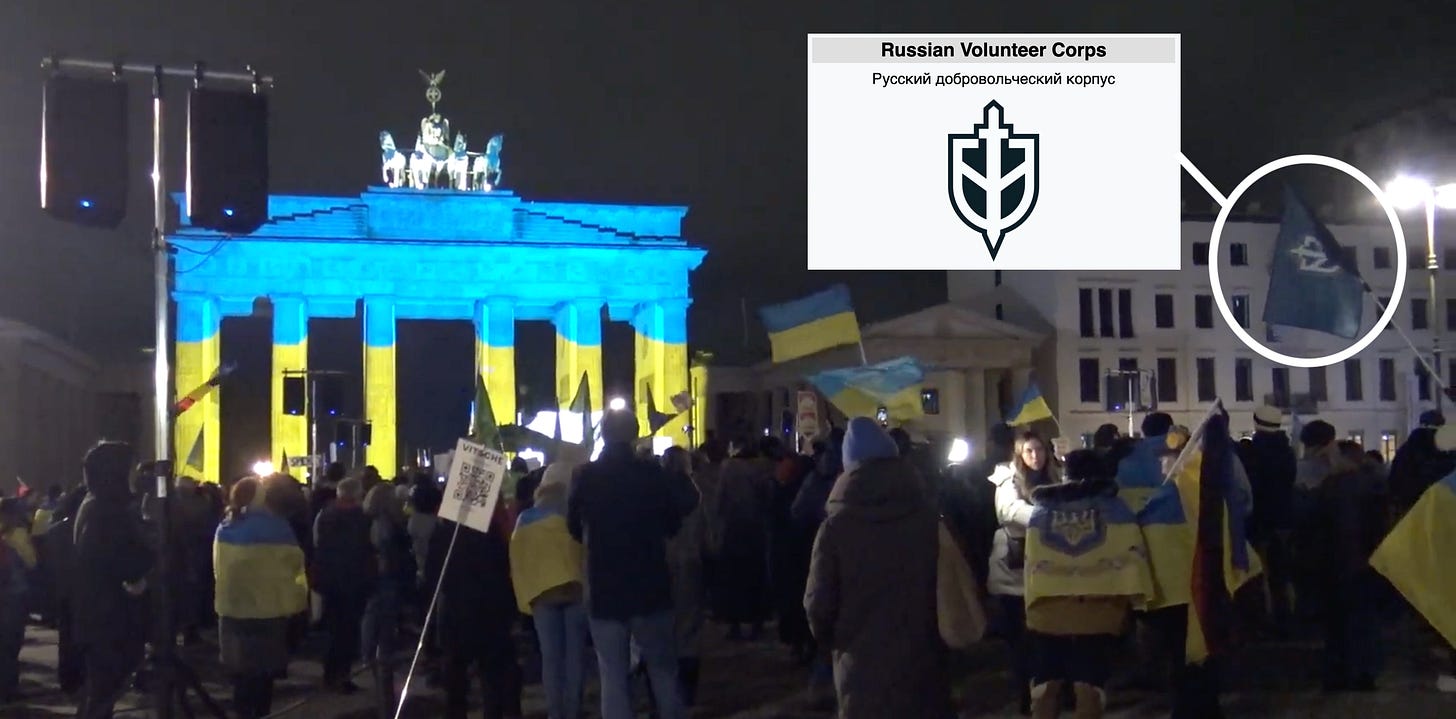
Marking the fourth anniversary of the 2022 Russian invasion of Ukraine, Azovites then stole the show at the annual “Cafe Kyiv” event in Berlin, which is said to be “Europe’s most outstanding event on Ukraine.” At a rally in front of Brandenburg Gate, a flag of the hardcore neo-Nazi “Russian Volunteer Corps” (linked to the Azov movement) waved in the crowd. Meanwhile in Nuremberg, an Azov officer from the National Guard spoke at “the leading trade fair for security and defence in Germany.”
It was a busy month for the “Azov Lobby” in Germany.
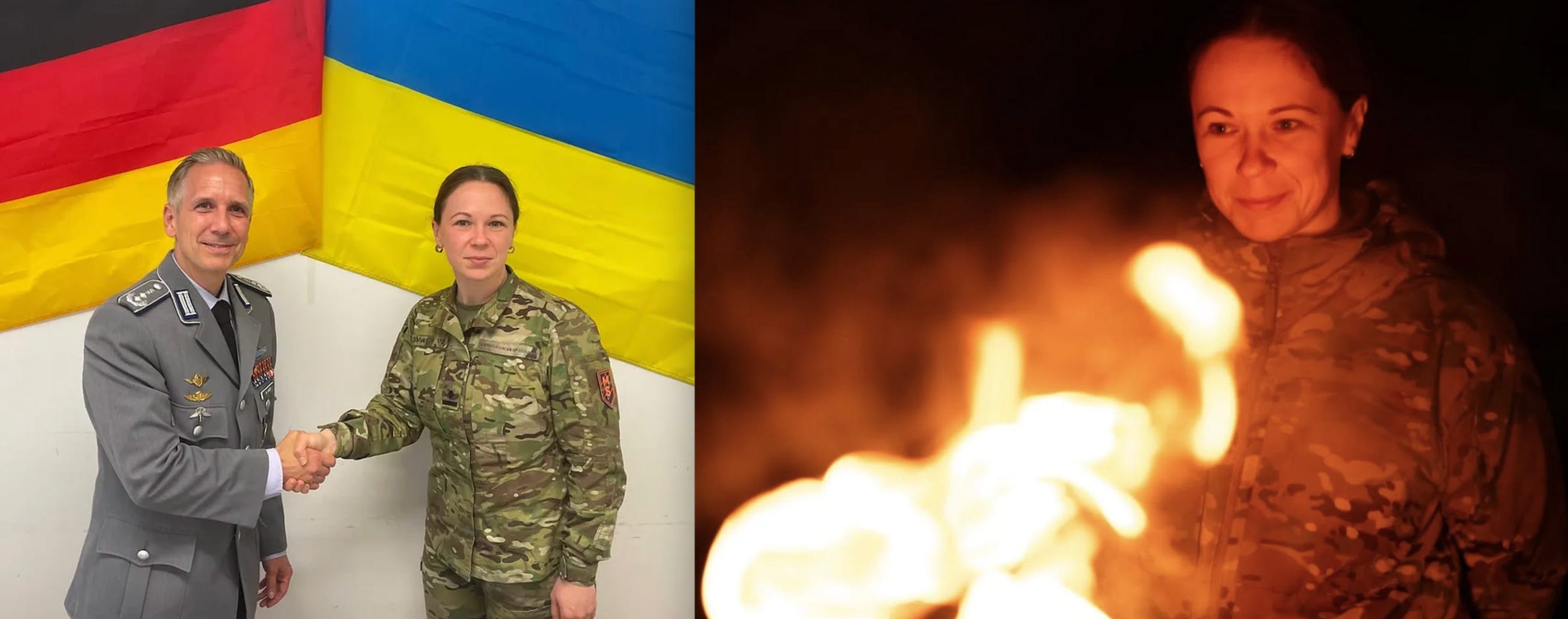
Viktoria Kovach, the head of the medical service of the Azovite 3rd Assault Brigade and now the 3rd Army Corps, is not a liberal newcomer to the most powerful armed movement in Ukraine. In 2014, she became a combat medic in the NGU Azov Regiment, when it remained an openly neo-Nazi unit.
Almost a year ago, Kovach met with a decorated official from the German Army Medical Service in Berlin. In early February 2026, about a week before the Munich Security Conference (MSC), she attended a five-day “Joint Medical Planning Course” at the NATO School in Oberammergau, Germany. Kovach wants NATO countries to prepare for war with Russia instead of “‘imaginary’ adversaries and made-up data sets used by our partners across a variety of training scenarios.”
The Munich Security Breakfast is described as “the leading platform for defense-oriented startups and companies within the framework of the Munich Security Conference.” Some of the main speakers at this year’s event previously rubbed shoulders with the Azovites:
In 2024, Andrius Kubilius, the European Commissioner for Defense and Space, met with an NGU Azov delegation in Brussels, which included an Azov medic interested in the Belgian Nazi collaborator Léon Degrelle.
Last year, Christian Freuding, now the head of the Germany army, spent the 80th anniversary of the Nazis’ surrender at the drone school of the Azov movement, “Killhouse Academy,” and got a look at their “ground-based robotic systems.”
Mykola Zinkevich, the commander of the NC13 “company of ground-based robotic systems,” which originated in the Dirlewanger unit of the Azovite 3rd Assault Brigade, attended the Munich Security Breakfast with Viktoria Honcharuk, apparently his girlfriend, who used to work on Wall Street. They sat several feet away from Freuding when the top German general gave his speech.
Honcharuk, a former investment banking analyst for Morgan Stanley, and then a combat medic in Ukraine, nows leads the “defense technology department” at Snake Island Institute (SII), a think tank established last year. Also in 2025, she co-founded AB3 Tech, a “startup accelerator” for the 3rd Assault Brigade and 3rd Army Corps. These Azovite entities have been making lots of friends from the political-security establishment and military-technology complex of NATO countries.
Canadian politician Chrystia Freeland, co-chair of the MSC Advisory Council, sat down with celebrity Ukrainian writer Serhii Zhadan at noon to discuss “Ukraine’s Uncertain Future.” Zhadan, ostensibly a “liberal nationalist,” is part of the Azov-inspired ideological unit in the famous NGU Khartia brigade/corps, which is more publicly aligned with the (openly neo-Nazi) 3rd Army Corps than the (more crypto-Nazi) 1st Azov Corps. As of this year, Freeland is an advisor to the Office of the President of Ukraine, now led by Kyrylo Budanov, the former military intelligence chief and top patron of neo-Nazi militants in Ukraine.
The Munich Security Conference officially began the next morning, which included the unveiling of “Ukraine House,” a high-profile platform at the MSC, organized by the Office of the President and the oligarch Victor Pinchuk Foundation, that was previously limited to the World Economic Forum. For whatever reason, the Azovites seemingly avoided Ukraine House at the MSC, although they have taken the opportunity to speak at Davos and Pinchuk’s annual conferences in Ukraine. The main attraction of Ukraine House Munich was an exhibition of drones being used in Ukraine, accompanied by a message from Kyiv displayed in illuminated letters: “CHANGE OR DIE.”
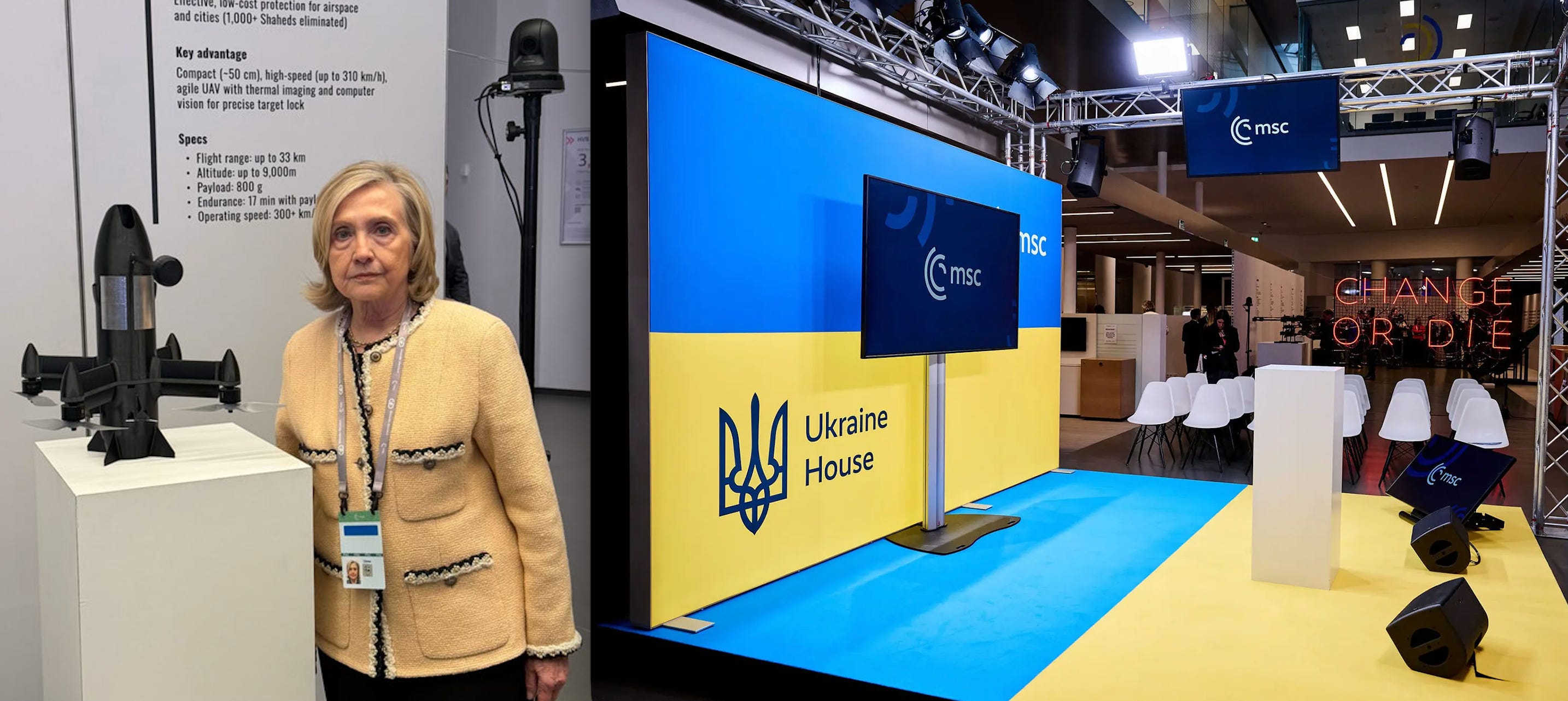
That first afternoon, Maryna Hrytsenko, the executive director of Snake Island Institute, joined a “Drone Assembly Workshop” at the Amerika Haus in Munich, appearing alongside the commander of the Centre for Military History and Social Sciences of the Bundeswehr, among others. Thanks to SII’s relationship with the European Defence Tech Hub, the Technical University of Munich (TUM, “the top-ranked technical university in the EU”) also hosted a hackathon featuring “mentors” from the 1st Azov Corps and 3rd Army Corps.
Meanwhile at the MSC, there was a screening of the documentary “Second Wind,” about a group of Ukrainian veterans who climbed Mount Kilimanjaro as some kind of demonstration of their mystical “Ukrainian resilience.” One of those wounded soldiers, Vladislav Shatilo, is a neo-Nazi who served in the 3rd Assault Brigade and now leads the Azov movement’s new Veteran Corps in Chernihiv. He has a matching tattoo with the (former?) head of the Azovite paramilitary youth group “Centuria,” a hardcore neo-Nazi “Organization of Ukrainian Nationalists.” Shatilo did not make it to Munich, but he is currently embarking on a tour of Canada.
That evening on the sidelines of the MSC, the Azovite SII reported to its 5000 LinkedIn followers, the Snake Island Institute and its partners “gathered around 200 investors, defense-tech founders, ecosystem and military representatives, and decision-makers for a candid fireside chat on cases of Ukrainian battlefield breakthroughs — air defense in drone-contested environments and strike UGVs [Unmanned Ground Vehicles].” SII used the opportunity to promote Killhouse Academy with an “FPV training booth, offering participants an introduction to [the Azov movement’s] veteran-led FPV academy.”
Former CIA director David Petraeus gave the keynote speech. He sure is becoming a good friend of the Azovites. Like the head of the German army, Petraeus has visited Killhouse Academy and was introduced to some prominent neo-Nazis, including SII president Vladyslav Sobolevsky, who didn’t make it to Germany this year. Sobolevsky is an important Azovite and alleged war criminal whose favorite books are by Nazi generals (Erich von Manstein and Burkhart Müller-Hillebrand) and Léon Degrelle. In 2024, Petraeus met Azov veterans at Joint Base Andrews near Washington, for a golf tournament that he hosted.
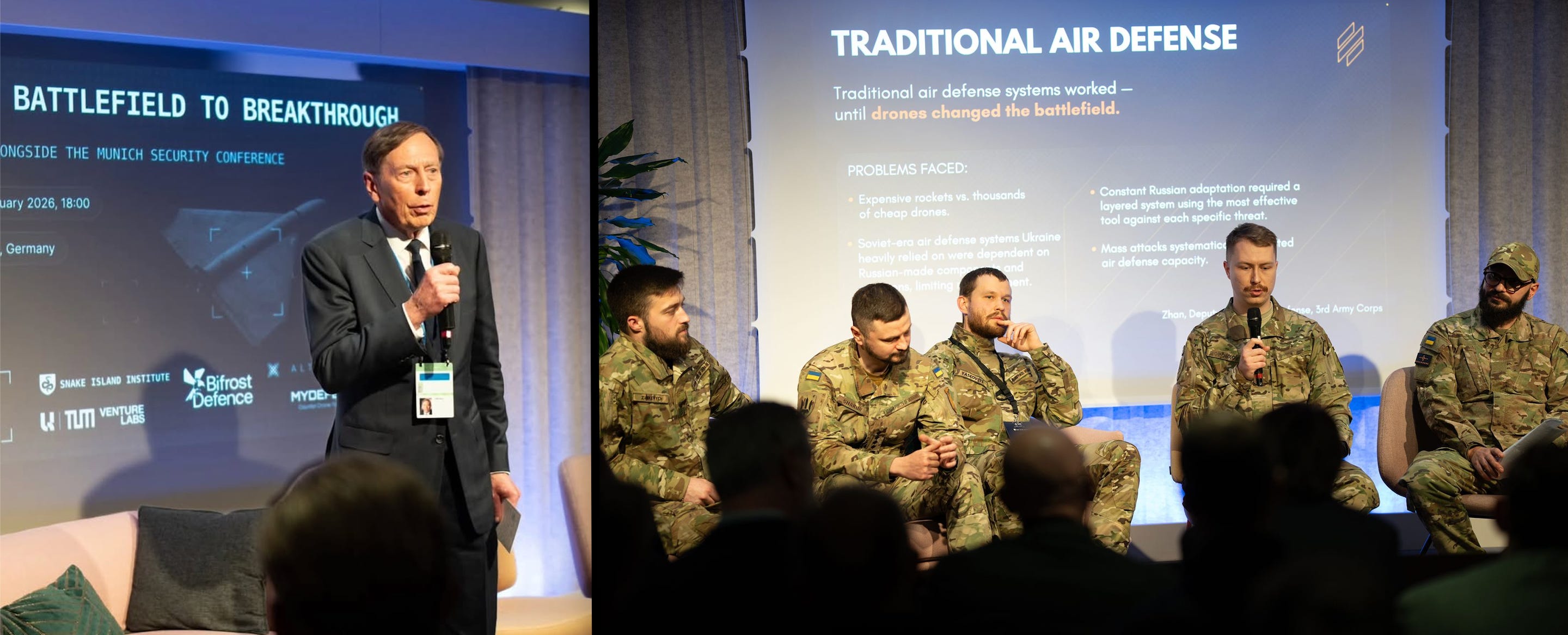
In addition to Mykola “Makar” Zinkevich, several Azovites from the 3rd Army Corps took the mic, such as Oleksandr “Zhan” Vorobiov, the deputy chief of air defense. His superior, Maksym Zaichenko, formerly led the Azovite political party (the National Corps) in the Zaporizhia region. “Boche,” the head of R&D for the anti-aircraft regiment, and Serhiy “Rut” Shakun, the chief of electronic warfare, also talked about their alleged breakthroughs on the battlefield.
Another speaker was Yevhenii “Bater” Batrun, said to be “the chief instructor” at Killhouse Academy, and “one of the first FPV pilots in the 3rd Assault Brigade.” Like the neo-Nazi founder of Killhouse Academy, Batrun is affiliated with the “Kraken 1654” drone regiment in the 3rd Army Corps. A neo-Nazi contingent of this relatively new regiment were considered to be some of the top fighters at the disposal of Ukraine’s military intelligence agency. Now they are supposedly in one of the most technologically advanced units in Ukraine’s army.
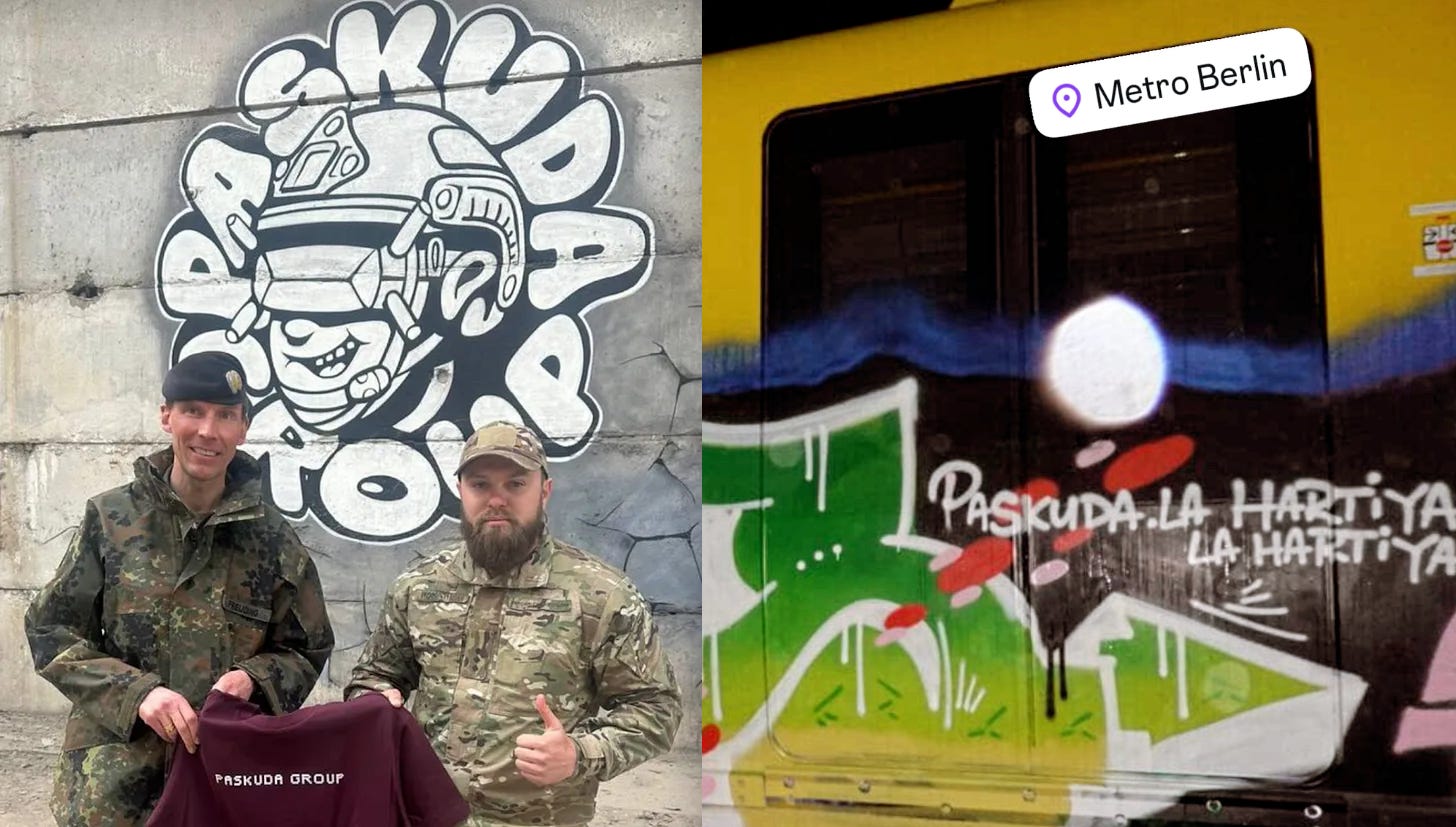
Christian Freuding with Killhouse Academy founder Oleh Romanov last year in Kyiv, promoting the Paskuda Group, a drone unit from the 3rd Assault Brigade that has since joined the Kraken 1654 regiment. Now the Paskuda Battalion, it noticed some graffiti in Berlin last month.
According to a former associate of the Munich-based Quantum Systems, the Azovites received “a strong interest from the investment crowd.” Earlier that day, someone from the Kyiv Post spoke with Zinkevich and Batrun. Their German interviewer described the 3rd Assault Brigade as “an elite unit widely recognized for its tactical innovation and being at the absolute tip of the Ukrainian spear.” As for the partners of the private event that evening, Friday the 13th:
MITS Capital, a high-powered US-Ukraine venture capital firm betting big on World War III, invited the intelligence chief of the NGU Azov Brigade to its inaugural “MITS Forum” in Kyiv dedicated to “Ukrainian Defense Tech as a Partner for Pax Americana.” This year, MITS Capital held a flashy conference with the NGU Azov Corps—more about that coming soon.
TUM Venture Labs, earlier that day, hosted the EDTH hackathon (featuring the 3rd Army Corps’ electronic warfare chief) and launched the “MSC Startup Hub.” This outfit at the Technical University of Munich aims “to accelerate scalable business models and start-ups in software, data and AI.” According to them, “We are THE Springboard for Deep Tech Entrepreneurship.”
Bifrost Defence, based in Copenhagen, explains, “We buy and build defence companies, focused on hardware.” The managing partner, who was recently in Israel to meet with its National Cyber Directorate, is proud that one of their portfolio companies has been recognized for supporting the 125th Mechanized Brigade in the 3rd Army Corps, which is going through a process of “Azovization.” He raved about the SII event, “What started as an idea by Viktoriia Honcharuk [SII, AB3 Tech] has turned into one of the biggest (unofficial) Munich Security Conference side-events on this year’s calendar, and today we already have over 200 invited guests registered!”
Rasmussen Global, “Europe’s preeminent independent geopolitical advisory firm,” also headquartered in Copenhagen, was founded in 2014 by Anders Fogh Rasmussen, the former Prime Minister of Denmark, after serving as the secretary general of NATO. In 2023, he said “the way we can put a quick end to the conflict is to deliver all the weapons the Ukrainians need,” and invite the country to join NATO. Asked “how do you think Russia is going to react to this?” he said to great applause, “I don’t care.”
Altas Ares, based in Paris, declares it “has been leading a NATO-backed project set to reshape the defense of Europe’s Eastern flank” by developing AI technology and learning from the war in Ukraine. Last year, “we had the privilege of mentoring” a European Defense Tech Hub event in Lviv, which the Azovites helped to organize. Partners of this EDTH hackathon included Zinkevich’s NC13 unit and the Galician Youth, as well as Centuria.
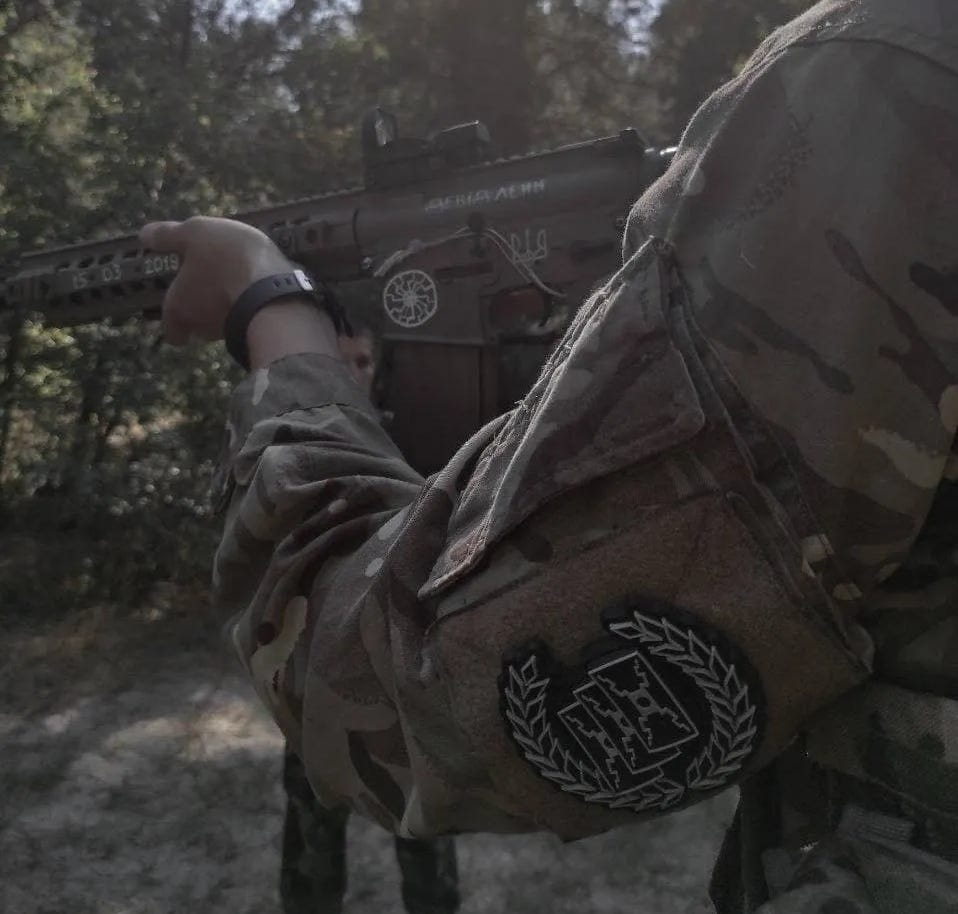
“Events in Ukraine” discovered, “In 2021, Centuria published photos of a training camp featuring a young man holding a gun inscribed with the date of the Christchurch massacre.”
Sergei Sumlenny is a German information warrior from Russia who “fights” for Ukraine, and now the “Azov Lobby.” Like many Azov supporters in Germany, he is linked to the Green Party. Last year, Sumlenny arranged a trip to the German parliament for Valery Horishny, a neo-Nazi pagan senior sergeant in the Azov Corps who has written poetry dedicated to Adolf Hitler.
A week after the 2026 Munich Security Conference, Germany’s Air Force Union held a conference dedicated to drones. Sumlenny brought Mykyta Puz, a “Miltech Scouting and Partnership Officer” from the NGU Azov Brigade, and someone from the NGU Rubizh Brigade (part of the Khartia Corps) to speak at the event. The far-right Svoboda party has two battalions in the Rubizh Brigade, one of which has an optical illusion of Nazi SS bolts in its emblem.
Puz was one of the “mentors” at the hackathon. In the coming days, he spoke at Cafe Kyiv in Berlin, “Europe’s most outstanding event on Ukraine,” and Enforce Tac in Nuremberg, “Germany’s leading trade fair for security and defense.”
Cafe Kyiv is another high-profile event, attended by several thousand people and organized by the Konrad Adenauer Foundation, which is associated with the center-right Christian Democratic Union (CDU). Friedrich Merz, the Chancellor of Germany and president of the CDU, gave a speech at the opening ceremony. “We are learning a great deal from Ukraine,” he said.
At 11am, a junior sergeant in the 1st Azov Corps and lieutenant from the 2nd Khartia Corps spoke with the Ambassador of Ukraine to Germany and German MP Jeanne Dillschneider (from the Green Party) about “Defining the European way of drone warfare – Lessons from Ukraine for NATO and Europe.”
They were joined by the managing director of Quantum Frontline Industries, “the first fully automated industrial production line for Ukrainian military drones to be set up in Europe.” The Ukraine-based Frontline Robotics, supporters of the 3rd Army Corps, and Quantum Systems in Munich, which loomed large at the MSC and Cafe Kyiv, announced this joint venture toward the end of last year. It may very well come to work with the Azovites, if it hasn’t already.

A Quantum Systems advertisement in Munich during the MSC. Its partners at Frontline Robotics worked with the German “Arx Robotics” to develop a combat tank, which the 3rd Army Corps is putting to the test. Arx Robotics is also a supporter of the Killhouse Academy School for Ground-Based Systems.
At 2pm, there was a screening of the Oscar-shortlisted documentary “2000 Meters to Andriivka,” starring the 3rd Assault Brigade. “I think that war is probably the best time in life to just start everything over from scratch,” a unit commander “Fedya” says in the film, “because all this Soviet influence will be gone.” The movie ends with him planting an upside down Ukrainian flag in the ruins of a village, and an ominous Azovite ceremony honoring their fallen fighters. Borrowed from the Italian fascist tradition, there is a roll call of martyrs, followed by unified chants of “Presente!” This goes on as the screen turns to black and the credits roll. It probably received a standing ovation from the audience.
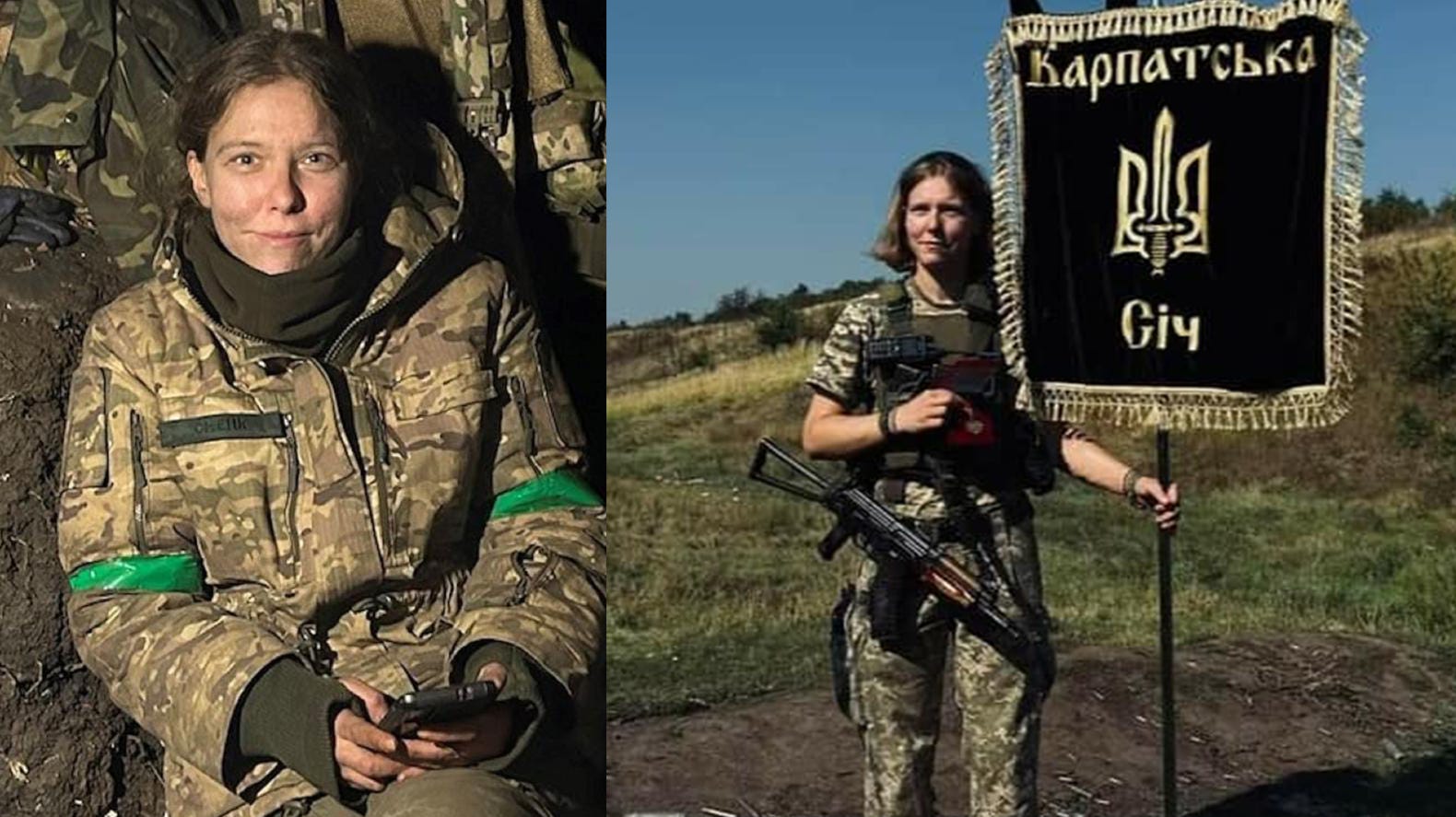
At 4pm, there was a presentation of the wartime diary of Savita Wagner, a German combat medic who served in Ukraine. She died in the far-right Carpathian Sich battalion, which originated in the Svoboda party. The “German Volunteer Corps,” linked to the German neo-Nazi party Der III Weg, later joined the unit. On the 4th anniversary of the Russian invasion, members of Der III Weg demonstrated in Zwickau with the German branch of Centuria (yes, that is a thing).
By 6pm, another panel concluded on “Securing European Skies: Lessons from Ukraine’s Innovation.” Sergej Sumlenny moderated this discussion, featuring the same Azov sergeant as before (Oleksii Rudenko). There was also a captain of the Rubizh Brigade, its head of civil-military cooperation (Maksym Proskurov). They appeared alongside a German former NATO official (Gerlinde Niehus), German MP from the CDU (Roderich Kiesewetter), and a “pro-Ukraine activist” from the U.S. (Jonathan Lippert) who has fundraised for the Azovites.
At 7pm, events at Cafe Kyiv pondered the issue of “Holocaust education in times of war,” and dismantling Soviet war memorials in Berlin. Anna Vriadnyk, a strategic communications officer from the 1st Azov Corps, took the stage at 8pm to discuss Russian hybrid warfare with the Ambassador of Canada to Germany, as well as Arndt Freytag von Loringhov, a former NATO intelligence chief and deputy director of the German Federal Intelligence Service. Meanwhile, Azov Brigade lieutenant Mykyta Puz and Khartia Brigade staff sergeant Oleksandr Zhylyayev spoke with a strategic communications officer from Quantum Systems, in a panel moderated by a journalist from the prominent German newspaper Die Zeit.
“A special thanks to the Ukrainian speakers and soldiers from the Azov and Khartiya Corps for sharing their insights,” said Mattia Nelles, CEO of the German-Ukrainian Bureau, who then accompanied the NGU Azov “Miltech Scouting and Partnership Officer” to Nuremberg.
When Sumlenny brought an NGU Azov delegation to Germany last year, Nelles helped to arrange their trip to the Bundestag. He was especially impacted by Valery Horishny, an open admirer of Hitler, who he previously met at the Kyiv Security Forum. Nelles helped to organize several panels at Cafe Kyiv 2026, including the one dedicated to “defining the European way of drone warfare.”
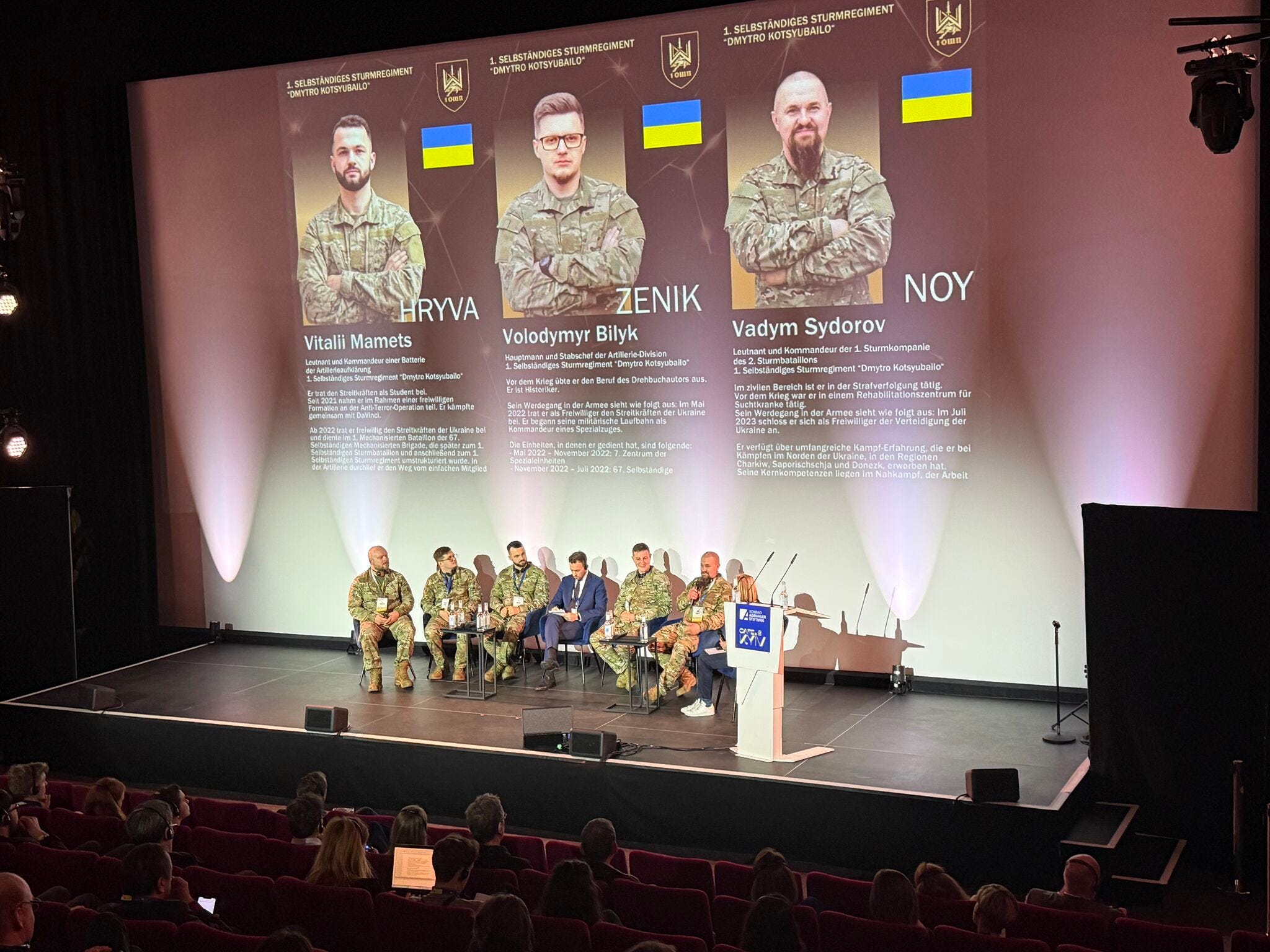
The 1st Assault Regiment, part of Ukraine’s controversial Assault Troops, also tabled at Cafe Kyiv and held a panel: “How to turn a civilian welder into an effective assault soldier in 51 days.” This unit originated in the Nazi-infested Right Sector movement, and is named after its former commander, Dmytro “Da Vinci” Kotsiubailo, a far-right “Hero of Ukraine.”
By the end of February, according to Nelles, he “brought representatives of the 1st Assault Regiment to the German Federal Foreign Office, where 100+ diplomats joined a conversation with these highly effective fighters, deployed to prevent breakthroughs along the front and conduct counterattacks.” His former boss, Green MP Robin Wagener, chairs the German-Ukrainian parliamentary group.
Thanks for reading. Stay tuned for more developments (including an overview of the “Azov Lobby” in Fall 2025-Winter 2026), and perhaps consider becoming a paid subscriber if you haven’t already. I couldn’t bring myself to paywall this article—maybe next time. If you want to make a one-time donation, you can “Buy Me a Coffee.”
Azov Lobby Blog is a reader-supported publication. To receive new posts and support my work, consider becoming a free or paid subscriber.
From Azov Lobby Blog via this RSS feed
You must log in or # to comment.