

- cross-posted to:
- drudgereport

- cross-posted to:
- drudgereport
Even before President Trump returned to office, his advisers sought to remove what they saw as unnecessary constraints on the way the American military fights. The man Trump had tapped to lead the Pentagon, Pete Hegseth, had long complained about “weak” and “woke” policies that he believed were hampering the cause of battlefield victory.
In early 2025, ahead of Trump’s second inauguration, members of his transition team asked military officials to review and potentially close a unit—a “center of excellence,” in Pentagon parlance—established to help the military devise better strategies to protect civilians. The creation of the Civilian Protection Center of Excellence in 2023 was part of an effort to understand why thousands of noncombatants had died in the battle against the Islamic State terrorist group and to find ways to limit civilian deaths in counterinsurgency struggles.
The center was created by law, so it couldn’t be closed outright. But the administration has dramatically reduced staffing there and fired or reassigned personnel focused on preventing civilian harm across the military. Total staff working on the issue across the military, which numbered nearly 200 at its peak, has been reduced by about 90 percent over the last year, people familiar with the matter told me.
Today, the U.S. Navy and Air Force (and their Israeli partners) are waging an all-out air campaign against the Iranian regime, dismantling military capabilities and destroying ships, missile sites and Revolutionary Guard command sites in thousands of strikes over the last nine days. Civilian casualties are already a prominent issue. Shortly after the start of the bombing campaign, a strike on a girls’ school in southern Iran killed about 170 civilians, Iranian officials say, most of them children. U.S. Central Command, which oversees operations in the Middle East, is investigating.
Hegseth—a former National Guardsman who rose to prominence vowing to restore a “warrior ethos” he argues was eroded by undue deference to military attorneys and international law—has remained defiant. “No stupid rules of engagement, no nation-building quagmire, no democracy building exercise, no politically correct wars,” he declared on the war’s third day. “We fight to win, and we don’t waste time or lives.”
The bellicose messaging from the administration has been accompanied by a sharp reduction in the number of staff focused on minimizing civilian casualties.
At CENTCOM the number of people working full-time on the issue was cut by two-thirds, leaving only a handful, although some staff have been reassigned to work on the issue during the Iran campaign, one person familiar with the staffing said. CENTCOM and other commands have fired and reassigned officials whose job was to ensure that civilian sites such as schools are avoided in strike planning, and to propose alternatives for targets that carry a high risk of killing noncombatants. “One chief problem I see are arbitrary constraints put on these good practices for ideological reasons,” a person familiar with the issue—who, like others involved, requested anonymity for fear of retaliation—told me. Asked for comment, the Pentagon pointed me to a social-media post by spokesperson Sean Parnell that said Iran Tehran was positioning missile and drone launchers in residential areas. “We’ve seen this cowardly strategy before—it’s no accident,” he wrote.
Trump and Hegseth have suggested that the toll at the girls’ school was the result of an Iranian misfire. “The only side that targets civilians is Iran,” Hegseth said alongside the president on Air Force One on Saturday. But the pattern of strikes on the school and at least seven nearby IRGC naval sites suggests a strike by guided munitions rather than an errant Iranian projectile, a Human Rights Watch analysis concluded, and video of the incident appears to show a tomahawk missile, which the U.S., not Iran, employs. (Iran, which alleges that U.S. and Israeli strikes over the last 10 days have killed more than 1,300 people, has meanwhile pounded Israel and Gulf nations with hundreds of missile and drone attacks, leading to civilian deaths.) The White House’s own messaging has not suggested extensive calibration to avoid civilian casualties. Instead, it has released a series of social-media posts mixing video games or action-movie clips with imagery of exploding Iranian targets. “No pause. No hesitation,” one such post says above grainy strike images, punctuated by an explosion emoji.
The overriding priority now is lethality, and protecting civilians “has been de-emphasized across the targeting and strike community,” one person familiar with the matter told me. That may be welcome news to some in the military, who chafed against certain restrictions on their ability to fight. But the changes have increased the potential for civilian casualties by scotching what many saw as a worthy effort to apply morality and American sensibilities to the messiness of war. “Political decisions and rhetoric at the top are undermining this work,” Annie Shiel, the U.S.-advocacy director at the Center for Civilians in Conflict, told me. “Civilians are ultimately paying the price.”
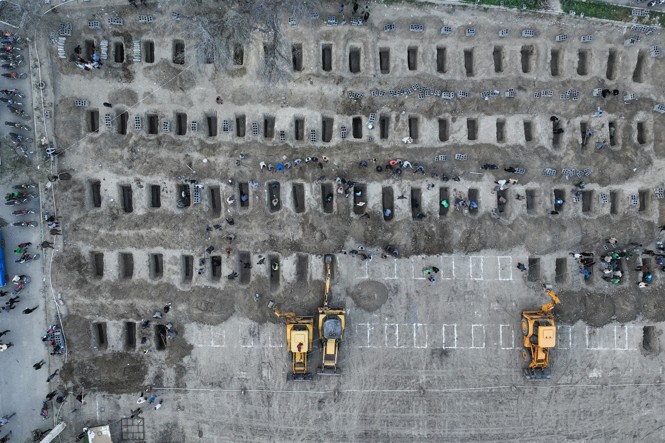
The Iranian Press Center released this aerial photograph of mourners digging graves during the funeral for children killed in a strike on a primary school on March 3, 2026.(AFP / Getty)
At the height of the war against the Islamic State in 2017, U.S. military officials received an urgent appeal from the Iraqi ground forces they were supporting in the city of Mosul. ISIS snipers on the second story of a nearby house had pinned down a detachment, and the Iraqis asked whether American planes could help. U.S. commanders authorized aircraft to drop a single 500-pound precision bomb. What they didn’t know was that more than 100 civilians had taken shelter on the lower floor of the building. When the bomb struck, it ignited a hidden cache of explosives, killing everyone inside. That incident created the worst civilian toll of the air campaign against the Islamic State and the biggest single loss of noncombatant life due to U.S. military action since 2003.
[Read: The Trump administration accidentally texted me its war plans]
Trump’s first chairman of the Joint Chiefs of Staff, Marine General Joseph Dunford Jr., commissioned a classified study that sought to examine what had gone wrong in the Islamic State air war, and why the military’s estimates of errant deaths was so starkly lower than the tallies amassed by outside groups. Airwars, a monitoring group that worked closely with the military, estimated that more than 8,000 civilians were killed in nine years of airstrikes against ISIS; the military acknowledged about 1,400. Dunford and other military leaders took the issue seriously, not just for ethical reasons but because of a central truth of counterinsurgency: To ignore accidental deaths was to lock America into generations of conflict.
I spent years writing about the military’s struggle to ensure its operations killed the people they intended to kill-–and no one else. I found that military officials generally wanted to avoid unnecessary bloodshed and were frustrated when their precautions failed them. Over the years, those safeguards included calculating a strike’s expected blast radius, estimating collateral damage, and using a practice called “shift cold” that allows officials to abort a strike in its final seconds if, for example, a child walks into the target area. Everyone understood the task was challenging, especially in places (like Iran) where the United States has few or no personnel on the ground, and where militants employ human shields. A general who commanded an operations center in Iraq once told me he saw an Islamic State militant dashing between buildings with a baby above his head, knowing the child would protect him.
Eventually, the Pentagon established a new system for improving its record on what it called “civilian harm,” establishing the center of excellence; creating a new military-wide policy on protecting civilians (which is still on the books); and making changes to the military’s targeting manual. The new apparatus also assigned personnel to combatant commands and set up new “civilian environment teams,” whose members advised planners on local customs and patterns of life to make strikes more precise. Other personnel were assigned to targeting cells or to investigating incidents when they occurred.
Trump at times has shown consideration for the likelihood of civilian harm. In 2019, he said he called off a planned retaliatory strike on Iran at the last minute after learning that 150 Iranian officials could be killed, an act that he believed was disproportionate to Tehran’s downing of a U.S. drone. Within the military, though, there has always been some friction around the effort to strike the right balance between “military effects,” a euphemism for adversaries’ deaths, and protecting noncombatants. In the fight against ISIS, some commanders were frustrated by what they saw as overly restrictive rules. They wanted to be able to exercise judgment and avoid bureaucratic processes for strike approval. Over time, commanders were permitted to widen the pool of targets to banks and oil rigs for their role in financing the enemy, and to conduct strikes with a larger number of acceptable civilian casualties.
To mitigate the internal resistance, the Pentagon, during the Biden administration, hired military insiders to run the civilian-harm-reduction efforts, typically those who had worked as targeters, civil-affairs specialists, or troops who called in airstrikes. People familiar with the system described it as a work in progress, an effort to change an established way of waging war, little by little. “There was always this hesitation from some who would say, ‘Hey, war is terrible, but what are you going to do?’” one person familiar with the process told me. “It was a balance, but the pendulum did swing a bit more toward protection.”
When I talked with Pentagon officials who worked on this issue shortly ahead of Trump’s return to office in 2025, they told me they were confident that the new apparatus would endure. They argued that there had not been any effort to place fresh constraints on service members’ actions or impose penalties when things went wrong. The intent was to provide operators with a clearer picture of the battlefield, allowing them to achieve results without unintended consequences. But Trump’s new advisers ordered the system’s dismantling anyway. The Pentagon also pulled the plug at the last minute on a planned database of errant strikes, which had been developed at a cost of millions of dollars, people familiar with the issue said. And the administration closed a State Department initiative to track civilian deaths caused by weapons that the United States provides to allies and repealed a White House weapons-transfer policy that emphasized human rights.
Not everyone was upset by these moves. Many in the ranks have welcomed the changes because “they now feel unleashed,” one person familiar with the issue told me.
Trump, in the past year, has ordered military engagements in countries including Iran, Venezuela, Syria, Nigeria, Yemen, and Somalia and has threatened to invade Greenland, part of a NATO ally. Hegseth has empowered commanders to conduct more airstrikes without seeking higher-level approval. He has also faced questions from lawmakers over the targeting of small boats off the coast of Latin America that the U.S. claimed to be legitimate narco-trafficking targets, an accusation for which the Pentagon has declined to provide evidence. In one case, two survivors were clinging to wreckage and appeared to signal for help before they were killed in a follow-on attack.
[Read: What Iran might do when it has nothing to lose]
Some within the Pentagon believe that the anti-civilian-harm program will have a lasting effect, even with the reductions in staff, including through references in the targeting guide to the “civilian environment”’ and the inclusion of (notional) civilians in training and exercises.
Hegseth’s rhetoric is perhaps the starkest change, given the solemnity that I’ve seen Pentagon leaders generally employ when discussing the use of military force. Hegseth, from his perch at Fox News during Trump’s first term, advocated for lenient treatment of service members who were accused of war crimes. In his 2024 book, Hegseth, a former Army National Guard member, derided overly cautious commanders and military judge advocates general—”jagoffs,” in his description—who seek to constrain battlefield operations and investigate claims of errant behavior. He also recounted telling his platoon in Iraq to disregard the rules of engagement.
Now, people familiar with the situation told me they are concerned that Hegseth’s approach will lead to unintended casualties in the Iran campaign that might have been otherwise avoided.
Emily Tripp, Airwars’ executive director, told me that the United States had emerged over the years as a global leader in using its power in a responsible way, with a system to prevent civilian harm more advanced and transparent than its peers. But that advantage may already be eroding. Trump last year launched Operation Rough Rider against Houthi rebels in Yemen, which involved roughly 800 strikes in the first six weeks. That is far fewer than the more than 1,700 targets struck in the first 72 hours in Iran. Watchdog groups believe that hundreds of civilians died in the Yemen operation. More than a year later, the Pentagon has not released any findings of investigations into those alleged deaths.
From The Atlantic via this RSS feed
You must log in or # to comment.