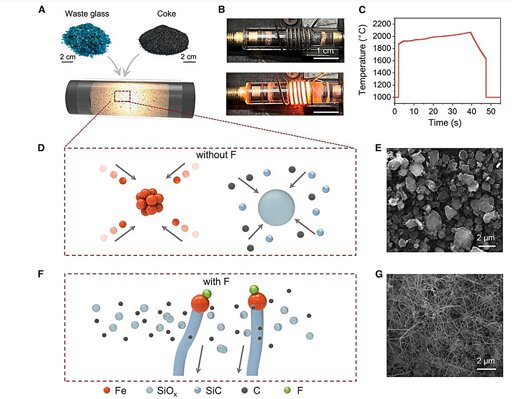
Engineering silicon carbide (SiC) with tailored morphologies for electronics and structural reinforcement materials has always been a costly and time-consuming affair, but scientists can now do it in a flash. A new study shows how discarded glass and silicon-rich coal waste can be turned into valuable SiC nanowires in seconds using a process known as Fluorine-Assisted Flash (FAF) Joule heating, where a quick pulse of electricity instantly heats up the reaction mixture to extremely high temperatures.