

It’s no surprise that the movies have been forever obsessed with mansions, apartments, interior décor, household appliances, and furniture. Raised from infancy to perpetual adolescence on California’s shores with their magic hour that stretches far beyond sixty minutes, Hollywood films make sure that interiors look good whether under Klieg lights or with the Pacific sunset streaming through picture windows.
The money-shot light buffing countertops and cabinets, warming sandstone pool decks, and caressing the convertible in the drive glimpsed through plate glass in the living room’s sliding door has always been a projection of domestic desire, the audience’s nesting instinct and acquisitive wants mercilessly titillated. This is a world of illusion in which single mothers struggling to make ends meet somehow can live in spacious arts-and-crafts bungalows, where petty crooks hole up in stylish flea pits that actual down-and-out actors (who have day jobs as movers) would die for. The late-model capitalist proliferation of so-called reality TV series devoted to the flogging off of luxury properties—”Selling Sunset”; “Buying Beverly Hills”; “Million Dollar Listing Los Angeles”—is the pornographic climax of the real estate and redecorating lusts aroused over decades by Tinseltown.
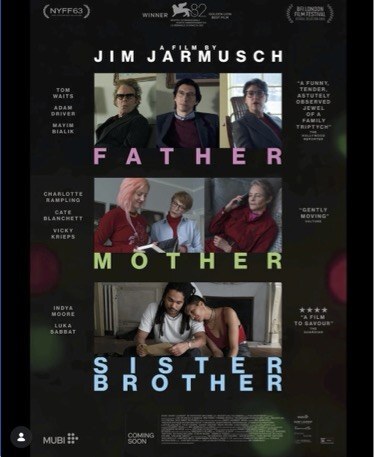
Jim Jarmusch’s latest film, Father Mother Sister Brother, which won the Golden Lion at the Venice Film Festival last fall, deconstructs this desire in the writer-director’s characteristically subdued, studied, and awkwardly hilarious fashion. The movie animates interiors and their objects as crucial, if mostly silent, characters, rather than reducing them to mere backdrops, or to glossy live-action catalogs of home furnishings.
A fiercely independent filmmaker with a uniquely uncluttered aesthetic vision, Jarmusch has now made a movie in which décor cannot be simply ogled and objectified. In so doing, he has shone a mocking light on one of Hollywood’s oldest obsessions. From now on, that Danish design dining set in the has-been film star’s hilltop mansion will be heard to whisper and seen to wink at the self-deluded goings-on between sideboard and sofa. The stainless fridge in the surfer’s beach “hut” will laugh at the folly of chasing waves while contemplating petty crimes to pay the rent. The Eames chair in the corner of the downtown loft will raise an eyebrow at the burgeoning romance with the new neighbor.
Returning to the anthology format that Jarmusch first explored in Mystery Train way back in 1989, Father Mother Sister Brother presents a succession of three familial encounters.
In the first, two middle-aged children (Adam Driver and Mayim Bialik) drive a black Range Rover along a rural route through snow-speckled, leafless woodlands, rolling past forlorn farms and lonely mobile homes. They are on their way to make a rare visit to their dad (Tom Waits, the radio DJ’s voice in Mystery Train and a vital cast member of many Jarmusch films since). As the journey continues, Jarmusch cuts repeatedly back to their destination, where the father is in the midst of an exercise in what you might call set un-design. He chucks a wooden crate of junk on the polished, cool green leather of a teak armchair and tosses a ratty rug over the matching sofa, and takes books from their shelves and stacks them haphazardly on the floor.
Yet even the bits of retro, mid-century form and sleek upholstery that are still visible broadcast the furniture’s expense. As dad busies himself with his deceptions, talk continues among the siblings in the car about his supposed poverty. There is no Social Security since he never held a job. Both the kids have ponied up money over the years to help him, and when they pull up to the house, the exterior looks sufficiently weather-beaten to sustain the plausibility of the idea that an impoverished senior lives there.
Once inside, the visitors’ attention is immediately caught by an elaborate yet elegant wooden swivel chair placed before mullioned windows that look out over a pond. Dad parries the admiring compliment by dismissing the piece of furniture as some cheap old thing. Even the windows, which should be dirty and maybe cracked, gleam. They are not only stylish but probably energy efficient to boot. Beneath the hastily choreographed clutter, the wood floors look to be in excellent shape.
When the daughter goes to make tea in the kitchen, the camera (the film was shot by long-time Jarmusch collaborator Frederick Elmes and Yorick Le Saux) catches sight of the quality fixtures and, through the camouflaging clutter strewn around the sink, the speckled granite countertop. Dad has made the tap drip annoyingly.
The sister seems at times to suspect the ruse, but the son can’t bring himself to see what should be obvious, and painfully so in his case, since he’s been funding his father even to the detriment of his own marriage. Ever the deft observer and orchestrator, Jarmusch puts his audience in a similar position to that of the grown children on screen. For decades in Hollywood, we have been lied to about what supposedly marginal characters should have in their location-scouted houses. We have been asked to do far more than simply suspend disbelief in accepting or ignoring these absurdities. Jarmusch makes the furniture the elephant in the room, and the crux of a family fable becomes a critique of one of Hollywood’s favorite lies.
The film’s second episode involves two daughters (Cate Blanchett and Vicky Krieps)—the one prim and proper, the other mischievous and melancholic—coming for their yearly visit to their mother (Charlotte Rampling), a best-selling romance novelist. She lives in an immaculate Victorian house of red brick in a graceful, gardened district of Dublin. The cardiganed and bobby-socked daughter has car troubles on the way (hers is a plain and extremely unstylish vehicle). While the mother waits, her upper-crust control of her interior is conveyed in a single motion when she adjusts by two inches the placement of a tray of macaroons on an otherwise perfectly arranged table laid out for high tea. Prints and pastels frown from the walls. The polished mahogany of the moldings exudes enmity or indifference—or, more likely, both. Not a piece of furniture or cutlery is out of place, not a picture askew. The front door is lacquered to perfection, the brass knocker shined up to a blinding glare. After the daughters are at last arrayed “at table,” as their mother puts it, she deploys the porcelain teapot elegantly, but with all the firepower of a maternal howitzer.
A series of shots from directly above, as if from the chandelier, shows us the entirety of the immaculately set table with its squadrons of cakes and floral-pattern china service arrayed in battle formation. Forks bayonet cakes, then flee to safety. Cups and saucers outflank trays of sweets as the furnishings analyze the bloodless hostilities. Never has civility been colder, décor more disapproving.
The third of the three installments has no décor at all. Twins (Indya Moore and Luka Sabbat) visit the empty Parisian apartment of their parents, who have died in the crash of their small plane. The brother has cleared out their belongings, and now he takes his sister, who arrived from New York, to say goodbye to the place where they grew up. They walk through the spacious rooms, open the French doors above the street, reminisce and mourn as they lie on the battered parquet.
Before they leave the apartment for the last time, the camera traces a full circle on its axis, taking in the layout of the space, the smudged walls, the small, grease-stained kitchen, the narrow bathroom graced by mildew, and the bedroom where the pair had most intensely felt the memory, even the presence of their parents. In contrast to the characters oppressed and deluded by objects in the film’s first two chapters, the profound love of these children for their vanished parents is all the more palpable in the empty interior.
The soundtrack, assembled by Jarmusch and the British/German singer-songwriter Anika, is even more minimal than his script. Music is introduced in blurry transitions between the chapters and at a few moments of reverie and hesitation in the episodes when guitar lines in blurry feedback search out a random diatonic melody or find their way to a ringing chord like an electric wind chime. A much earlier version of Jarmusch might have let the silence linger rather than import what sounds like an allusion to Brian Eno’s “Music for Airports.” Or perhaps these swatches of sonic wallpaper mock the idea of the soundtrack as yet one more design factor, a necessary element of the décor, an accessory of distraction.
The film opens with Anika’s cover of Dusty Springfield’s 1968 hit “Spooky.” It ends with the original, played on the eight-track in the vintage Volvo that once belonged to the twins’ parents.
What has become of all the furniture, art, and effects, other than bits of childhood art that the brother has set aside to show his sister? Jarmusch will take you to find out as Dusty sings: “Just like a ghost you’ve been a-hauntin’ my dreams.”
The post Family Furnishings: Sofa and Soundtrack in Jim Jarmusch’s Father Mother Sister Brother appeared first on CounterPunch.org.
From CounterPunch.org via this RSS feed