

The administration of US President Donald Trump has launched a series of military and political offensives in the last several months in different corners of the globe. The goals of Washington’s various military and diplomatic actions have been the subject of heated debate. Are they aimed at reestablishing a threatened hegemony? Do they strive to secure a unipolar position that was never really in danger? Or are these the dying (and most violent) breaths of an empire in decline?
What is certain is that these actions have had a major impact on the peoples of Latin America and the Caribbean, as the US government appears eager to secure key territories and/or to conquer natural resources that are indispensable for the geopolitical and military conflicts it anticipates.
The Monroe Doctrine has now been revived under the so-called Donroe Doctrine. Washington has demonstrated that it will secure hemispheric control at all costs, whether by imposing new tariffs (as it did against Brazil), directly supporting a presidential candidate (as happened with Nasry Asfura in Honduras), or the granting of USD 20 billion to save an ally (such as the far-right libertarian government of Javier Milei in Argentina).
This is how Miguel Ruiz, professor at the Central University of Ecuador and scholar of international relations between the United States and Latin America, understands this current moment. Ruiz spoke with Peoples Dispatch to understand this phenomenon:
“The world is undergoing a profound geopolitical transition that, like an onion, has several layers, some more visible than others. On the surface, we can see aspects such as Trump’s tariff offensive; a radical shift to the right in various parts of the world besides the United States itself, such as in some countries in Europe and Latin America; the increase in US belligerence in Latin America (Venezuela, Cuba); the aggression of Israel and the US toward Iran, etc. All these more visible aspects are merely symptoms of deeper processes, among which I would highlight two fundamental ones:
a) the so-called ‘fourth technological revolution’ (AI, robotics, manufacturing 4.0) that the world is undergoing is redefining the strategic branches and priority geographical areas of the global economy;
b) parallel to changes in the productive forces, there is another no less important trend: the emergence and consolidation of new centers of accumulation on a global scale, such as China and India.”
Regarding the consequences of these factors, Ruiz asserts that they are causing fundamental economic transformations:
“The combination of both factors, to which we must add the relative decline in the competitiveness of the US economy, is driving the most visible transformations in global geopolitics, such as the opening of new resource frontiers, the struggle for control of critical minerals, attempts by the declining power to delay its decline and, in the case of our continent in particular, the updating of the Monroe Doctrine with the Trump Corollary, which aims to reinforce control over Our America while undermining the good economic and diplomatic relations we have with China and other leading countries in the emerging multipolar world.”
Cuba in Trump’s strategy
As is well known, Trump’s project in Latin America goes beyond simple diplomacy and economic pressure. Military action began in the Caribbean Sea in September 2025 against dozens of small vessels, extrajudicially executing over 140 Venezuelans, Colombians, and Trinidadians. “Operation Southern Spear”, it was later dubbed, culminated in a military attack against Venezuela on January 3, 2026, “Operation Absolute Resolve”. In the January 3 operation, the US carried out airstrikes across areas of Venezuela, killing 100 people, and kidnapped Venezuelan President Nicolás Maduro and the First Lady Cilia Flores, who now sit in a prison in New York. Now, through gunboat diplomacy, the US has tacit control over Venezuela’s oil reserves.
Read more: Tactical retreats: Why Venezuela’s revolution still stands
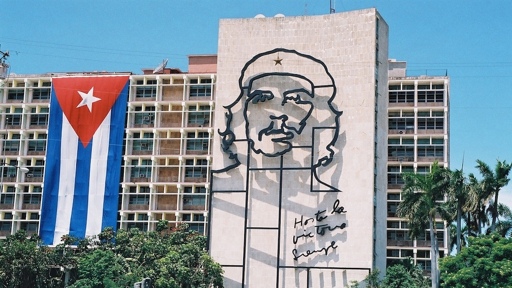
In the aftermath of this operation, Trump triumphantly declared that Cuba was next. To this end, in addition to depriving the island of Venezuelan oil, a lifeline for Cuba in the 21st century, he threatened to increase tariffs on any country that sends hydrocarbons to Cuba. This has provoked a serious humanitarian crisis in Cuba, whose energy grid depends heavily on fuel to function.
Ruiz thus asserts that the war on Cuba appears to be a unifying link for US interests in the region: “Cuba has been inconvenient from the point of view of the US power elite, but not because it poses a threat to US security, far from it, as those same interests often argue. It has been inconvenient because since the triumph of the Revolution in 1959, Cuba has become a beacon of what the United States has been boycotting in Latin America for 200 years: a commitment to recovering sovereignty (political, economic, cultural) that has always been threatened by colonialism and neocolonialism, as well as a permanent effort to build Latin American integration that is not subordinate to the interests of the empire.”
“Although the pretext for suffocating the Cuban people was (and continues to be) the fight against socialism,” Ruiz remarks, “what really terrified the US elites from the beginning of the Revolution was its ability to call on the rest of the region to embark on emancipatory paths of a sovereign and anti-imperialist nature.”
When asked what the United States hopes to achieve with the fall of Cuba’s revolutionary government, the professor at the Central University explained: “In more general terms, a first objective would be to bury once and for all that counter-example that they want to avoid at all costs in a region that, like Latin America, remains particularly important to control.”
Another main objective, Ruiz outlines, is that the US government dreams of somehow replacing the political structures of Cuba with one controlled by the US. This would allow them to “regain control of the island as a space to secure and expand the economic and geopolitical interests of the power factions that currently rule the US. These factions have interests in certain branches of accumulation (both legal and illegal) for which Cuba could be useful: real estate, tourism, casinos, and even drug trafficking. In other words, they would seek to turn Cuba back into what it once represented for the US economy, but under the new conditions of the 21st century.”
Read more: Countries step in to supply oil to Cuba as US considers limited opening of sales
Is it possible to take action in the face of imperialism?
Given this reality, it may seem impossible for progressive and left-wing social and political movements to offer any kind of resistance to US power in relation to Cuba. However, Ruiz believes that, despite being a very complex challenge, it is not impossible: “A first line of action involves the well-founded denunciation of the ongoing aggressions. This denunciation must be accompanied by organization and mobilization in all possible arenas, including the streets, the media, institutional spaces, and parliaments. It is essential to acknowledge that we are currently at a moment in which, in most Latin American countries, progressive movements are on the defensive. So, continuing to defend ourselves against oligarchic and imperial attacks is the number one priority.”
But Ruiz also explains that progressive and left-wing movements must not only resist, but also act proactively: “We should also aspire to change the balance of power so that, where possible, we can regain important areas of power that we had in the not-too-distant past, such as state powers. The challenge now is to do so in broader coalitions than before, including a plurality of social actors who do not necessarily agree on the entirety of a program, but who do converge on its essential aspects of defending national and regional sovereignty, to build a horizon that allows Our America to stand on its own two feet. It is also imperative to resume the project of non-subordinate integration, as well as to maintain measures of solidarity with the countries that suffer most from imperial aggression, as is the case with Cuba at the moment.”
The post “Cuba is where the broader aspirations of the US elite as a whole intersect”: Why the US wants to destroy Cuba appeared first on Peoples Dispatch.
From Peoples Dispatch via this RSS feed