

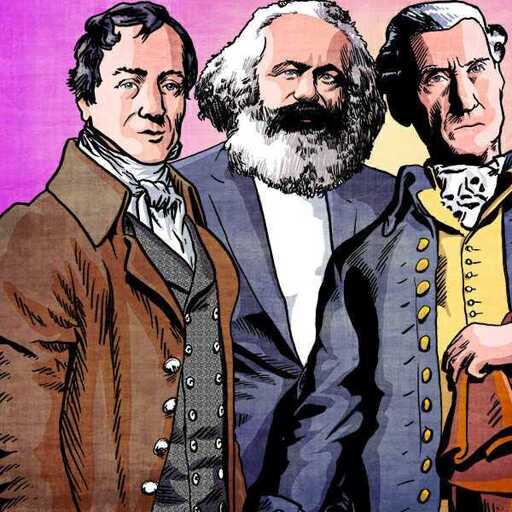
Anyone who’s made it through even the first few pages of Capital knows that Marx thinks the value of a commodity is the average socially necessary labor time it takes to produce it (once we’ve abstracted away from all of the differences between different particular labor processes). While he’s always careful to distinguish between value and actual market price, he doesn’t think that the two are entirely unrelated.
In Ch. 5 n. 24, for example, he writes:
This average price is the guiding light of the merchant or the manufacturer in every undertaking of a lengthy nature. The manufacturer knows that if a long period of time is considered, commodities are sold neither over nor under, but at, their average price. If, therefore, he were at all interested in disinterested thinking, he would formulate the problem of the formation of capital as follows: How can we account for the origin of capital on the assumption that prices are regulated by the average price, i.e. ultimately by the value of the commodities? I say ‘ultimately’ because average prices do not directly coincide with the values of commodities, as Adam Smith, Ricardo, and others believe.
In these few sentences, you can see several conceptual headaches. Marx claims that Smith and Ricardo are overstating the connection between value and even “average” prices. But, he still thinks that values “ultimately” regulate prices. What does “ultimately” mean, and how do we test it? Also, many contemporary Marxists think that what Marx means by “value” is profoundly different from what bourgeois economists like Smith and Ricardo meant, but how do we parse the quote if he doesn’t think he and Smith and Ricardo are all talking about the same thing (although disagreeing about how closely connected that thing is to even average prices)? And most importantly, in so far as Marx thinks labor-time “value” operates as at least some kind of long-term regulating mechanism on average prices, that opens the door for one of the most common anti-Marxist arguments, which goes something like this:
Marxism is based on the Labor Theory of Value (LTV). Marx can’t really be faulted for that, since even great economists like Adam Smith believed it. But he built his entire theory on that foundation, and the foundation is wrong. Since the “marginal revolution” in economics, we’ve known that the underlying mechanism regulating prices isn’t labor time but consumer preferences. So, Marx’s analysis of capitalist exploitation in Capital is fatally flawed.
Marxists have responded to this argument in several ways. Some have thought it was very important to argue against marginalism and defend a traditional understanding of the LTV (because they agree with the anti-Marxist’s initial premise that everything hangs on this question). Others reinterpret Marx’s ideas about value to the point where it’s no longer clear that he and the marginalists are even offering competing theories of the same subject. Still others, like G.A. Cohen or early-career John Roemer, have offered LTV-less reconstructions of some of Marx’s core points about capitalist exploitation. These reconstructions are explicitly presented as revisions of Marx’s arguments—attempts, in other words, to separate the wheat of *Capital’*s core insights from the LTV-chaff.
In my view, all of these responses are misguided (although they aren’t all equally misguided). Instead, the position I’ve come to hold over the course of the last few years of reading and thinking about Capital with different groups of students is that the anti-Marxist argument is wrong about how Marx himself sees the relationship between value and exploitation.
Capital is divided into eight parts. Pt. 1 (“Money and Commodities”) isn’t specifically about capitalism. Instead, it’s about markets and money in general. Those are the building blocks capitalism is made of, although capitalism isn’t the only thing that ever has been or ever might be made of them. In fact, Marx explicitly says (in Ch. 1 n. 15) that for the sake of simplicity, at this “stage of the presentation” he’ll just assume that wage labor doesn’t exist.
Here’s the goofy analogy I usually give my students when we’re thinking about why Marx starts the book this way:
Imagine that, in the far future, humans encounter a race of silicon-based alien monsters. Maybe they eat a bunch of our astronauts. Eventually, though, a couple of the aliens are captured and studied, and a human scientist writes a textbook about them for the use of future explorers. It would made a lot of sense for the first sentence to be “the aliens are made out of silicon” and for the first chapter to be all about the properties of silicon in general, because the most striking difference between these monsters and any other species we’ve ever encountered is that they’re made out of silicon instead of carbon. Similarly, there have been various class systems—various modes of production based on domination and exploitation—before capitalism, but a striking difference is that capitalism is the first one to be made out of market transactions. So, we start with those building blocks.
In Marx’s exploration of markets and money in Pt. 1, the pattern of market transactions he focuses on is C-M-C. Commodities are exchanged for money in order to buy other commodities. Marx doesn’t think the basic dynamics of C-M-C are different on any deep point of principle from C-C (i.e. barter). It’s just a way of more quickly and efficiently exchanging commodities without having to worry about whether the person whose product you’re buying wants the particular commodity you’re selling. For example, a linen-weaver makes 20 yards of linen. He sells the linen for £2 “and then, being a man of the old school, he parts for the £2 in return for a family Bible of the same price.”
Does the Bible salesman want linen? As Marx explains, in a money economy, it doesn’t matter.
The weaver has undoubtedly exchanged his linen for a Bible, his own commodity for someone else’s. But this phenomenon is only true for him. The Bible-pusher, who prefers a warming drink to cold sheets, had no intention of exchanging linen for his Bible; the weaver did not know that wheat had been exchanged for his linen. B’s commodity replaces that of A, but A and B do not mutually exchange their commodities. It may in fact happen that A and B buy from each other, but a particular relationship of this kind is by no means the necessary result of the general conditions of the circulation of commodities. We see here, on the one hand, how the exchange of commodities breaks through all the individual and local limitations of the direct exchange of products, and develops the metabolic process of human labour. On the other hand, there develops a whole network of social connections of natural origin, entirely beyond the control of the human agents. Only because the farmer has sold his wheat is the weaver able to sell his linen, only because the weaver has sold his linen is our rash and intemperate friend able to sell his Bible, and only because the latter already has the water of everlasting life is the distiller able to sell his eau-de-vie [“water of life”]. And so it goes on.
One way of thinking about Marx’s project in Capital is that he’s waging a two-front ideological war against, on the one hand, bourgeois apologists who argue that capitalism can’t be a system of domination and exploitation because its building blocks are voluntary market transactions, and on the other hand, bad critics of capitalism who think that the problem with capitalism is that it does trample the rules of fair exchange—perhaps because market exchanges are mediated through money, which tricks workers and other victims of capitalist processes into making unfair trades. Marx thinks this view (which he associates, for example, with Proudhon) misses the point about the respect in which capitalism is exploitative, so in the opening chapters on the building blocks, before he even looks at how those blocks can be assembled into a capitalist class structure, he argues at length that exchanging a particular useful commodity for money isn’t fundamentally different from exchanging it for any other particular useful commodity (like a Bible, or twenty yards of linen).Money, he argues, is just a commodity that happens to have been promoted to the “universal equivalent” position in an economy. (In other words, it can be exchanged for all the other commodities, which facilitates exchanges like the ones connecting the “Bible pusher” to the “man of the old school.”) In principle, any commodity could fill this role, and Marx has some fun rattling off some of the unusual commodities that have been used as money in various times and places. Still, he thinks, gold and silver have particular properties that make them particularly good candidates for such elevation. They’re easy to divide into small bits and recombine into larger ones. They can be stored for an arbitrarily long time without spoiling. And they (mostly) don’t have any uses other than their power of being exchanged for other commodities—though he notes exceptions like gold being used to fill follow teeth.
Marx is very far from being a market socialist. He takes it for granted that, in the socialist future he has relatively little to say about in Capital (but which he looks forward to with relish the few times he turns to the subject) we’ll be able to plan the entire economy without any remaining need for markets or money.1 But neither does Marx think that the mere existence of widespread market mechanisms is sufficient for the existence of capitalism (although it’s certainly necessary). He would have disagreed with Ellen Meiksins Wood, for example, who said that capitalism is “market dependency.” If everyone was like the self-employed linen-weaver who can’t get a Bible (or, say, food) without selling his linen, but no one was engaged in wage labor, we wouldn’t have capitalism. What makes the relationship between the class of wage laborers and the employing class a relationship of exploitation isn’t that the worker is being ripped off in an unfair transaction (whether due to money-trickery, or some other reason). If we want to find the respect in which capitalism is a system of exploitation, we have to look beyond the building blocks to understand the particular way they’ve been put together under particular, historically specific circumstances.
The first thing that Marx notes in Pt. 2 (“The Transformation of Money Into Capital”) is that capitalists aren’t engaged in C-M-C at all but M-C-M. That is to say, when the capitalist business-owner invests in factory machinery, raw materials, and the wages of his workers, he isn’t “selling in order to buy” but “buying in order to sell.”
In so far as the goal is amassing money, the capitalist resembles a miser. Marx even calls the capitalist a “rational miser” and the miser a “capitalist gone mad.” The key difference between someone stashing their gold in a closet and someone investing it in a business enterprise is that the second plan puts the money itself to work in making more money. In other words, the characteristic “circuit” of capitalist economic activity isn’t just M-C-M (money to commodities to money) but M-C-M’ (money to commodities to more money). If it weren’t, if the capitalist was only trying to get back as much as he invested in the fist place and no more, why expose it to the vagaries of the market? The miser’s plan would be safer.
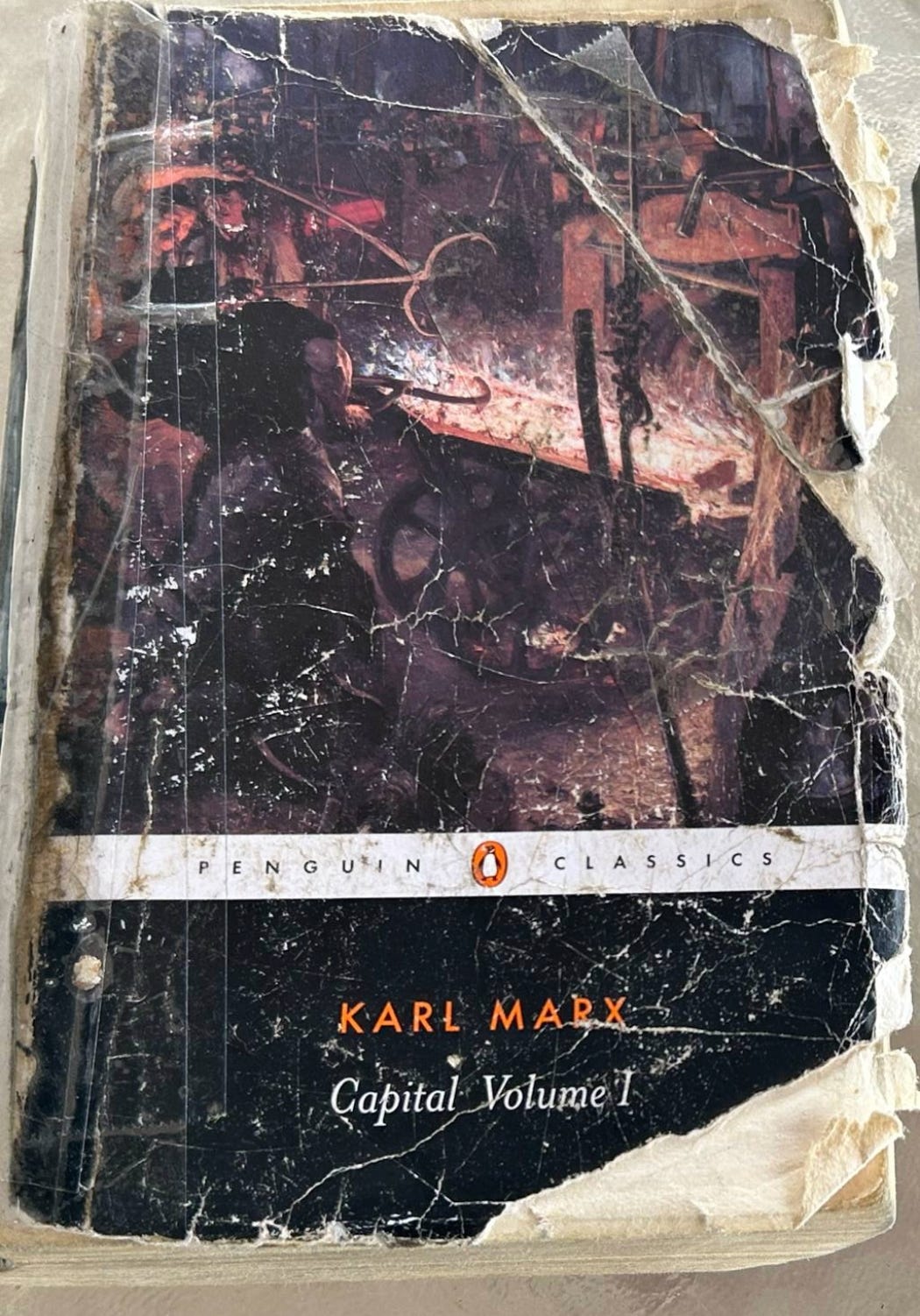
The bourgeois economist assumes that the market transactions M-C-M’ is built out of are fair ones. No one is being ripped off. Marx is happy to accept this for the sake of argument, since he ultimately wants to argue that capitalism is (a) based on exploitation (contra the bourgeois apologists) and that (b) this exploitation isn’t a matter of unequal exchange (contra the system’s bad critics). If so, though, where could the ΔM (the difference between the original M and the eventual M’) arise?
Marx spends some time in these chapters poking fun at bourgeois economists who play up the fact that market exchanges can be mutually beneficial (in the sense that both parties end up with commodities that are more personally useful to them than the ones they started with) as if that explained the source of the ΔM. Marx certainly doesn’t deny that exchanges can be mutually beneficial in this sense. He just points out that this doesn’t mean that they can be mutually beneficial in the sense that, as a result of an exchange and nothing else happening, both parties can end up with more money in their bank accounts than they had at the outset. In that sense, no, exchanges can’t be mutually beneficial.
What if we drop the assumption that the market exchanges M-C-M’ is built out of adhere to the norms of market fairness, and assume that people are getting ripped off left and right? Marx thinks this won’t help. He doesn’t deny that some capitalists are better at business than others, and may succeed in buying low and selling high, or even that individuals can get the better of their competitors on enough deals over the course of a career to become individually wealthy in this way. But he denies that this can explain how the capitalist class as a whole turns its collective M into M’. “The capitalist class, of a given country, cannot defraud itself.”
In principle, I suppose, it’s possible that they could defraud some equally numerous and previously wealthy class of non-capitalists, but at any rate that’s very clearly not what happened in the decades or centuries leading up to the publication of Capital. In societies like Victorian England, the descendants of small-holding peasants may have been poorer than their ancestors, but the wealth of the capitalist class of that society was far greater than anything that could be explained by that difference alone. Something else was going on.
As Pt. 2 draws to a close, Marx argues that the “something else” is labor exploitation. The key conceptual breakthrough here is the insight, which he credits Thomas Hobbes in a footnote for arriving at a couple centuries before Capital, that what the worker is really selling in the labor market isn’t his “labor” per se but (in Hobbes’s formulation in The Leviathan) “the use of his power.” A self-employed ice cream salesman is selling each customer a cone of ice cream. The employee at an ice-cream shop is selling his only customer (the shop-owner) the use of his labor for a certain period of time—something different, Marx notes, from what the person who sells himself into slavery is selling only in so far as he only sells a certain time-slice of it, and it thus continually reverts to him so he can sell it again and again.
Several decades after Capital and on the other side of the ocean, “Big Bill” Haywood’s Industrial Workers of the World (IWW) represented the radical wing of the labor movement while Samuel Gompers’s American Federation of Labor (AFL) represented the moderate wing. The slogan of the moderate craft unionists of the AFL was “a fair day’s wage for a fair day’s work” whereas the socialists and anarchists of the IWW saw their long-term goal as “the abolition of the wages system.” The first is a call for the norms of market fairness to be respected in labor-market transactions. The latter is a call for a society in which labor power is no longer a commodity that workers have to sell to capitalists to survive.
Some critics of capitalism might sneer that the AFL’s goal was impossible. This commodity can’t be purchased at a fair price. Their assumption is that the capitalist can only make money by ripping the worker off in this transaction—that if the worker was paid in full for what he was selling, the capitalist’s profits would simply disappear. Marx disagrees.
In fact, if “a fair day’s work at a fair day’s wage” means that the worker diligently carries out his assigned task, recognizing the capitalist as the owner of his day’s labor-power, and in return the capitalist pays a wage that amounts to whatever counts as “making a decent living” in a particular culture at a particular stage in history, then one way of seeing Marx’s point at the end of Pt. 2 about why labor power is a “peculiar commodity” is that all of the following can be true:
the capitalist uses part of his initial M to buy the workers’ labor power at this price, and then
uses the worker (in combination with the physical means of production, produced by previous workers, the capitalist invests the remainder of M in) to produce goods and services that can be sold for M’,
and thus pockets the ΔM
without any violation of the norms of market fairness so beloved by both the apologists and the bad critics.
In a famous but often misunderstood line in Pt. 3, Marx says that the fact that capitalists can buy a full day of labor power at the fair price defined above, and that it only takes part of the day to reproduce those wages (and so, in a sense, the capitalist buyers get the rest for free), is “is a piece of good luck for the buyer, but by no means an injustice towards the seller.”
This sentence confuses a lot of readers because they assume “by no means an injustice” means “not normatively objectionable in any way,” which is very obviously not Marx’s position. Capital is overflowing with passages where Marx compares capitalist exploitation to theft, extortion, serfdom, slavery, or the tribute demanded by a foreign conqueror. What he’s denying is that it’s an an unjust exchange—one that would violate the norms of market fairness. He doesn’t want to use those norms to criticize capitalism. Indeed, he thinks that to overcome capitalism and arrive at a better society we’ll have to trample all over those norms (by expropriating the capitalists’ property). Instead, he thinks that to see what’s objectionable about wage labor, we have to leave the sphere of exchange entirely and descend into the infernal depths of “the hidden abode of production, on whose threshold there hangs the notice ‘No admittance except on business’.” If we focus all our attention on the sphere of exchange, as bourgeois apologists prefer to, capitalist markets seem like “the very Eden of the rights of man.”
But:
When we leave this sphere of simple circulation or the exchange of commodities, which provides the ‘free-trader vulgaris’ with his views, his concepts and the standard by which he judges the society of capital and wage-labour, a certain change takes place, or so it appears, in the physiognomy of our dramatis personae. He who was previously the money-owner now strides out in front as a capitalist; the possessor of labour-power follows as his worker. The one smirks self-importantly and is intent on business; the other is timid and holds back, like someone who has brought his own hide to market and now has nothing else to expect but – a tanning.
Parts 3-7 add up to a sustained exploration of how the tanning happens and what else happens as a result. In Pt. 3, he explores the analogy between capitalism and feudalism. Under feudalism, there’s an undisguised division of the serf’s time into weeks they’re working to meet their own needs and weeks they have to do corvée labor for their lord. In other systems, he says, this division of time between “necessary labor” and “surplus labor” still exists but it isn’t out in the open.
“What distinguishes the various economic formations of society – the distinction between for example a society based on slave-labour and a society based on wage-labour – is the form in which this surplus labour is in each case extorted from the immediate producer, the worker.” Slaves appear to do only surplus labor, but of course the resources used to feed and clothe and shelter slaves need to come from somewhere, and in a slave-based economy, where would they come from but the labor of the slaves themselves? Under capitalism, the misleading appearance is the other way around. Every hour appears to be compensated, and in that sense to be labor the worker is doing for himself. But as a matter of fact, if the worker spends X hours making Y products (whether “goods” or “services”) that the capitalist sells for Z revenue, and the workers wages only represent half of Z, then X is evenly divided between hours of necessary labor and hours of surplus labor.
The most obvious way for the capitalist to increase the number of hours of surplus labor he’s squeezing out of the worker is to simply increase the workers’ hours. In Pt. 3, we get a series of diagrams representing different working days:
Working day I: A - - - - - - B - C
Working day II: A - - - - - - B - - - C
Working day III: A - - - - - - B - - - - - - C
In every case, the length from A to B (the hours the worker spends reproducing his wages) is exactly the same. Holding that assumption constant, the longer the capitalist can stretch the overall time from A to C, the more time from B to C, and hence the higher the capitalist’s profits. When we remember that capitalists (unlike feudal aristocrats, for example) are in market competition with each other, we get a grim result. There’s obviously a sense in which what Marxists call “the bourgeois revolution” (the transition from pre-capitalist forms of exploitation to capitalism) is a massive step in the direction of greater human freedom. But the capitalists have a far greater incentive to step up the rate of exploitation than their feudal predecessors. Medieval aristocrats were only trying to extract enough surplus labor to keep themselves and their families and retainers living in luxury. Capitalists striving to out-compete their competitors have what Marx calls a boundless, “vampire-like” thirst (or, at one point, a “werewolf-like hunger”) for more surplus.2 This leads to the many horrors Marx chronicles in his long and lurid historical explorations of the expansion of the working day during the rise of capitalism in Britain, and ultimately to the legal limits on the working day he portrays as a magnificent victory in the class war (although what a great victory looked like in that context was that working hours would now ‘only’ be ten hours a day, six days a week).
Of course, expanding the working day isn’t the capitalist’s only mechanism for extracting more surplus labor from proletarians. Until almost the end of the book, Marx mostly ignores the obvious mechanism of pushing wage levels down below the fair price defined above, because he wants to show that everything he’s describing would be true even if the norms of market exchange were followed scrupulously. But he spends Pt. 4 exploring ways that capitalists can expand the hours of surplus labor not by expanding the absolute gap between A and C, but by going from:
A----------B—C
…to:
A---------B’-B–C
…where the hours of necessary labor no longer go all the way from A to B, but only from A to B’. This can happen if capitalists revolutionize the production process, which can happen in a variety of ways. Formerly independent artisans who have been turned into capitalist employees (but who are otherwise producing exactly the way they did before) can be brought together under one roof. Capitalists can introduce a division of labor to making production more efficient. And they can introduce new technology. All of this means that it takes workers fewer hours to produce goods and services that sell for the equivalent of their wages, and more time to produce the ones that become the capitalist’s profits.
Many otherwise bright people (Keynes! Bill Gates!) have predicted that technological progress would, all by itself, reduce the working week. In The Jetsons, George complains to his (stay at home!) wife that his boss Mr. Spacely is making him work for three hours a day during the Christmas rush. The joke relies on viewers getting that this would (of course!) be an unusually long workday in such a high-tech future.
But real life hasn’t been kind to any of this. In the United States, the 40-hour week was set by the Fair Labor Standards Act in 1938 and it hasn’t gone down by one lousy minute since then. That’s certainly not because technological progress stopped in 1938. And befuddled articles in the business press keep reporting that the widespread use of AI has led to office workers working more instead of less.
None of this would be confusing to anyone who’d read and absorbed Pt. 4 of Capital. Marx is optimistic about the liberatory potential of technological progress in a communist future, but under capitalism, he argues, it always leads to some people losing their jobs while others have to work as many hours as ever. In fact, in the largely unregulated capitalism of his time, it led to the widespread introduction of child labor, since jobs that formerly had to be done by big burly guys could be done by smaller people with frailer bodies. It even led the longer working day for the big burly guys, who could now stay at their stations longer without collapsing from exhaustion.
In Pt. 5, the basic arguments about these two forms of surplus-extraction are remixed in a slightly different way, and in Pt. 6 Marx explores the way that different forms of wages (time wages, piece wages, etc.) might obscure the operations of capitalist exploitation. (He argues that, however any given boss has arranged your wages, the underlying commodity being sold is always labor power.) In Pt. 7, he explores the distinction between the “simple reproduction” of capital (where at the end of each M-C-M’ cycle the capitalist just needs to reinvest enough profit for exactly as much M in the next round as the last one) and “accumulation” (where more and more is reinvested every time, so capitalists can go from M to M’ to M’’ to M’’’). Accumulation, of course, is what actually makes the capitalist world go round, and in Pt. 7 Marx predicts that the imperatives of competitive accumulation will lead capitalists over time to invest less of their capital in human labor power and more in machines.3 This is one of the reasons his model predicts that capitalism, at least all else being equal, will generate immense wealth at one pole of society and immense misery at the other.
Finally, in Pt. 8, Marx turns to the historical emergence of capitalism. It’s important to him to save this for last. He thinks the combination of a distribution of property that gives you a large population desperate enough to sell their working hours to capitalists with normal market mechanisms that obey the norms of market fairness is enough to get you his whole model of how capitalist exploitation works and what its consequences are. It’s important to him that this doesn’t depend in any way on capitalist property relations having been born in sin. If the system was immaculately birthed, with the capitalists (as Marx says in Pt. 7) getting the initial sum of M invested in the first round of M-C-M’ from their own toil “and that of their forefathers,” it would still be a class structure based on domination and exploitation, liable to give rise to all the miserable human consequences explored in Capital.
At the same time, though, he isn’t willing to just grant the bourgeois apologists the premise that capitalism did come about that way. If all the capitalists really were descended from particularly hard-working people and all the proletarians from particularly lazy people, this would be a piss-poor excuse for current economic realities, but Marx won’t let the apologists have even that excuse, and so Pt. 8 is about the enclosures that drove the ancestors of the British proletariat off their ancestral lands, the laws persecuting paupers, and all the other ways that in real history “capital comes dripping from head to toe, from every pore, with blood and dirt.”
Moving to a better system, he concludes, will involve “the expropriation of the expropriators,” a process he hopes will be shorter and less bloody than the transition to capitalism itself was, because that “was a matter of the expropriation of the mass of the people by a few usurpers” while the transition to socialism will consist in “the expropriation of a few usurpers by the mass of the people.”
In the last chapter of the book, Marx explores the possibility that the proletariat of the old world can find a better life by emigrating to the colonies, or to the United States. This option, he concludes, is increasingly off the table. As he writes, new land for free-holding settlement is drying up and working-class immiseration is operating in those places too. Stay and fight, or go over there and fight, but it’s all going to be the same class struggle.
Necessarily, a four-thousand word summary of a 980-page book is going to exclude an awful lot, including a lot that matters (even for filling in the gaps in the argument captured here). I do think, though, that I’ve followed the most important thread of Marx’s argument. And I haven’t used the word “value” once.
While I don’t think I’ve actually distorted or revised any of the points of that central argument, I certainly have used different language. “Fair price” was an attempt to capture the most important function in context of Marx’s talk of commodities being sold at their full “value,” and “norms of market fairness” was my way of capturing the “law of exchange” that Marx explains in terms of value being traded for equal value. I obviously don’t claim that this captures everything that Marx is talking about in those passages. I do, however, claim that this is an important part of his point, as he argues against apologists and bad critics who think the crucial issue is whether value is being traded for equal value in capitalist markets. And one thing I haven’t done, even once, explicitly or implicitly, whether in Marx’s language or in my own paraphrase, is say a single word about how market prices are actually formed. You just don’t need that to capture the main thread of Marx’s argument in Capital Vol. 1.
There are other places (e.g. in Vol. 2!) where he explores different economic subjects, and the value-talk plays different roles. But in Vol. 1, which is where his primary analysis of the basic dynamics of capitalist exploitation happens, the main role played by all the value-talk is in Marx’s argument that capitalism is based on exploitation even if everything is sold at its full value. (So, the “fair price” of labor power I mentioned earlier is, for Marx, the price that corresponds to the average socially necessary labor time it takes to produce labor power, by which he means that it takes to produce the commodities workers need to buy in order to maintain themselves at a given historically defined level of subsistence.) What he absolutely does not need to make any of the arguments I’ve summarized above is the empirical premise that everything is sold at its full value. Indeed, as we saw in the opening quotation about average prices, Marx doesn’t think that. And he’s particularly aware that labor power isn’t always sold at its full value. In fact, in his argument about working-class immiseration in Pt. 7 he goes out of his way to note that capitalists desperate to out-accumulate their competitors have every incentive in the world to drive wages below the value of labor power as he’s defined it. His claim was never that they don’t or won’t do this, but that we don’t need the claim that they’ve done so to make sense of capitalist exploitation.
To the extent that sophisticated bourgeois apologists in 2026 are marginalists who have no interest in talking about fair and unfair prices (they think a legitimate price is simply whatever the other person is willing to pay), that certainly reduces the importance of the argument that workers can be exploited without being ripped off, or at least its importance in arguments with those sophisticated apologists, because “not being ripped off” in a market transaction is, by their lights, pretty trivial. Then again, I suspect that the vast majority of ordinary people do think there can be such things as fair and unfair prices, and don’t at all foreclose the possibility that participants in market transactions unmarred by force or fraud can nevertheless be gouged. So arguing to them that Marx’s model of exploitation can apply even when market norms are being respected might still be interesting or important.
Either way, Marx’s claims that workers are forced by the “mute compulsion” of their economic circumstances to sell themselves to capitalists, that what they’re selling is their labor power, that some but not all of the working day is spent reproducing workers’ wages, that capitalists have a powerful incentive (which previous exploiters didn’t) to extend the surplus part of the producers’ working time, that automation won’t lead to lower working hours as long as capitalist property relations persist, that capitalism will, all else being equal, lead to working-class immiseration, and etc., all go through just fine whatever you say about the value-theory assumptions that Marx shared with predecessors like Smith and Ricardo.
There are certainly ways you could criticize some or all of conclusions I’ve just rattled off that have nothing to do with the value debates. You could, for example, argue that rising living standards since 1867 disprove the “immiseration thesis.” For the record, I disagree. My own view is that, while…
all of this really is complicated by the rise of certain professional and managerial layers in advanced corporate capitalism,
and changing technology does have some impact on setting society’s floor,
and I’m sure you could talk me into several other such caveats
…Marx’s picture in Capital remains a largely correct model of capitalism in its “raw” state, before the welfare state and the regulatory state and the labor movement have sanded off some of the rough edges. And the capitalist class will take every political opportunity they can to nudge us back in the direction of raw capitalism. In other words, I think the correct answer to “OK, but things are better now” is “well, they are as long as we keep taking our medicine.” We’ve controlled some of the symptoms. We haven’t cured the disease.
Obviously these are big substantive claims. There’s lots of room for argument there. But whatever you make of the rest of that, it does seem to me that the standard anti-Marxist argument we started with doesn’t survive sustained engagement with what Marx actually says Capital.Notice too that I haven’t taken a position one way or the other on the empirical question about the LTV and marginalism. Those are complicated, messy debates I have no interest in trying to settle here. Whatever you think about those debates, though, it seems to me that the right answer to the question of how much of Marx’s central argument in Capital would survive simply giving up on the premise that average prices “ultimately” reflect labor-time values is “almost all of it.”
Thanks for reading Philosophy for the People w/Ben Burgis! This post is public so feel free to share it.
The economic history of the flawed socialist experiments that played out in the twentieth century isn’t encouraging on this front, which is one of the reasons why I’m less optimistic than Marx was about our ability to completely transcend markets any time soon. Nevertheless, I think we can completely transcend capitalist property relations. Bhaskar Sunkara, Mike Beggs, and I wrote a book about how a logistically feasible version of a fully socialist society might work that’s coming out this fall. You can pre-order it here, or read a preview of some of the key arguments here. In any case, Marx himself, having died decades before the Russian Revolution, can be forgiven for having failing to have grappled with the issue.
The absolute worst option for producers, Marx notes, is pre-capitalist relations of production are combined with production for the world market and all the competitive pressures that come with it. That way, you have the “vampire-like thirst” but you don’t even have a right to quit. Marx discusses the Danubian principalities as an example of a feudal-capitalist hybrid, and the antebellum American South for the slave version.
Just over the course of the last few years, I’ve noticed that the reception of this prediction by students has changed pretty sharply. It used to be, “gosh, that’s interesting, I wonder if that’s true, let’s think about examples” and now I can’t get the basic point out of my mouth without students starting to laugh in recognition, because they can’t open a news site without seeing examples of that tendency at work.
From Philosophy for the People w/Ben Burgis via this RSS feed
You must log in or # to comment.