
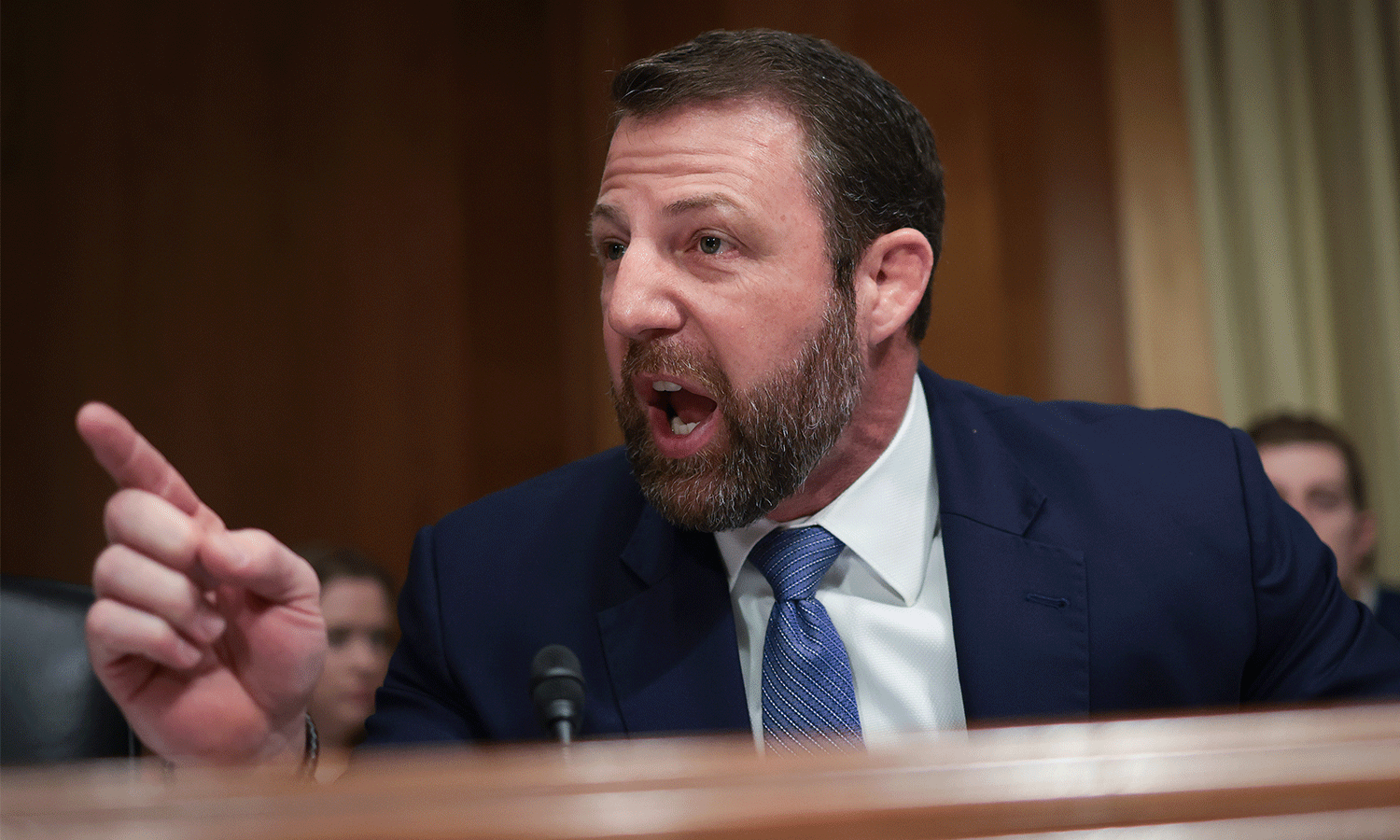
Senator Markwayne Mullin Is Unqualified to run DHS and its Nine Agencies, Including Diminished FEMA
On March 18, the Senate Homeland Security and Government Affairs Committee will hold a confirmation hearing for Senator Markwayne Mullin, a Republican from Oklahoma—President Trump’s nominee for secretary of the Department of Homeland Security (DHS). A vote will follow the next day, when by all accounts he’ll likely be confirmed even though the Senator is uniquely unqualified to lead the third largest federal department with a half a million employees, nine agencies including ICE, FEMA and the Coast Guard among others, and roughly a $100 billion budget.
The Union of Concerned Scientists (UCS) strongly opposes Senator Mullin’s nomination, and we ask members of the committee to thoroughly interrogate his qualifications and vote no on Thursday.
If confirmed, Senator Mullin would be yet another unqualified member of President Trump’s particularly unqualified cabinet. Senator Mullin could be counted on to continue the same harmful, destructive leadership as his fired predecessor, Kristi Noem, who has been called “the worst DHS Secretary since the agency was formed.” Secretary Noem implemented vicious and deadly immigration policies and called for FEMA to be dismantled, leaving the agency in disarray. We can’t afford to let this happen.
It’s critical that senators closely examine Senator Mullin’s qualifications to run DHS and question him regarding the damage done by his predecessor’s extreme, destructive agenda.
Senator Mullin uniquely unqualified to lead DHS
Senator Mullin represented Eastern Oklahoma in the US House of Representatives from 2013 until 2023, when he was elected to the US Senate. Senator Mullin has little to no professional experience that makes him qualified to be Secretary of DHS and it is unlikely that he would lead the department in a way that serves the public interest. He has no experience in national security, immigration policy, or emergency management and does not serve on the Senate Homeland Security Committee.
He has, however,
Been on the record as a climate denier as climate change is accelerating and driving more costly and disruptive extreme weather and disasters nationwide, while receiving more than $1.4 million in fossil fuel industry contributions.
Backed extreme immigration policies in Congress, such as defending violent actions after immigration agents fatally shot Alex Pretti and Renee Good in Minneapolis, Senator Mullin defended the officers and criticized the victims.
Reportedly used insider knowledge as a member of the US Armed Services Committee to make considerable financial gains to his stock portfolio, increasing his jaw-dropping $66 million net worth which makes him the fourth-richest Senator in Congress.
Voted against certifying the 2020 elections and defended the pardon of the January 6 rioters.
Questions senators should ask Senator Mullin
There are questions galore to ask Senator Mullin, particularly about deadly, inhumane, unconstitutional actions taken by ICE. Because I am a senior climate resilience policy analyst who works on safeguarding communities from climate change-related risks and impacts, my focus here is on how the senator would manage FEMA on disaster preparedness, response, and recovery.
There were 23 separate billion-dollar extreme weather and climate change-related disasters last year. Recent reports find that global warming is accelerating and the impacts are playing out before our eyes with more frequent and intense flooding, extreme heat, and wildfires. Secretary Noem is leaving FEMA ill-prepared for the upcoming Atlantic Hurricane season that begins this June.
Here are the questions that I hope members of the Senate Homeland Security and Government Affairs Committee will ask Senator Mullin that reflect my top concerns regarding FEMA:
Will you continue to implement the goal of President Trump and former Secretary Noem to dismantle FEMA, or will you implement badly needed measures to ensure that FEMA fulfills its essential role and functions?
One year ago, former Secretary Noem called for FEMA to be eliminated and then walked it back to say the agency should be dismantled. Noem in many ways met this goal by severely reducing staff by 20%, draining much of the expertise at FEMA headquarters and cutting Cadre of On‑Call Response and Recovery (CORE) staff with plans for 41% cuts in the CORE team, causing a bottleneck on spending approvals, delaying disaster assistance and generally creating a hostile work environment. Based on Senator Mullin’s record, I’m doubtful that he’ll defend FEMA against President Trump’s attacks on the agency.
The Union of Concerned Scientists submitted comments to the FEMA review council offering five major buckets of reforms the council should consider, including: 1) Strengthen FEMA and its internal systems; 2) Improve FEMA’s role in disaster response and recovery; 3) Restore resilience programs; 4) Advocate for modernization and reform of National Flood Insurance Program; and 5) Restore climate and equity to all FEMA standards, programs and guidance. Strengthening FEMA requires hiring and rehiring staff, returning FEMA to a cabinet-level agency and nominating a qualified FEMA administrator.
If Senator Mullin is confirmed, his first order of business must be to repeal former Secretary Noem’s requirement to review expenditures over $100,000, largely disliked by members on both sides of the aisle who want to see funding allocations speed up significantly to better help communities recover and shore up their resilience efforts.
Unfortunately, this won’t necessarily change the policies under this administration that push state and local governments to take on more of the costs of disaster response and recovery. This could mean fewer disaster declarations which would hurt those states and local governments with the least resources and those that have been hit with back-to-back disasters the most. While the impacts of such policies could be felt broadly, historically disadvantaged communities, rural areas, people with disabilities and the elderly will be hurt first and worst.
FEMA has obstructed Congress’ oversight responsibilities by failing to respond to congressional requests for information. Will you ensure transparent and prompt responses to congressional oversight of DHS and FEMA?
Earlier this month, Senator Welch co-authored a letter to the DHS inspector general (IG) with four other Senators asking the IG to investigate all complaints into FEMA. The letter speaks to how FEMA whistleblowers have been retaliated against and the lack of a Senate-confirmed FEMA administrator is “fueling widespread employee uncertainty and policy whiplash.” Last summer, many concerns such as these and more rose to such a level that former and current FEMA staff signed a letter to Congress titled the Katrina Declaration to raise alarm that many of the safeguards put into place by Post-Katrina Emergency Management Reform Act of 2006 were not holding up.
How will you handle political standoffs such as what is going on currently with the DHS budget given the critical need to fund FEMA, among other agencies, as the Atlantic hurricane season approaches?
It’s very concerning that FEMA’s Disaster Relief Fund (DRF) is running low and that it’s caught up in the Department of Homeland Security (DHS)-specific shutdown. Typically, FEMA can withstand these types of funding dips but we’re not talking normal times. The Trump administration has delayed and denied disaster assistance even as communities are still recovering from the record 2024 wildfires and hurricanes and as the Atlantic Hurricane season approaches, it’s essential that FEMA’s mission is protected and concerns about FEMA funding are not used to justify continued funding for DHS without significant reform. The DHS budget fight and issues with former Secretary Noem underscore why FEMA should be re-established as an independent, cabinet-level agency and why it’s long overdue for the president to nominate a FEMA administrator with the requisite emergency management qualifications.
Will you advise against President Trump’s illegal cancellation of federal grants, withholding and delaying FEMA disaster assistance and continued use of FEMA and other DHS resources to support mass deportations, or withhold them to punish states and localities that refuse to participate in them without due process?
The federal government watchdogs, the US Government Accountability Office (GAO) found that former Secretary Noem violated the Impoundment Control Act (ICA) by withholding or delaying the allocation of funding for FEMA programs including the Emergency Food and Shelter Program, the Shelter and Services Program, and the Next Generation Warning System Grants Program.
The Trump administration illegally canceled the Building Resilient Infrastructure and Communities (BRIC) program that US District Court Judge Stearns has ordered FEMA to reinstate for the second time. The administration also rescinded the Federal Flood Risk Management Standard (FFRMS) that simply ensured federally funded projects would be built to withstand future flooding, saving federal taxpayer dollars.
Denials and delays in approval of disaster declarations and cost-sharing with the federal government have added a layer of uncertainty in local and state government budget planning at a time when these local officials are already feeling the impacts of President Trump’s One Big Beautiful Bill Act (OBBBA) passed last July.
It’s a Catch-22 when states and local governments need to invest in climate adaptation to be more resilient to climate change while much of the funding they rely on comes from the federal government. A year ago, President Trump released an executive order that called for pushing the burden of disaster response and recovery on to states and local governments, among other things. Most state and local governments don’t have the resources to invest in adequate levels of resilience.
We need close oversight of the acting FEMA administrator and the new DHS secretary to ensure the essential funding in the Disaster Recovery Fund isn’t diverted towards other accounts, which has happened previously under this administration.
With the impacts of fossil-fueled climate change accelerating, DHS needs a qualified and steady hand at the helm
Congress must ensure the March 18 confirmation hearing is not a sham. Senator Markwayne Mullin lacks qualifications to lead homeland security, much less FEMA.
As extreme weather and disasters are increasingly showing up in people’s everyday lives, communities across the nation need a qualified and steady leader at DHS.
Senator Mullin has vowed to be open to listening to his colleagues on both sides of the aisle, however his actions to date have proven his allegiance to President Trump and this does not bode well for disaster victims who continue to wait on assistance, the DHS agency staff not being paid during the budget shutdown, or for communities that have suffered at the hands of ICE.
The Union of Concerned Scientists strongly opposes Senator Mullin as the nominee for DHS, and we ask members of the Senate’s Homeland Security and Government Affairs Committee to vote NO on this nomination.
From The Equation via this RSS feed
You must log in or # to comment.