

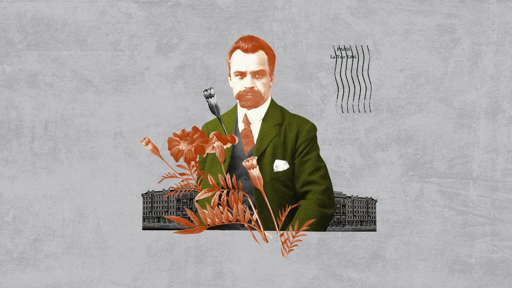
Editor’s Note: This story is part of the “Hidden Canon” – a special series celebrating Ukrainian classic literature and aiming to bring it to a wider international audience. The series is supported by the Ukrainian Institute.
Like many intellectuals shaped by the turmoil of the early 20th century, Ukrainian author and statesman Volodymyr Vynnychenko was an idealist. He dreamed not just of political reform in Ukraine, but of a radical new path for humanity — one liberated from the compromises and hypocrisies of the old world order.
“Vynnychenko had his own philosophy and ethics, which he called concordism, and at one stage ‘honesty with oneself’,” Ukrainian literary scholar Tamara Hundorova told the Kyiv Independent.
“Essentially, it is a very hybrid utopia, combining ideas of vitalism, natural philosophy, Darwinism, and the philosophy of life, along with socialist utopias.” (Vynnychenko’s concordism is not to be confused with the wider-known concordism — the concept that suggests that religion and science agree).
Born in 1880 in central Ukraine, then part of the Russian Empire, Vynnychenko came from a peasant family and rose quickly up in the revolutionary intelligentsia. From an early age, he was monitored and repeatedly detained by Russian imperial authorities for his political activities. After the collapse of the Russian Empire, amid Ukraine’s push for independence, Vynnychenko served as the head of the General Secretariat (Ukraine’s de facto prime minister) and later as leader of the Directory of the Ukrainian People’s Republic.
But the independence he helped declare was short-lived, undone by war, internal divisions amid Ukraine’s leadership, and the advance of Bolshevik forces.
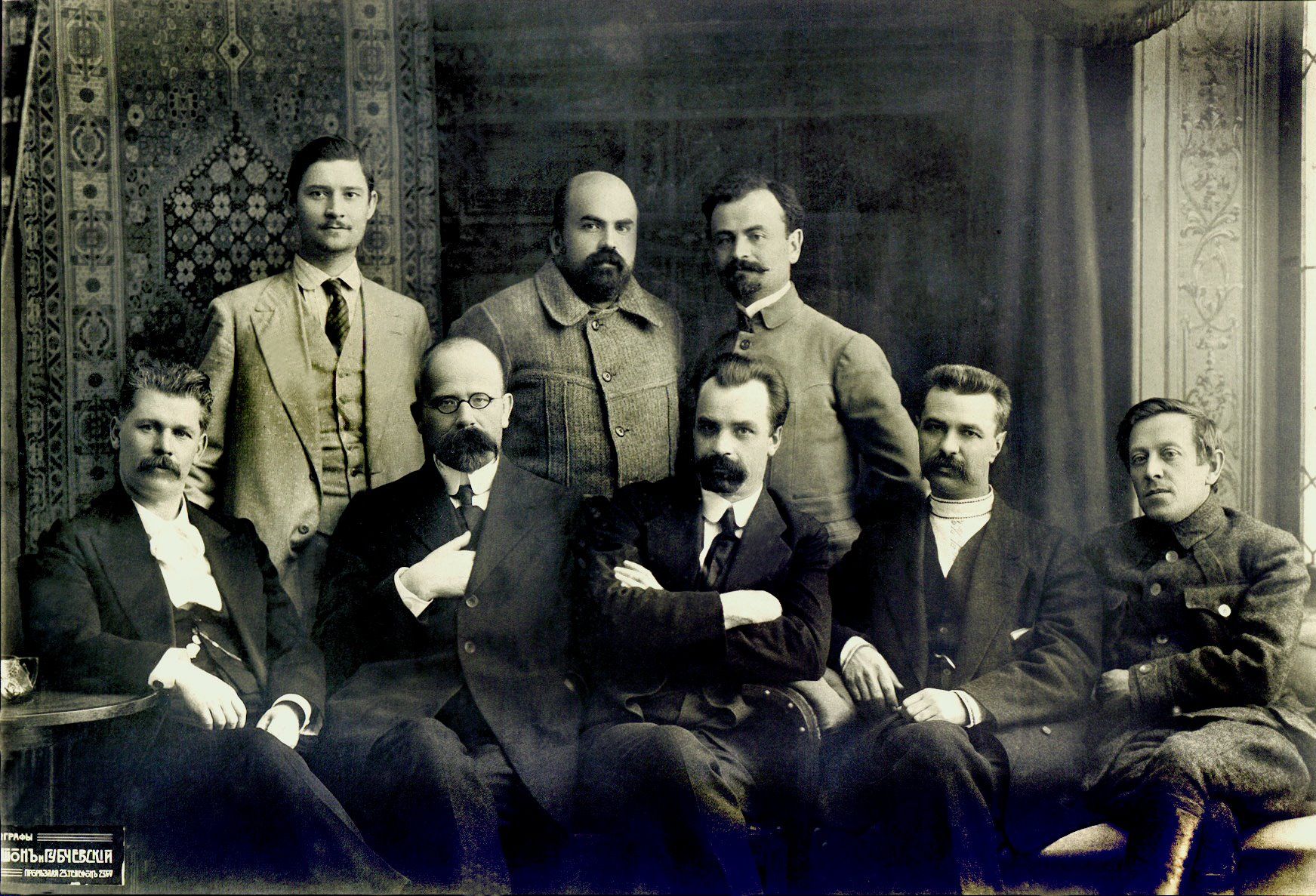
Members of the first General Secretariat of the Central Rada pose for a group portrait in Kyiv, Ukraine, in 1917. Standing (L-R): Pavlo Khrystiuk, Mykola Stasiuk, Borys Martos. Seated (L-R): Ivan Steshenko, Khrystofor Baranovskyi, Volodymyr Vynnychenko, Serhii Yefremov, Symon Petliura. (Wikimedia)
Vynnychenko’s ideas were eclectic, arguably more driven by a sense of urgency than dogma. He engaged Marxist thought for what he saw as its promise to address the crises of his era and secure Ukraine’s place in a changing world.
At the same time, Vynnychenko was sharply attuned to what he saw as the persistence of imperial habits within the supposedly internationalist culture of the Russian revolutionary intelligentsia. Despite the Bolsheviks’ rhetoric of proletarian solidarity, Ukraine was still treated not as an equal partner, but as a peripheral group to be managed and even outright surpressed.
“You are the first representative of the so called ‘progressive’ Russian intelligentsia, who so overtly and daringly snatched off the fig-leaf of silence with which the Russian intelligentsia has always covered the zoological nakedness of tsarist despotism concerning the Ukrainian issue,” Vynnychenko wrote in an open letter to Russian author Maxim Gorky in 1928.
The letter was sparked by Gorky’s refusal to allow his work to be translated into Ukrainian, having dismissed the language as merely a “dialect,” and accusing those who sought to elevate it as indulging in provincialism.
“Vynnychenko, it seems, belonged to that species of human being that cannot live without a utopia.”
Vynnychenko is also known for famously declaring that “Russian democracy ends where Ukraine begins,” which was spurred by failed negotiations with the Russian Bolsheviks in 1917.
So why did he believe for so long that it was possible to negotiate with the Bolsheviks? As Ukrainian historian Ivan Rudnytsky noted, Vynnychenko was drawn to Marxism less for its claim to practical rigor than for its utopian vision. Unlike many Marxists, he did not arrive at these ideas through deep engagement with the philosophical traditions behind them, according to Rudnytsky. What he embraced instead was Marxism’s moral and imaginative power: a language for naming injustice and, more importantly, for imagining its abolition.
“Vynnychenko, it seems, belonged to that species of human being that cannot live without a utopia,” Rudnytsky writes.
“Perhaps it is because he rejected the idea of a transcendent absolute so vehemently that he could not do without the belief in an earthly divinity, in the image of an ideal future society. When Marxism failed to satisfy him (later on in life), he immediately began fashioning his own personal utopia.”
Following all his setbacks as a statesman, Vynnychenko went into permanent exile in the fall of 1920.
“I shake off all the dust of politics, surround myself with books, and plunge into my real, only business — literature,” he wrote in his diary. Once an architect of Ukraine’s independence, he ultimately traded political intrigue for philosophical reflection and farming land in the south of France.
For the Ukrainian community in exile, Vynnychenko during this period was at times quixotic. If he could not achieve an ideal world through his politics, he tried to do it through his own personal actions. He followed a strict daily regimen, and, with his wife, gave up alcohol, tobacco, and meat. But discipline proved harder to apply to the heart: his romantic entanglements resisted any system of control.
While these experiments did little to boost his reputation as a politician, they opened new paths in his writing. In exile, unburdened by the pressures of political life, Vynnychenko turned to fiction. He created works of philosophical and science fiction, the latter of which remains, even today, somewhat marginal in Ukrainian literature.
Arguably his most ambitious work is the science fiction novel “Solar Machine” (1928). Set in Germany, it follows an inventor, Rudolf, who discovers a strange “solar mineral” called helionite. When exposed to sunlight, it can turn organic matter into nourishment he calls “solar bread.”
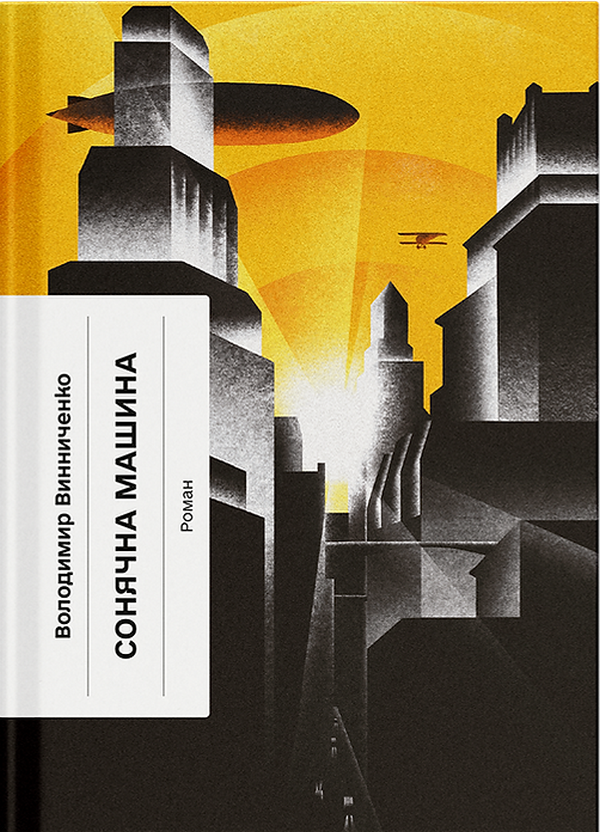
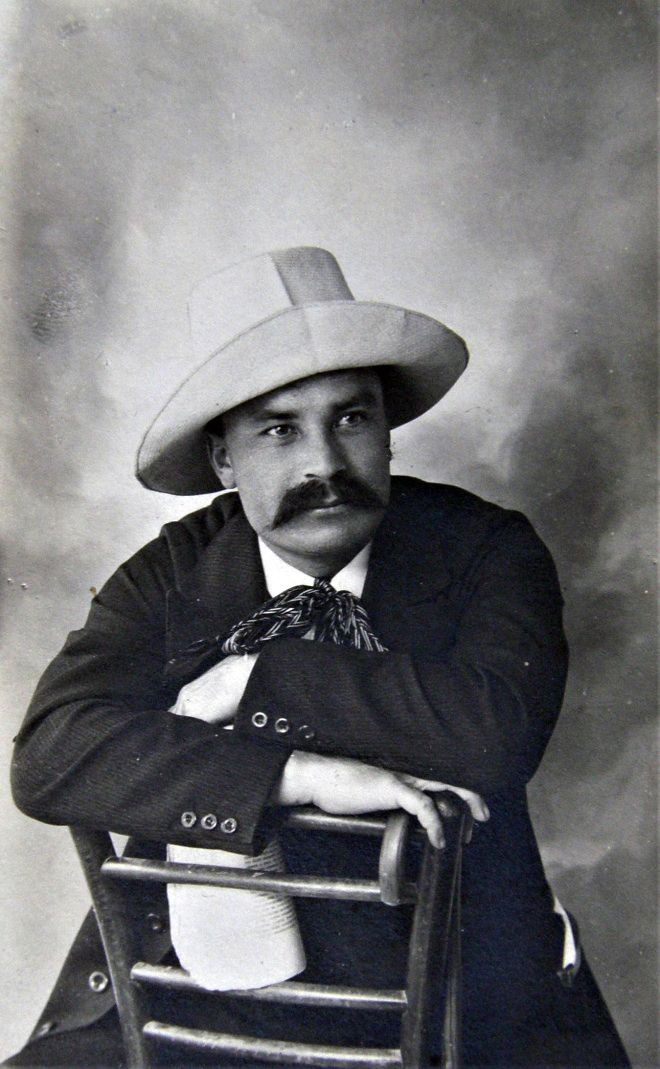
L: The cover of a new edition of “Solar Machine” by Volodymyr Vynnychenko. (Nataliia Shulga / 1morepage) R: Volodymyr Vynnychenko in the 1910s in Sestri Levante, Italy. (Wikimedia)
“The Solar Machine allows a person to feed directly on the plant — grass, leaves, hay, straw. And not some special kind, do not think so, for God’s sake, but simple, ordinary grass eaten by horses and cows. More than that: the Solar Machine makes any plant — even pine needles, nettles, weeds, thorns — completely suitable for human consumption,” Rudolf declares in the novel.
He also clarifies that solar bread is produced only “when (the plant and solar energy) come into contact with the energy of the person making the bread,” a revelation that can be read as an example of Vynnychenko’s conception of concordism. That is, the individual is the source of their own fulfillment. In this respect, it is a literal interpretation: the very act of nourishment becomes inseparable from the self that sustains it.
What makes this invention so incredible is that it would let humanity live directly on sunlight, ending hunger and, with it, the vast systems of labor and exploitation built to sustain it. The new society envisioned by “Solar Machine” is one of self-reliance and fulfillment, which in turn is meant to foster greater unity across the world.
Around this central plot, Vynnychenko weaves several storylines: a princess bent on revenge against a predatory magnate whose wealth comes from financial manipulation, and a militant group, known as the International Avant-Garde of Revolutionary Action, determined to seize the solar machine and use it against global capitalism. The result is a narrative that shifts between political allegory and speculative fiction, all tied to a single, unsettling question: What happens to society when its most basic needs are no longer scarce?
Naturally, the utopian promise takes a dystopian turn. Once food is no longer scarce, the economic systems built around its production and distribution start to collapse. Freed from the necessity to work in order to eat, people do not move toward harmony but fracture.
“There are few people on the streets. There is nowhere for them to go, nothing to rush toward,” Vynnychenko describes the scene witnessed by Rudolf after this societal collapse. “On the sidewalks lie scattered remnants of Bacchus: broken wine bottles, smashed barrels, tin cans, gnawed clean by dogs. Near the cans are piles of torn papers and banknotes. Thousands, tens of thousands of tickets lie trampled — pieces of useless paper. All the shops are wide open, with broken windows and doors, bare shelves, piles of torn paper, splinters, and straw.”
“On the streets, sometimes severed telephone wires hang, abandoned cars stand with their leather upholstery stripped — wet, gnawed-out skeletons. Occasionally, a horse corpse lies half-eaten by dogs and cats. Every now and then, people on old-fashioned two-wheeled bicycles appear, pedaling with their feet. They glance at the unfortunate pedestrians with satisfaction, ready to fight for their privilege with anyone who would take it.”
Viewed through the lens of Vynnychenko’s concordism, “Solar Machine” can be read as an eco-social utopia, according to Hundorova. Yet by entangling this vision with the realities of society, the novel takes a darker turn: Utopia risks corruption at the hands of the masses, who transform idealism into fetish and discipline into dictatorship.
“The novel is an attempt to reinterpret the lessons of recent history, at least in the form of speculative fiction,” Hundorova explains.
“Vynnychenko was working through the trauma of the 1917–1921 revolution, in which he had been one of the key participants. In this sense, ‘Solar Machine’ functions as a kind of postscript to the Ukrainian revolution.”
Vynnychenko didn’t just set a precedent for Ukrainian science fiction. Throughout his career, he experimented with genre in his short stories, novels, plays, and philosophical essays. His early works are notable examples of naturalism and realism. Over time, though, his writing shifted toward deeper explorations of the human psyche, probing questions of moral relativism. He broke new ground for his era, especially in how he portrayed certain vices.
Vynnychenko’s 1917 novel “Notes of a Snub-Nosed Mephistopheles” plunges us into the dark world of Yakiv Mykhailyuk, a lawyer who dedicates himself to slowly ruining people’s lives. He confesses to the reader that he enjoys to “lure a man to the very top” before bringing them down, and that the terror which replaces hope and excitement is “the best feeling.”
“Morality is a wall, built between the basic laws of life and its higher expression — reason, dusted over with cosmetic powder,” Mykhailuk explains. “The entire moral progress of humanity lies in the fact that people, stone by stone, try to tear down this wall of their own making. But the elites, on their side, carefully preserve it, aided meticulously by fools whom they milk.”
Mykhailuk rejects the idea that there is absolute good or evil in the world, convinced that by refusing to accept this, he is freer than most. Is he really free, though? Over the course of the novel he increasingly struggles with the sense of emptiness that defines his life. Both he — and the reader — are left to wonder if his actions are not those of a truly free man, but rather one who is a prisoner to his most atavistic compulsions.
This inner conflict comes to a head in Mykhailuk’s affair with a married woman named Sonia, and the uncertainty over whether Sonia’s son is Mykhailuk’s only raises the ethical stakes. “You are a deeply immoral, ugly, and cruel person… After being with you, one feels empty and unnecessary. Life becomes boring…” Sonya accuses him, laying bare the emotional wreckage their relationship causes. Their relationship is full of both passion and conflict, and it eventually becomes unclear who is really the oppressor and who is the victim.
In the end, “Notes of a Snub-Nosed Mephistopheles” leaves us with uneasy questions about how well we truly know ourselves and how easily we can deceive ourselves about right and wrong. As with much of Vynnychenko’s writing, the novel rigorously interrogates the place of honesty and moral integrity in a world largely devoid of it. For that alone, he deserves to be more widely read in translation.
Volodymyr Vynnychenko’s novel “Eternal Imperative” will be published in English translation by Harvard’s Ukrainian Research Institute (HURI) in Winter 2027.
A selection of his short stories was published in English translation in the early 90s. You can read them online here at Diasporiana, the largest online library of Ukraine-related books.
Read also: Overlooked by the Western canon: Why Mykhailo Kotsiubynskyi matters now
From The Kyiv Independent - News from Ukraine, Eastern Europe via this RSS feed