

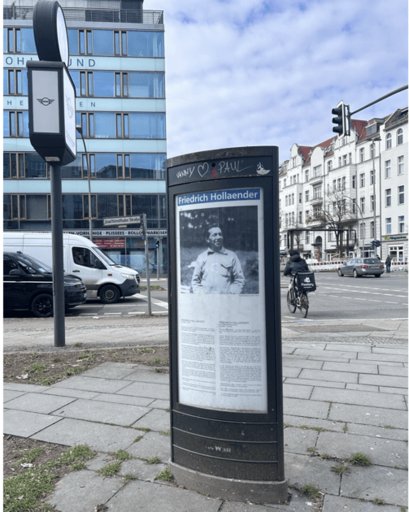
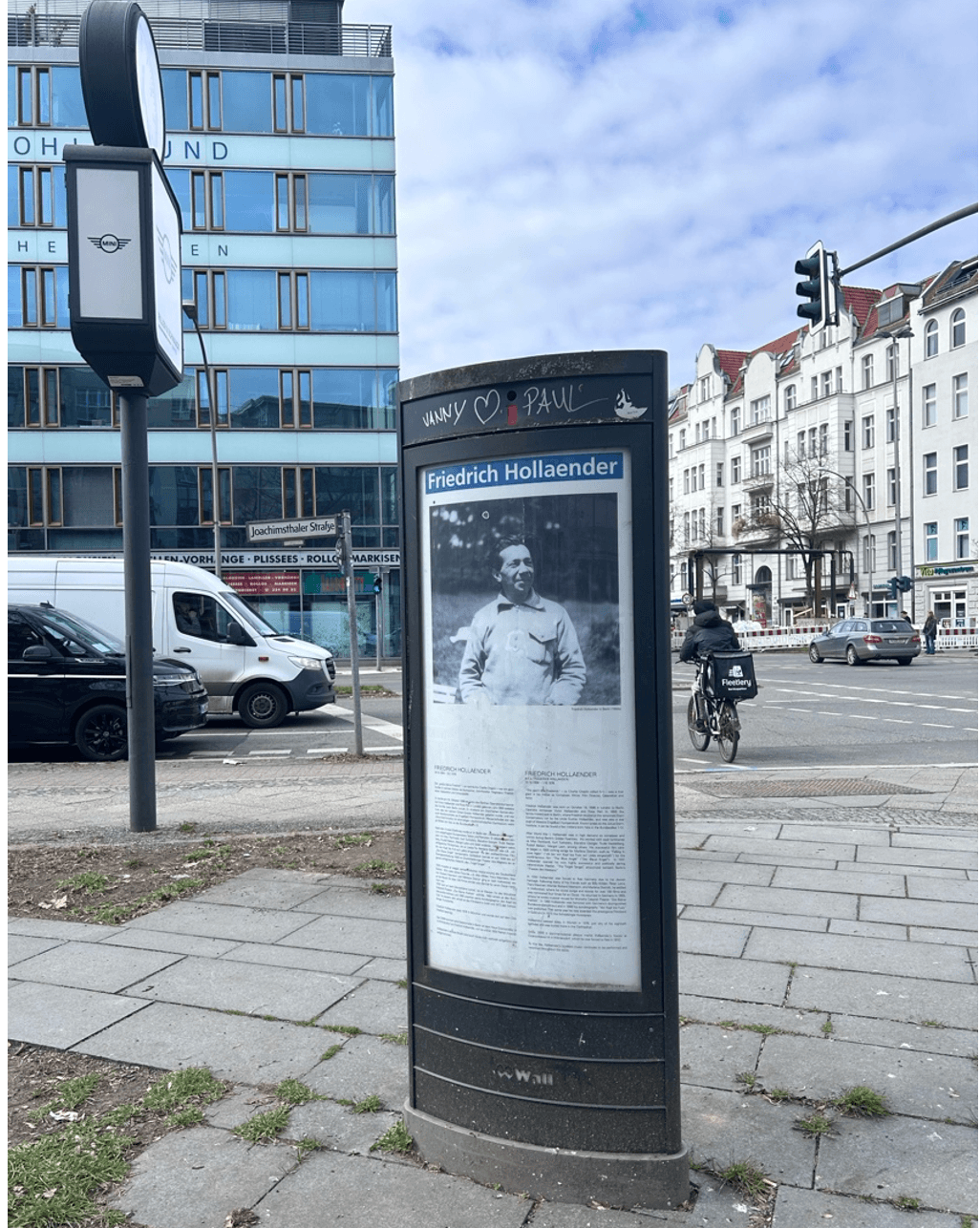
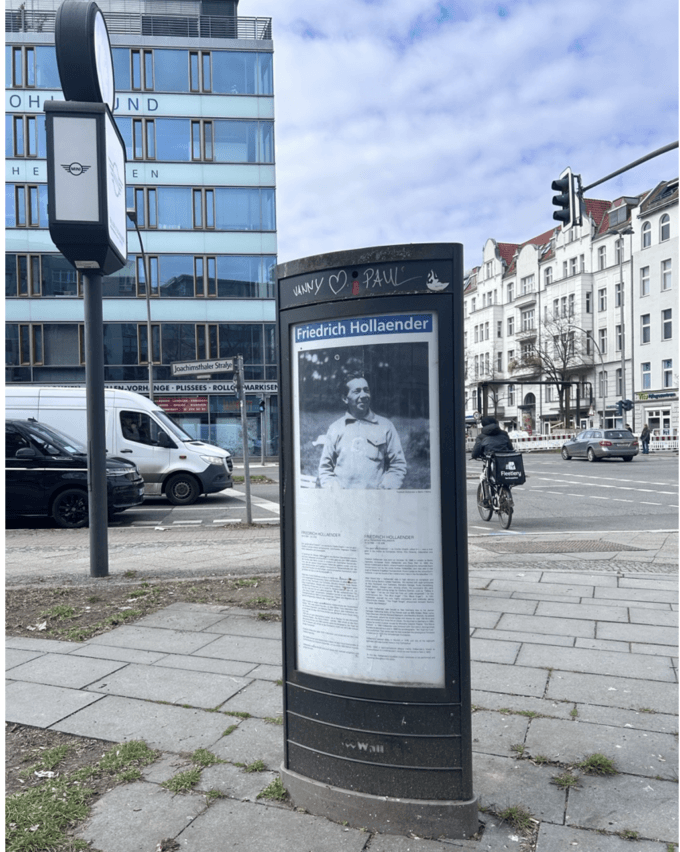
riedrich Hollaender Platz, Berlin, Germany. A refugee from Nazi Germany, Hollander, who died fifty years ago this year, was nominated twice for the Academy Award for Best Original Songs: “Whispers in the Dark” (1937) and “This Is the Moment” (1948). Photo: David Yearsley.
A decade ago, the Academy of Motion Picture Arts and Sciences at last summoned the annually assembled Oscar orchestra into the Dolby Theatre to play for the annual awards ceremony in the auditorium where the industry, come mid-March, doles out the gold-plated statuettes that give their name to, and provide the pretext for, this grinding epic of self-praise and promotion, bromides, and the occasional political broadside. The musicians have been in the house for awards night ever since, now not even hidden in an orchestra pit, but elevated for all to see at the back of the stage, even if through a scrim.
Before 2016, the Oscar musicians had been “live” only in the most tenuous sense. Holed up as they were a mile down Hollywood Boulevard in a studio in the RCA Building, their offerings were piped into the self-aggrandizing goings-on on the Dolby stage. The synchronization demanded by this demeaning off-siting was made possible through technology—that two-edged, supposedly budget-slashing sword that might seem to expand timbral possibilities and augment productivity, but that increasingly threatens to render costly human performance utterly redundant.
During the televised ceremonies that took place up to 2016, contractual obligation, it seemed, forced the Oscar host to acknowledge the orchestra and its conductor. An embarrassed shot of the banished musicians would flicker across screens at home and above the Dolby stage.
Broadway musicians went on strike to fight for their “liveness,” along with better pay and working conditions, back in 2004. Subsequent walkouts have been threatened as members of the union—the American Federation of Musicians—in New York and Los Angeles have sought to protect their professions from replacement by the pre-recorded and the real-time robotic. A 2024 agreement between the movie studios and the union holds until the beginning of next year and protects the actual from incursions of the artificial.
As the expiration of that contract comes closer, the AFM staged a rally in Times Square in Manhattan just a few days before Oscar night. At the top of the list of objectives on the union’s website was “Protecting Human Artistry from AI Displacement.” One of the key battles is over music’s century-long servitude to the moving image since, as the AFM declares, “Musicians provide the scores for films, the soundtracks for series, and the audio for the world’s digital content.” The New York demonstration went unreported by all major media outlets.
Aside from the Oscar producers’ purported wish to enhance the “human atmosphere” of the ceremony, one of the main reasons given for the relocation of the orchestra to the Dolby back in 2016 was the increased effectiveness of the in-house musicians in silencing and “playing off” those award winners who go on too long while at the microphone, clutching their Oscar. These efforts have often been thwarted, most anti-heroically by Adrian Brody after he won the Best Actor award last year. He shouted down the on-stage sound police and went on to evade arrest and smash the record for the longest speech.
The 2025 Oscars ran to nearly four hours. The latest show squeaked in under three. This year’s viewer numbers were down nearly 10% anyway. Maybe the off-script, refreshingly disastrous speech is actually the main draw, rather than coy crosstalk comedy bits by mismatched pairs of movie stars stumbling through their flat gags before they finally get to the task of opening the envelope.
As for the enrichment of humanity that only live music can supposedly provide, it was ironic that last week’s ceremony sought most drastically to slash the event’s running time by dispensing with performances of the nominees for Best Original Song.
Perhaps another reason for this decision was to prevent Barbra Streisand’s tribute to the late Robert Redford from being overshadowed. From behind a podium rather than front-and-center at an exposed microphone, her spoken reverie was bafflingly underscored by the orchestra. The sonic shroud only masked and muddied Barbra’s words before surging with symphonic ardor as she seamlessly segued into a breathy rendition of “The Way We Were”—that high-water mark of tear-jerking Hollywood sentiment. There was not a wet eye in the Dolby. Streisand’s lament queried not so much the difference between the live and the canned, but between the live and the moribund.
An unavoidable concession to the dictates of the world market, the only exception to the best-song blackout came with the production-number performance of “Golden,” the global chart-topping hit from the animated movie KPop Demon Hunters. The song’s co-writer and queen crooner, Ejae, led a trio of detective divas in front of a packed chevron of dancers waving golden flags. The entire Dolby audience waved along with light sticks.
The space and time allotted to this literal showstopper, with its crowdsourced, interactive choreography, left no doubt that when the Oscar for their category was announced sometime later in the broadcast, the K-poppers would be the winners. The be-gowned Ejae mounted the stage, escorted by the half-dozen other composers of the winning tune. Too many cooks had clearly not spoiled this high-energy hotteok—the sugary street-food pancake that the super-slender demon hunters are seen to eat in the movie.
Choking back tears, Ejae spoke of her youthful dreams of becoming a K-pop star that she pursued despite derision of her voice and talents. She ended her comparatively concise remarks by claiming the award as recognition not of success, but of resilience. One of her co-writers, Yu Han Lee, then replaced her at the microphone, but the report of percussion echoed from the back of the stage, the lights dimmed, the microphone feed was cut, the orchestra started up, and the frustrated jumpings and gyrations of the cohort were silhouetted and silenced.
Earlier in the show, after one of the winners for Best Live Action Short had foiled an orchestra attempt to shut him up, the host Conan O’Brien remarked on returning to the stage that “I know we’re tight, but to retract a microphone on a man as he’s speaking… is hilarious.” Clearly, he didn’t think it funny at all.
O’Brien had nothing to say, however, about the gagging of the “Golden” collaborator. The producers must have told him backstage to stifle any comment.
Earlier in the evening, O’Brien had made a quip about the AI menace, slipping in a remark that this would be the last Oscar ceremony with a “human” host. The show’s final, pre-recorded segment called back to this crack with a parody of the scene from One Battle After Another, which had just been named Best Picture. In this spoof, O’Brien was made Oscar “Host for Life,” then shown to his office and gassed through the air-conditioning vent.
Music is sometimes hailed as a universal language, praised for its supposedly unique immediacy and capacity to express emotion and nourish human connection. After an OpenAI Korea celebration last September, one of the employees tweeted that his “fav moment from the launch celebration was hearing singer/songwriter Vince share that ChatGPT helped him write ‘Soda Pop’ from KPop Demon Hunters! It apparently gave him ideas to make it sound ‘more bubbly.’”
Strenuous denials followed from the creative team. AI may have helped with some brainstorming, but these aids to the imagination, if indeed they were used, apparently don’t count as cheating or a violation of the terms of the union deal of 2024. Autonomous artistic authorship of “Golden,” claimed along with the Oscar by no fewer than seven composers, was not to be doubted.
Yet it was both strangely fitting and bitterly ironic that the live musicians in the Dolby Theatre earned their paycheck from powerful entertainment corporations partly by silencing songwriters who may have been flirting with large language models, even as the models onstage are skinny indeed.
The Academy Awards centenary is two years away. Let’s see if live music on the movies’ big night makes it to 100. Before he announced the winner for best song, Lionel Ritchie, who won the Oscar for “Say You, Say Me” from White Nights forty years ago, claimed in his potted lead-in that “stories cannot be told without music.” Oh, but they can.
The post Sound Police at the Oscars appeared first on CounterPunch.org.
From CounterPunch.org via this RSS feed