

I am happy to share my latest contribution, a new deep-dive paper published by the Earth4All Initiative of the Club of Rome. The paper, titled “Africa’s Just Transition Opportunity: Decolonising Economic Transformation for Climate Resilience,” explores one of the most urgent questions of our time: how can Africa pursue climate action while simultaneously undoing the colonial economic structures that continue to restrain its development trajectory. You can read the full paper here. We will also discuss the key findings during the Earth4All deep-dive launch webinar on Monday March 23, 2026 at 10am EDT or 5pm EAT. You can RSVP for the webinar here. I hope many of you will join the conversation. I will highlight some of the paper’s main messages and will add a few points about the importance of Pan-Africanism, joint-industrial policies, and geopolitical strategies.
Africa did not cause the climate crisis, but it is paying the price
Africa’s relationship to the climate crisis is defined by a profound injustice. The continent contributes only a small share of global greenhouse-gas emissions, yet it is has some of the most exposed regions to climate shocks such as droughts, floods, rising food insecurity and displacement. At the same time, hundreds of millions of Africans still lack access to basic energy services.
But climate vulnerability alone does not explain Africa’s predicament. The deeper issue is structural.
For centuries, Africa has been locked into a particular role in the global economy: exporting raw materials, importing manufactured goods, and providing low-cost labour within global supply chains. These roles were not accidental. They were constructed during the colonial period and reproduced through the rules of international finance, trade, investment and taxation.
The result is that many African economies remain trapped at the bottom of global value chains. Even when exports increase, the highest value-added segments of production namely technology, branding, manufacturing, and finance remain concentrated in the Global North.
This structural position has profound consequences. Persistent trade deficits force countries to borrow foreign currency to finance imports of food, fuel, medicine, and industrial equipment. Over time, these external deficits accumulate into sovereign debt crises that constrain public investment in development and climate resilience. In short, the climate crisis and the debt crisis are not separate problems. They are symptoms of the same structural imbalance in the global economy.
The structural roots of Africa’s economic entrapment
In this Earth4All paper, the analysis shows that Africa’s economic vulnerability can be traced to three interlocking structural deficits: food, energy, and manufacturing value-added. This is very much in line with the analysis produced in the Just Transition report (2023), and several pieces that I published recently (see this, this, and this for example).
First, the continent faces a severe food deficit. Despite possessing vast agricultural resources, Africa today imports a large share of its food, partly because global trade rules and agricultural subsidies in the Global North have historically undermined domestic food systems in the Global South.
Second, Africa faces an energy deficit. More than 600 million people across the continent still lack access to electricity, while many more rely on polluting fuels for cooking and heating. This energy poverty persists despite the fact that Africa holds some of the world’s richest renewable resources. According to the International Renewable Energy Agency (IRENA), the continent’s renewable energy potential could generate up to 1,000 times its projected electricity demand using existing technologies within the next 15 years.
Third, Africa faces a deficit in manufacturing value-added. Much of the continent’s manufacturing sector is structured around low-value assembly operations that depend heavily on imported inputs and technology. This model generates limited domestic value capture and reinforces dependence on external supply chains.
Taken together, these deficits create a persistent structural trade imbalance. Countries must borrow foreign currency to finance imports, which then leads to recurring external debt cycles.
The central insight of this analysis is therefore simple but powerful: Africa cannot decarbonize an economic system that has not yet been structurally and economically decolonized.
The false solutions dominating the climate debate
Unfortunately, much of the current global climate agenda fails to address these structural realities. Instead of supporting structural transformation, Africa is often encouraged to rely on mechanisms such as carbon markets, offset schemes, and export-oriented green investments. I have debunked all of these as dangerous distractions here, here, and here.
Carbon markets, for example, are frequently presented as a major source of climate finance. In practice, they function as “pollution permits,” allowing large emitters in wealthy countries to continue producing greenhouse gases while purchasing offsets generated elsewhere to greenwash their unwillingness to act on climate change.
These schemes can displace indigenous communities, generate speculative profits for intermediaries, and deliver little to no meaningful emission reduction. At the same time, revenues from such projects are often used to service external debt rather than finance structural transformation.
In this sense, the emerging carbon-offset economy risks reproducing a familiar pattern: the extraction of value from African ecosystems to sustain the insatiable obsession with growth, consumerism, waste, and planned obsolescence in the Global North.
Pan-African Structural Transformation
If Africa is to pursue a genuine just transition, climate policy must be embedded within a broader strategy of Pan-African structural economic transformation. As I have argued before. there are three strategic pillars for such a transformation.
The first is food sovereignty. Rather than relying on imports and volatile global markets, African countries must rebuild resilient domestic food systems rooted in agroecology and local production. This is a climate resilience solution, but it’s also a pathway to escape the external debt trap, and decolonize the economy.
The second is renewable energy sovereignty. Africa possesses extraordinary renewable resources (solar and wind to geothermal and hydropower) but currently captures only a fraction of this potential. Despite hosting some of the world’s best solar resources, the continent receives only 1% of global clean-energy investment. Expanding renewable energy systems for domestic use, especially electricity access, clean cooking, and industrial power, would simultaneously reduce import dependence and support long-term economic development. This is a climate resilience solution, but it’s also a pathway to escape the external debt trap, and decolonize the economy.
The third pillar is Pan-African industrial policy. Industrialization at the national level is often constrained by small markets and limited economies of scale. Regional industrial cooperation can overcome these barriers by pooling resources, coordinating supply chains, and building integrated markets across the continent. Such cooperation is particularly important in sectors linked to the global energy transition. Africa holds large reserves of the critical minerals used in batteries, renewable technologies, and electric mobility. With the right industrial policies, these resources could support a new generation of green manufacturing industries across the continent. This is a climate resilience solution, but it’s also a pathway to escape the external debt trap, and decolonize the economy.
The Earth4All “Giant Leap”
The Earth4All modelling framework examines two possible global trajectories for this century. The first scenario, which the researchers call **“Too Little Too Late,”**assumes incremental policy changes and continued reliance on the existing economic model. Under this scenario, inequality rises, ecological degradation accelerates, and global temperatures exceed safe limits.
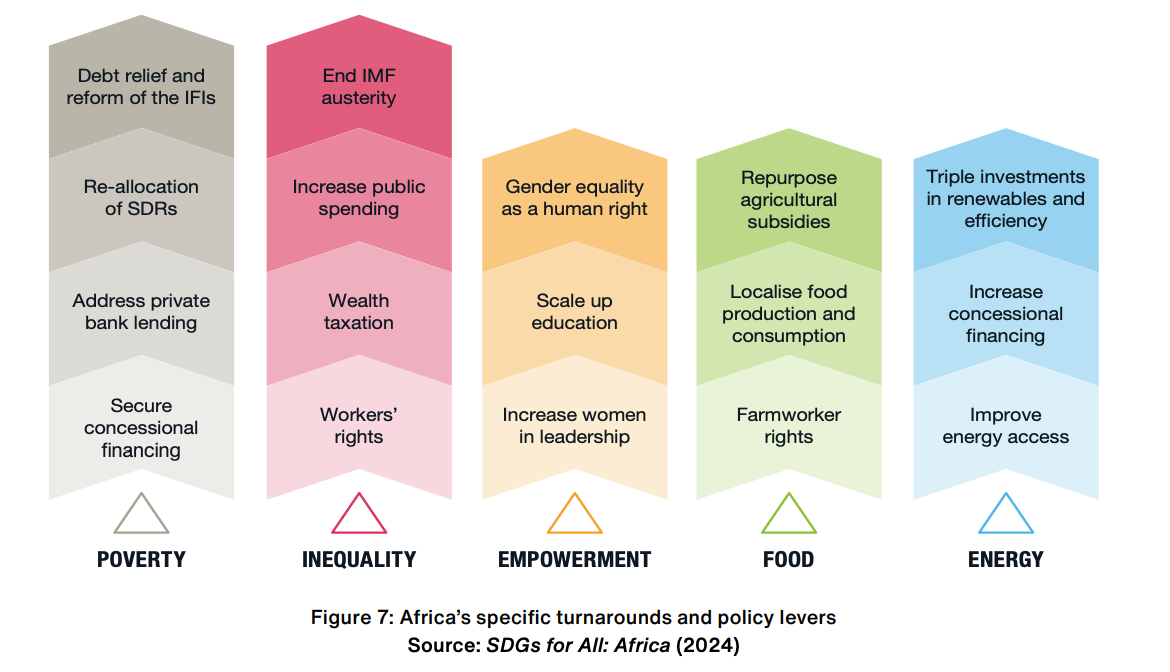
The alternative scenario, which the researchers call the “Giant Leap,” envisions a coordinated transformation of economic systems across five domains: poverty reduction, inequality, gender empowerment, food systems, and energy systems. For Africa, this transformation would require a deliberate strategy of structural change supported by international cooperation and reform of the global financial architecture.
From climate finance to climate justice & reparations
The debate about climate finance often obscures a deeper issue: historical responsibility. Industrialized countries accumulated wealth through centuries of fossil-fuel-driven growth while contributing disproportionately to global emissions. The climate crisis therefore represents not only an environmental problem but also a historical imbalance in the global economic system.
Addressing that imbalance requires more than loans and market mechanisms. It requires meaningful transfers of resources, technology, and policy space to enable structural transformation (aka structural decolonization) across the Global South. In other words, what is needed is not charity. What is needed is climate justice in the form of climate reparations, which I’ve written about here, here, here, and here.
It’s Pan-Africanism or Death!
The global economic order is entering a period of rapid transformation. Supply chains are shifting, energy systems are being rebuilt, and geopolitical alliances are taking new shapes. These changes present both risks and opportunities for Africa. If current patterns continue, the continent could remain a supplier of raw materials and a consumer of imported technology; therefore, once again positioned at the bottom of global value chain. But if African countries coordinate strategically under a Pan-African economic and geopolitical strategy that prioritizes collective reliance via food sovereignty, renewable energy sovereignty, and joint industrial policies, then Africa could transform the continent into a major economic and geopolitical powerhouse in the 21st century. The question is not whether Africa has the resources, talent, or potential. The question is whether African Heads of States have the courage to think, act, and lead as a Pan-African unit to be reckoned. If they do, then I have no doubt that Africa will be unstoppable.
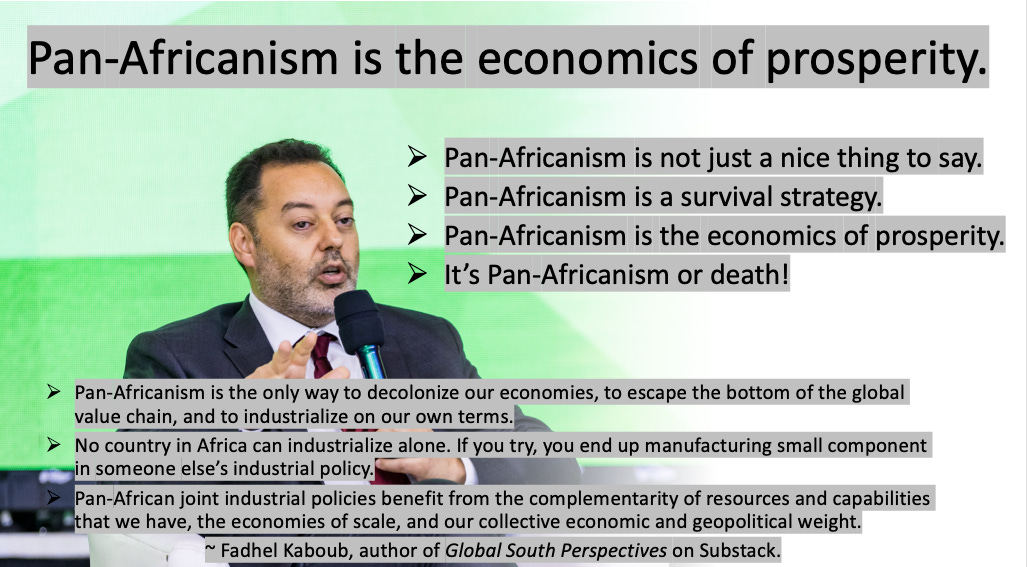
I don’t use the term Pan-Africanism lightly. It’s not the nice fluffy term that some people use as a rhetorical and diplomatic expression of brotherhood, sisterhood and occasional solidarity of the convenient kind. Pan-Africanism is the economics of industrializations, because without economies of scale, no African country can industrialize. Pan-Africanism is the economics of prosperity, because without it Africa cannot become the economic powerhouse that it deserves to be in the global food, energy, transportation, logistics, finance, insurance, real estate, and manufacturing systems. It’s Pan-Africanism or Death! Because the breakdown of all the life-sustaining systems (food, water, biodiversity, energy, health, etc.) is accelerated by the climate crisis, dangerous distractions, and neocolonial greenwashing forms of extractivism and economic entrapment.
I have also discussed many of these themes in this recent episode of Macro N Cheese. Take a listen “You can’t vote away Colonialism.”

This has never been done before!
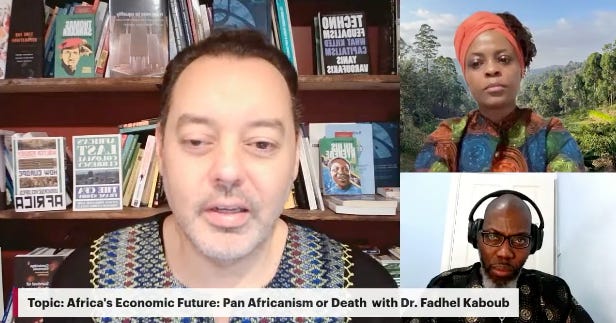
In this 10-min clip, I explain how a specific kind of Pan-African joint industrial strategy can not only unleash Africa’s potential for a just transition and green structural transformation, but also redraw the geopolitical map of the world by positioning Africa and the rest of the Global South at the center of a new international economic order of peace, justice and sustainable prosperity. This is what I call the Geopolitical Bargain of the Century. I argue that this has never been done before, because we’re trying to undo colonial and imperial structures that have kept billions of people in poverty, and we will do this without abusing nature, without throwing our own people under the bus, without invading or colonizing any other nation, and without inflicting revenge on former colonial and imperial nations. We are inviting the world the join us in this win-win endeavor to benefit humanity.
Join the conversation
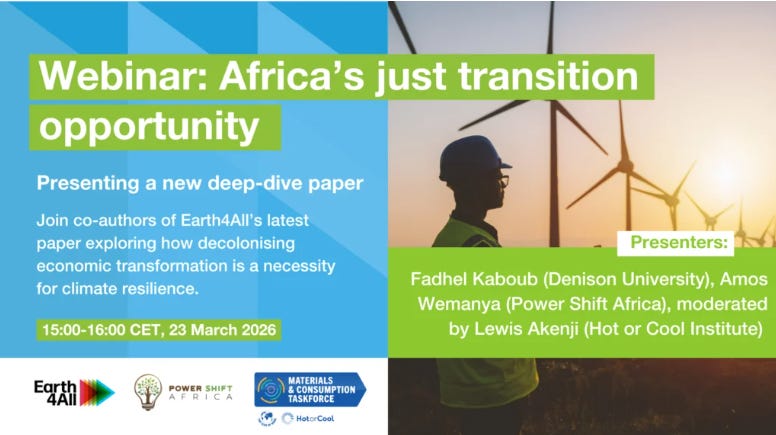
We will discuss these ideas in more detail during the upcoming Earth4All Deep-Dive Launch Webinar on Africa’s just transition. Read the full paper here and RSVP for the webinar here. I hope many of you will join the conversation on Monday March 23, 2026 at 10am EDT or 5pm EAT.
Fadhel Kaboub is an associate professor of economics at Denison University, and the president of the*Global Institute for Sustainable Prosperity.* He is the author of*Global South Perspectives* on substack. In 2025, Dr. Kaboub was recognized by the New African Magazine in the Top 100 Most Influential Africans under the Thinkers & Opinion Shapers category. He is a board member of the United Nations High-Level Advisory Board on Economic and Social Affairs at UN-DESA. He is also a member of the*Independent Expert Group on Just Transition and Development, an expert group member with theGlobal Solidarity Levies Task Force, a member of theEarth4All 21st Century Transformational Economics Commission, a Steering Committee member with theFossil Fuel Non-Proliferation Treaty Initiative*, and a member of the Independent Expert Group on Just Transition Finance. He has recently served as Under-Secretary-General for Financing for Development at the Organisation of Southern Cooperation in Addis Ababa, Ethiopia. Dr. Kaboub is an expert on designing public policies to enhance monetary and economic sovereignty in the Global South, build resilience, and promote equitable and sustainable prosperity. His recent work focuses on Just Transition, Climate Finance, and transforming the global trade, finance, and investment architecture. His most recent co-authored publications include “A Coherent Framework for Sovereign Debt and Economic Transformation: Towards a Global South Debtors’ Coalition,” (Institute for Economic Justice, 2025), and Just Transition: A Climate, Energy, and Development Vision for Africa (May 2023). He has held a number of research affiliations with the Levy Economics Institute (NY), the John F. Kennedy School of Government at Harvard University (MA), the Economic Research Forum (Cairo), Power Shift Africa (Nairobi), African Forum on Climate Change, Energy and Development (Abuja), and the Center for Strategic Studies on the Maghreb (Tunis). Dr. Kaboub is currently working on a book manuscript tentatively called The Geopolitical Bargain of the Century: Towards a New International Economic Order of Peace, Justice, and Sustainable Prosperity (forthcoming).
Global South Perspectives ~ by Fadhel Kaboub is a reader-supported publication. To receive new posts and support my work, consider becoming a free or paid subscriber.
From Global South Perspectives ~ by Fadhel Kaboub via this RSS feed
You must log in or # to comment.