

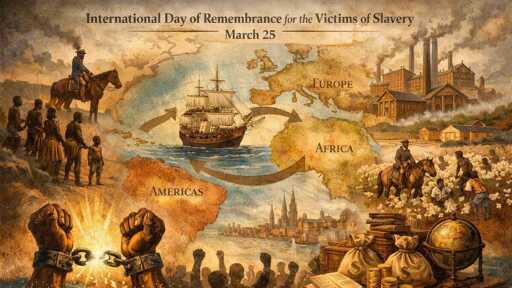
Today marks the International Day of Remembrance of the Victims of Slavery and the Transatlantic Slave Trade, and on this March 25, 2026, Ghana’s President John Mahama will be at the United Nations Headquarters in New York to support The UN General Assembly vote on a resolution designating the transatlantic African slave trade as “the gravest crime against humanity.” This important recognition sets the stage for structural reparations and structural transformation for Africa and the rest of the Global South. That is the next frontier of the struggle for justice.
If we want to understand how the modern world economy was built, we have to stop treating the trafficking and chattel enslavement of Africans as a tragic “labor system” sitting on the sidelines of industrialization. It was an engineered architecture of extraction, designed to do three things at once:
transfer people at a continental scale,
convert human beings into capital assets, and
organize global trade and production around coerced commodity frontiers.
That architecture did not disappear. It mutated. Its logical components, namely forced specialization, external dependence, racialized devaluation of labor, and the financing of “development” through extraction, are still familiar to the Global South today.
1) The scale of slavery wasn’t incidental: it was a demographic and economic shock
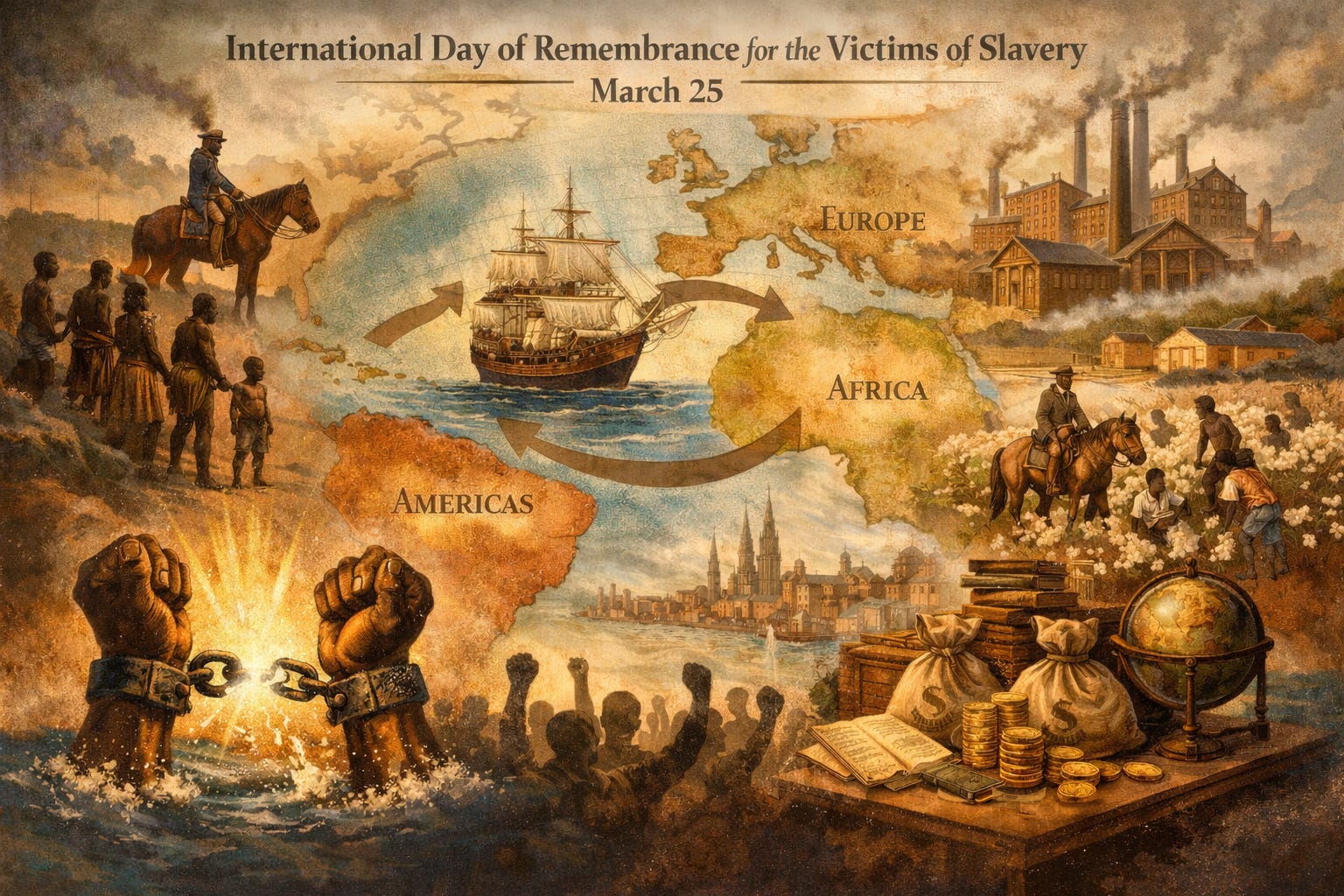
Let’s start with the basic arithmetic of the transatlantic system. The best-known quantitative baseline is the Voyages / Transatlantic Slave Trade Database: about 12.5 million Africans were forced aboard slave ships, and about 10.7 million survived the Middle Passage (1526–1866); not to arrive as migrants, but as legally commodified property for plantation economies.
That number matters economically for a simple reason: removing millions of people, disproportionately young and able-bodied, was not just “population loss.” It was the targeted extraction of productive capacity, skills, and future generations. In other words, it was an early, violent form of what we would now call deindustrialization-before-industrialization: stripping labor and social reproduction from one region to accelerate accumulation elsewhere. Entire nations never recovered from that damage.
2) The “underdevelopment” of Africa is not a metaphor
For decades, Global South scholars have insisted that underdevelopment is made, not found. What’s striking is how much of that claim is now supported by mainstream empirical research.
Nathan Nunn’s landmark work constructs historical estimates of slave exports using shipping records and documents on enslaved people’s origins, then tests whether exposure to the slave trades is associated with present-day economic outcomes. The core result is blunt: countries that exported more enslaved people tend to be poorer today, with a “robust negative relationship” between slave exports and current economic performance, and additional strategies to address causality.
Warren Whatley synthesizes the growing econometric literature and emphasizes that researchers find recurring evidence of long-run harm, including lower income per capita, heightened conflict and mistrust, underdeveloped access to credit, and greater political corruption, among other constraints on growth.
This is important for how we talk about “African poverty.” It is not primarily a story of internal failure. It is a story of historical extraction becoming institutional path-dependence; with measurable legacies in incomes, trust, conflict dynamics, and credit access. In other words, the economic damage of slavery and colonialism did not stop when slavery ended and colonial empires left Africa.
3) Slavery didn’t just use capital. It created capital by turning people into collateral
One of the most revealing corrections to conventional economic storytelling is this: enslaved Africans were not merely labor. They were also used as financial instruments.
A 2025 peer-reviewed article in the Journal of Global History by Igor Martins and Erik Green argues that slavery was a unique institution because it granted enslavers “complete rights over mobile property,” giving access to both labor and capital; and that the capital-investment dimension is key to understanding slavery’s persistence. They specifically highlight situations where the data allow us to observe enslaved people functioning as collateral in economic transactions across the United States, Brazil, and the Cape Colony.
Read that carefully: collateral. That means the system didn’t just extract output from coerced labor; it expanded credit by making human beings pledgeable assets. This is how plantation economies plugged into banks, merchants, and insurance, and that is why slavery is at the core of the history of modern finance.
4) Cotton wasn’t “a crop.” It was an organizing technology of global capitalism
If you want one commodity that makes the argument about slavery crystal clear, it is cotton.
In his peer-reviewed work, historian Sven Beckert describes cotton as one of the world’s largest industries at mid-century and notes a central fact: prior to 1861, most of the world’s raw cotton supply was produced by enslaved people on plantations in the American South, then spun and woven by textile workers in places like Lancashire.
Writing on the antebellum world cotton market, economist Douglas Irwin states that the United States accounted for about 80% of the world’s cotton production between 1820 and 1860, and that cotton comprised over half of all U.S. exports in the antebellum period, with about three quarters of the crop exported, almost all to the United Kingdom.
What does that mean in plain language? It means a coerced labor regime in the Americas was producing the key input for the most dynamic industrial sector in Britain and Europe. And it means the “free market” celebrated in many textbooks was, in practice, a market whose central commodity chain was anchored in unfree labor that mand secured by state power, property law, and violence.
5) The debate is not whether slavery mattered, but how it mattered, and for whom
There’s a temptation in public discourse to treat this as a binary: “Did slavery cause industrialization?” Serious scholarship about this issue is more careful and more damning.
Economic historian Gavin Wright revisits the long-running debates and explicitly connects British and American literatures on slavery and growth, focusing on what he calls the “neglected” second part of the Williams thesis: slavery and the slave trade were “once vital” for expanding British industry and commerce, and then became less “indispensable” later as structures changed.
We don’t have to accept every claim in every camp to see the structural point: even when scholars debate magnitudes and mechanisms, they are debating within a framework where slavery is already recognized as deeply entangled with trade, finance, and industrial expansion, precisely because the commodity chains were so large and so central.
6) From slave ships to “data colonialism”: the continuity is the business model
Here is why this history belongs on Global South Perspectives, not as memorialization, but as political economy. The transatlantic system did at least three things that still define Global South insertion into the world economy:
Forced specialization: Africa and the Americas were locked into extractive roles, while Europe consolidated higher value-added production.
Externalized vulnerability: prosperity in the core depended on controlled access to inputs (cotton then; critical minerals, and data now).
Financial capture: when people can be collateral, or when future export revenues can be collateral (today’s sovereign debt architecture), credit expands for extractors while the periphery is disciplined into repayment.
Whatley’s summary of long-run legacies, especially underdeveloped access to credit and greater political corruption, reads like a description of the structural vulnerabilities that today’s lenders and ratings agencies exploit. And Liu, Xu, and Zhou (2026, Journal of Corporate Finance) add contemporary firm-level evidence: using data from over 30,000 firms across 41 African countries (2006–2021), they find a robust positive relationship between historical slave export intensity and present-day measures of firm corruption (including bribes requested/paid and corruption obstacles), with channels including diminished trust and weak institutions.
Again, the point is not to reduce everything to slavery. The point is to understand slavery as a foundational shock that helped design durable global hierarchies that later colonialism, unequal trade, debt regimes, and modern extractive supply chains would deepen rather than reverse.
The Final Word
In short, slavery economically restructured the world by:
moving millions of Africans through violent forced migration at scale (12.5 million embarked; 10.7 million survived)
converting human beings into mobile property that could function as capital investment and collateral, expanding credit and accumulation in slave societies
organizing global industrialization around plantation commodities—especially cotton—where the U.S. produced about 80% of world cotton (1820–1860) and exported most of it to the U.K., while much of the world’s cotton supply before 1861 was produced by enslaved labor
leaving measurable long-run damage in Africa’s development trajectory, including lower incomes and multiple institutional constraints on growth
The way forward is to acknowledge the harm, offer a public apology, commit to structural reparations. All of this requires African countries to speak with one voice, unapologetically and uncompromisingly about reparations, and to create the economic and geopolitical leverage to compel the perpetrators to pay for the reparations claims.
Share Global South Perspectives ~ by Fadhel Kaboub
Fadhel Kaboub is an associate professor of economics at Denison University, and the president of the*Global Institute for Sustainable Prosperity.* He is the author of*Global South Perspectives* on substack. In 2025, Dr. Kaboub was recognized by the New African Magazine in the Top 100 Most Influential Africans under the Thinkers & Opinion Shapers category. He is a board member of the United Nations High-Level Advisory Board on Economic and Social Affairs at UN-DESA. He is also a member of the*Independent Expert Group on Just Transition and Development, an expert group member with theGlobal Solidarity Levies Task Force, a member of theEarth4All 21st Century Transformational Economics Commission, a Steering Committee member with theFossil Fuel Non-Proliferation Treaty Initiative*, and a member of the Independent Expert Group on Just Transition Finance. He has recently served as Under-Secretary-General for Financing for Development at the Organisation of Southern Cooperation in Addis Ababa, Ethiopia. Dr. Kaboub is an expert on designing public policies to enhance monetary and economic sovereignty in the Global South, build resilience, and promote equitable and sustainable prosperity. His recent work focuses on Just Transition, Climate Finance, and transforming the global trade, finance, and investment architecture. His most recent co-authored publications include “A Coherent Framework for Sovereign Debt and Economic Transformation: Towards a Global South Debtors’ Coalition,” (Institute for Economic Justice, 2025), and Just Transition: A Climate, Energy, and Development Vision for Africa (May 2023). He has held a number of research affiliations with the Levy Economics Institute (NY), the John F. Kennedy School of Government at Harvard University (MA), the Economic Research Forum (Cairo), Power Shift Africa (Nairobi), African Forum on Climate Change, Energy and Development (Abuja), and the Center for Strategic Studies on the Maghreb (Tunis). Dr. Kaboub is currently working on a book manuscript tentatively called The Geopolitical Bargain of the Century: Towards a New International Economic Order of Peace, Justice, and Sustainable Prosperity (forthcoming).
Global South Perspectives ~ by Fadhel Kaboub is a reader-supported publication. To receive new posts and support my work, consider becoming a free or paid subscriber.
From Global South Perspectives ~ by Fadhel Kaboub via this RSS feed
You must log in or # to comment.