

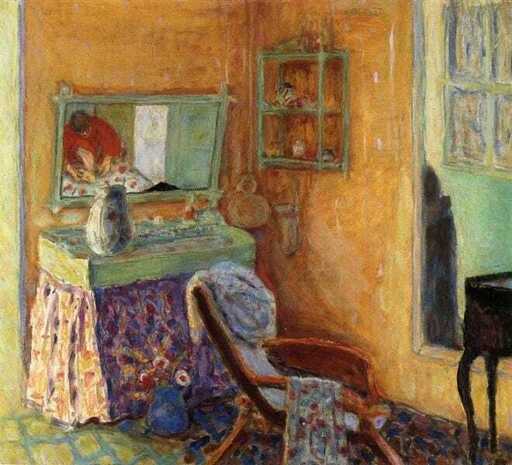

Interior, 1913 by Pierre Bonnard
Hello!
Welcome to Cultural Capital. Sorry for the fortnight’s absence. I was completely overwhelmed with work. Normal service now resumes! In The Times I wrote about the final triumph of the attention economy. And the last episode of my Radio 4 series about literacy and civilisation, How Reading Made Us went out on Monday. This one was about the relationship between literacy and democracy.
Thanks for reading Cultural Capital! Subscribe for free to receive new posts and support my work.
Base financial self-interest also moves me to remind you that you can buy my cheerfully-titled book The New Dark Ages, about how the collapse of reading is reversing the Enlightenment and destroying democracy here.
The end of readingI wouldn’t have thought this was actually possible but the novelist Will Self is even gloomier about the future of literacy than I am:
We’ve lost 50% of literacy in the last fifteen years. So, that epiphenomenon of writers like me being attacked and abandoned by our friends running scared of social media was part of the progression towards illiteracy and the fundamental inability to morally deliberate, which now characterises our society and which will propel us into authoritarianism, like America. That’s what the book’s about.
Someone who can’t read a book cannot deliberate, cannot think and cannot conceptualise, and therefore is a threat – particularly humans who, instead of conceptualising in isolation and being able to think inside their own heads, only think through their engagement with others. That’s where fascism gets going, or social movements that depend on a kind of hysterical level of identification. What books and the ability to read books do is present a barrier that prevents you from being able to avoid moral deliberation at some point. He is in an odd generational situation. He’s old enough to remember when novel
As a friend points out, Self is in a weird position generationally. He saw the golden age of nineties literary culture when novelists were lionised as celebrities. If he were a bit older, he would have safely become a Grand Old Man of letters like Alan Hollinghurst. If he were a bit younger it would never even have occurred to him that being a novelist could bring fame and riches.
But he saw the end of the last golden age of novel reading only for it all to melt in front of his eyes:
When I started writing, it was a totally different culture [. . .] You just cannot imagine what the past was like. When I was in my mid thirties, I would give a reading to five hundred people, young people. Then, afterwards in the lineout, I’d say to a young woman ‘how would you like me to sign your book?’ and she would say ‘I’d like you to sign my body.’
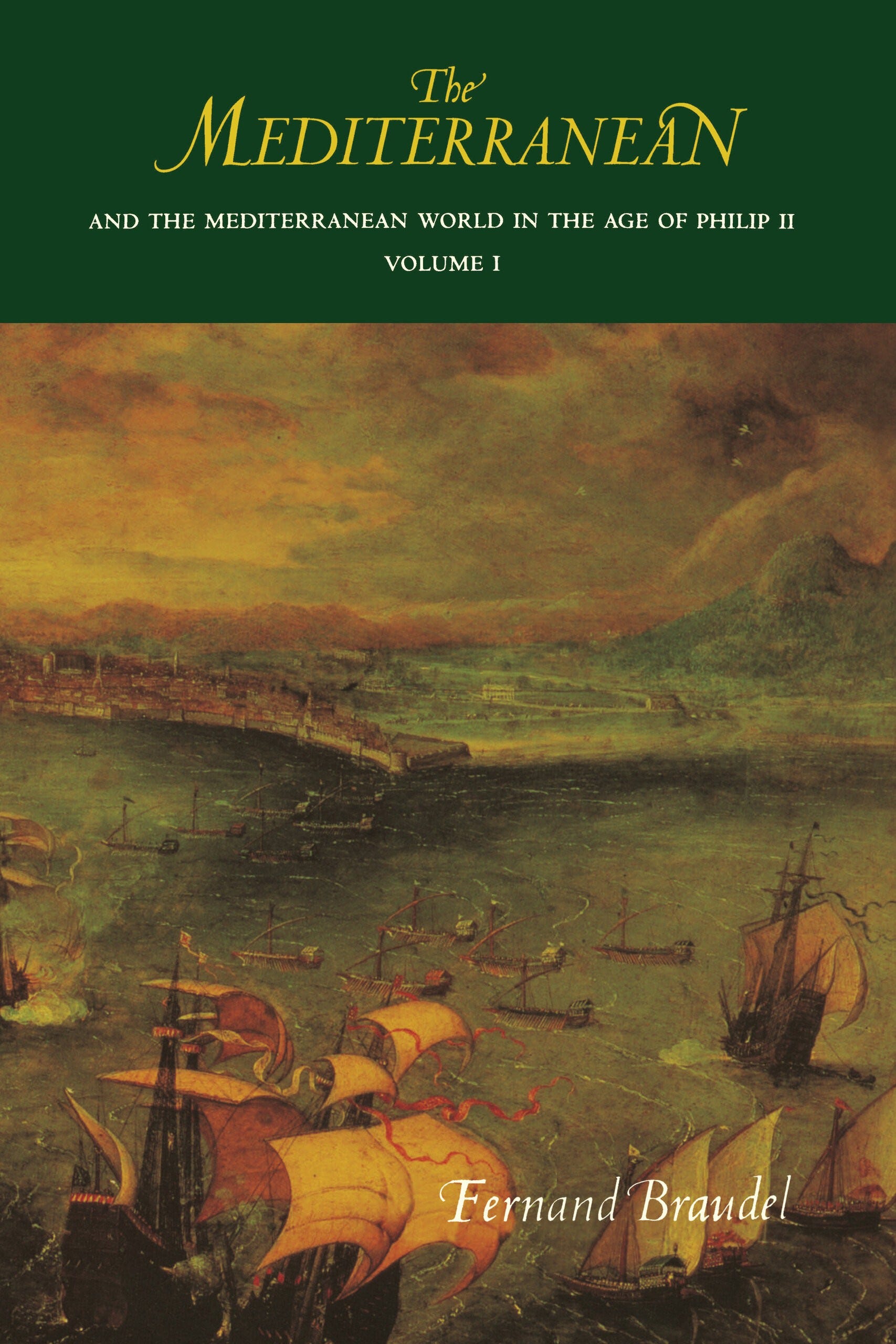
The snow trade in the MediterraneanI’ve been dipping into Fernand Braudel’s book The Mediterranean in the Age of Philip II which is sometimes called the best history book ever written. Braudel is famous for moving history away from kings/wars/diplomatic treaties and towards a “longue durée” approach that emphasises geography, climate and social trends. The book is full of wonderful details.
I especially loved this passage about the snow trade in the Mediterranean in the sixteenth century. It reads like something from a magical realist novel:
In Turkey in the sixteenth century [snow] was not merely the privilege of the rich; in Constantinople, but elsewhere as well, Tripoli in Syria, for instance, travellers remarked on merchants selling snow water, pieces of ice, and water-ices which could be bought for a few small coins. Pierre Belon relates that snow from Bursa used to arrive at Istanbul in whole boatloads. It was to be found there all the year round according to Busbecq, who was astonished to see the janissaries drinking it every day at Amasia in Anatolia, in the Turkish army camp. The snow trade was so important that the pashas took an interest in the exploitation of the ‘ice mines’. It was said in 1578 to have provided Muhammad Pasha with an income of up to 80,000 sequins a year.
Elsewhere, in Egypt, for example, where snow arrived from Syria by relays of fast horses; in Lisbon which imported it from great distances … Western pilgrims travelling to the Holy Land in 1494 were astonished to see the owner of the boat presented, on the Syrian coast, with ‘a sack full of snow, the sight of which in this country and in the month of July, filled all on board with the greatest amazement’. On the same Syrian coast, a Venetian noted with surprise in 1553 that the ‘Mores’, ‘sprinkle snow on their food and dishes as we would sugar’.
Why can’t AI write?This is a great piece by Jasmine Sun in The Atlantic arguing that creative writing is still “the human skill that eludes AI”. In fact there’s a case that AI writing is actually getting worse at writing. Modern AIs are trained on far more data than their predecessors which makes them less erratic and more reliable colleagues but also seems to make them less creative:
In a certain, strange way, generative AI peaked with OpenAI’s GPT-2 seven years ago. Little known to anyone outside of tech circles, GPT-2 excelled at producing unexpected answers. It was creative. “You could be like, ‘Continue this story: The man decided to take a shower,’ and GPT-2 would be like, ‘And in the shower, he was eating his lemon and thinking about his wife,’” Katy Gero, a poet and computer scientist who has been experimenting with language models since 2017, told me. “The models won’t do that anymore.”
This may be partly be design. If you want a reliable AI model maybe you don’t actually want it to be too creative:
In some ways, creativity is directly at odds with AI companies’ other objectives. Generally, chatbots are trained to avoid misinformation, political bias, child-sexual-abuse material, copyright violations, and more. [. . .]And if most users are using ChatGPT to draft corporate emails, bold text and brief bullet points may be exactly what they want. “The more you control for these” traits, Nathan Lambert, a post-training lead at the Allen Institute for AI, told me, “the more you suppress creativity.”
The agency theory of everythingHere is a fascinating interview with the pollster James Kanagasooriam on Amol Rajan’s podcast Radical. Kanagasooriam argues that the most important dividing line in politics is between those who feel in control of their lives and those who don’t. If you feel you have agency over your life you are likely to vote for one of the traditional parties (in Britain, Labour or the Conservatives) if you feel like you have no agency you are likely to vote for a new populist or insurgent party (Reform, the Greens etc). I think this sounds very convincing. I would love to know how much else it explains about the modern world.
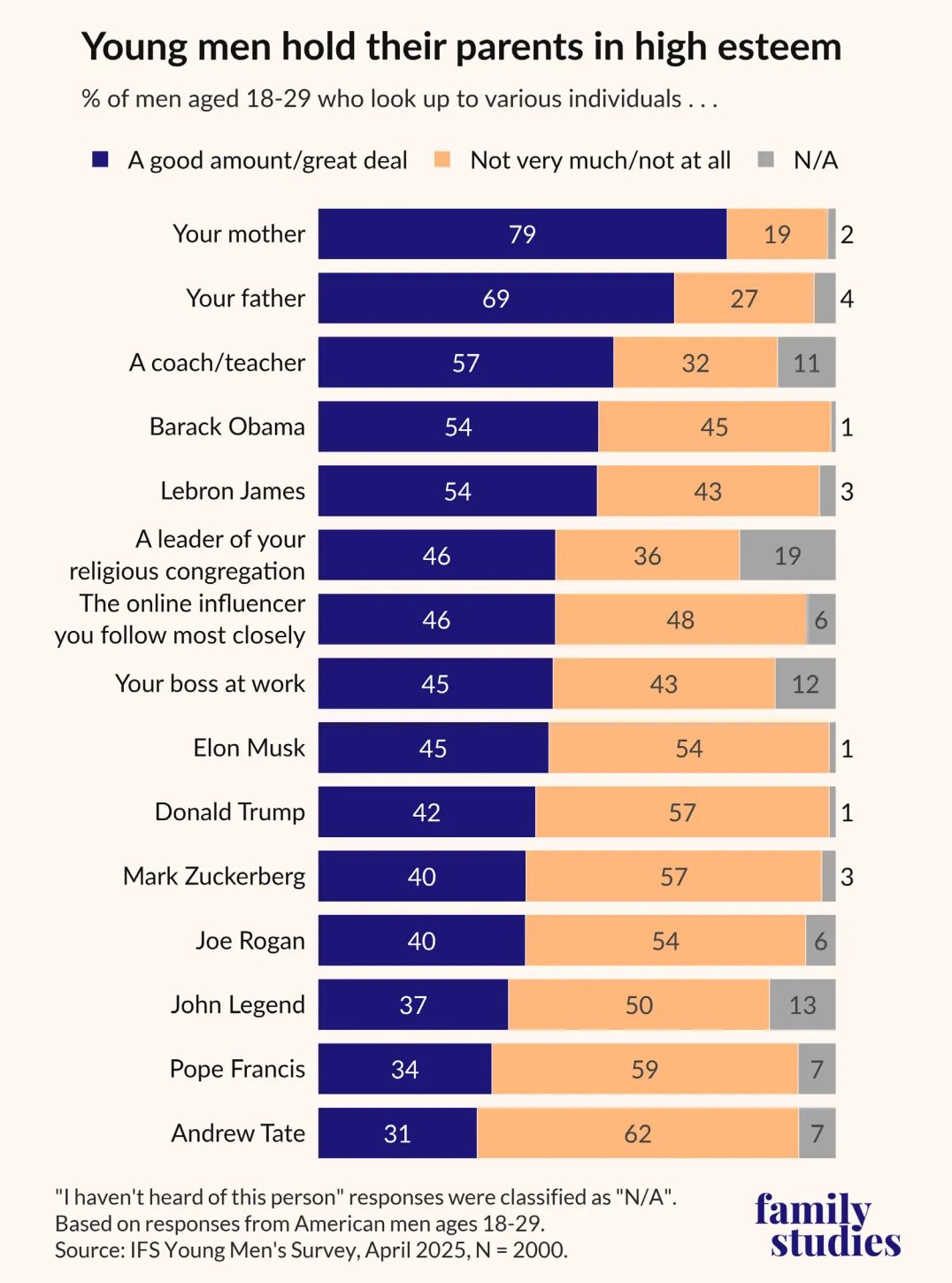
**Who do young men admire?**It’s widely believed that young men have all been radicalised into becoming followers of deranged manosphere influencers. This graph offers a heart warming corrective. Men admire their mothers, their bosses and Barack Obama. Though the depressing conclusion to draw from it would be that the fact a third of them still admire Andrew Tate which does seem very high given he seems so obviously a moron.
Automation of cashiers (bank tellers)This is a fascinating piece by David Oks about why the ATM didn’t replace the human cashier (bank teller to American readers) but the iPhone eventually did. The fact that ATMs created more jobs for cashiers is perhaps the most widely cited counterintuitive instance of automation not creating the expected job losses. As Oks explains:
The natural expectation is that ATMs would make human bank tellers obsolete, or at least strongly reduce demand for bank teller jobs. And indeed the number of bank tellers per branch declined significantly: from 21 tellers per branch to about 13 per branch once ATMs had hit saturation. But this decline in teller intensity corresponded with an increase in aggregate teller employment. The number of ATMs per capita grew dramatically after 1975; but the number of bank tellers increased along with it.
So what happened? A version of this story is common in automation:
First, by reducing the cost of operating a bank branch, ATMs indirectly increased the demand for tellers: the number of tellers per branch fell by more than a third between 1988 and 2004, but the number of urban bank branches (also encouraged by a wave of bank deregulation allowing more branches) rose by more than 40 percent. Second, as the routine cash-handling tasks of bank tellers receded, information technology also enabled a broader range of bank personnel to become involved in “relationship banking.” Increasingly, banks recognized the value of tellers enabled by information technology, not primarily as checkout clerks, but as salespersons, forging relationships with customers and introducing them to additional bank services like credit cards, loans, and investment products.
As Oks says this is a classic instance of the Jevons paradox. By lowering the cost of services, automation actually opens up new demand for those services. But cashiers were automated eventually. Just not by ATMs. iPhones and online banking have simply made them redundant. It’s a great lesson in how automation really works. As Oks says, “Automating a job is much harder than making it irrelevant”:
The lesson is worth stating plainly. The ATM tried to do the teller’s job better, faster, cheaper; it tried to fit capital into a labor-shaped hole; but the iPhone made the teller’s job irrelevant. One automated tasks within an existing paradigm, and the other created a new paradigm in which those tasks simply didn’t need to exist at all. And it is paradigm replacement, not task automation, that actually displaces workers—and, conversely, unlocks the latent productivity within any technology. That’s because as long as the old paradigm persists, there will be labor-shaped holes in which capital substitution will encounter constant frictions and bottlenecks.
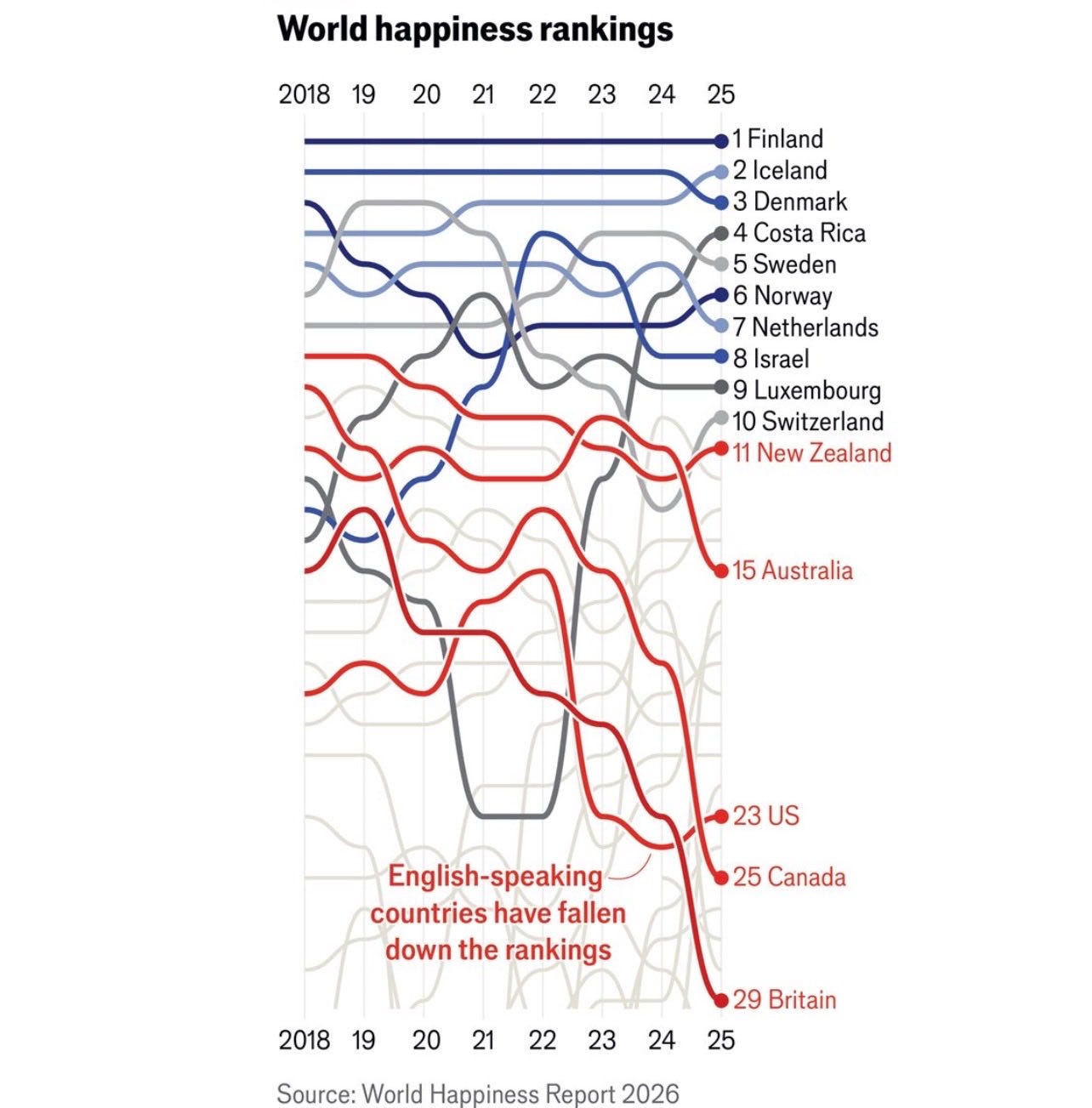
Anglosphere miseryThe Economist points out that English speaking countries are becoming increasingly miserable: “nearly twice as many countries have grown happier over the past two decades as have become less so. The English-speaking world is a clear exception: for the second year running, no country in the Anglosphere made the top ten.”
What is going on? Not smartphones in this case as Finland and Iceland and Denmark have smartphones too. I wonder if it’s that we’re all plugged into America’s nation-wide nervous breakdown and all the terrible ideas it is generating. Could it also be that the Anglosphere provides a huge, competitive market for online content and therefore supercharges incentives for developing toxic ideologies and mad influencers? Perhaps there is just not that much mileage in being a deranged manosphere type in Finland as there is a clear ceiling on your potential audience. Only a thought.
Keats ConversionI’m reading Walter Jackson Bate’s biography of Keats and loving it. It’s a very enjoyable book on its own terms but it’s also converting me to Keats’s poetry. I’d always been a bit of a Keats sceptic (too sugary, too twee) but it’s all clicking into place for me now. The poems are dense with this kind of intensity of genius which (as Bate says) you don’t really get anywhere outside of Shakespeare. I’ve been listening to this recording of St Agnes Eve on Spotify. You have to get past the fruity voice (a hazard of poetry recordings) but I think it’s a great reading:
Until next week!
James
Thanks for reading Cultural Capital! Subscribe for free to receive new posts and support my work.
From Cultural Capital via this RSS feed