


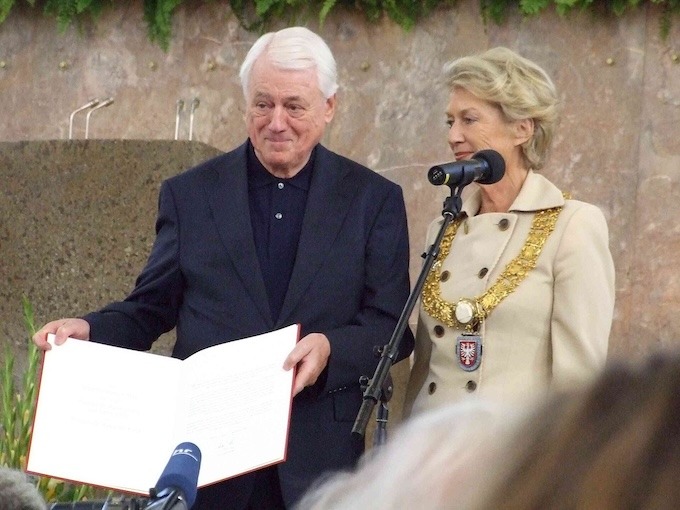
Alexander Kluge receiving the Adorno prize in Frankfurt, Germany, 2009. Wikimedia. CC BY-SA 3.0
A Renaissance man who survived the modern terrors of total war, Alexander Kluge died this week in Munich at the age of 94.
He might not have made it past 13. His hometown of Halberstadt, near the geographic center of Germany, was destroyed by aerial bombardment just a month before the end of World War II. American bombers had been diverted from other higher-priority targets because of cloud cover and instead laid waste to this city of no military, industrial, or strategic importance.
Kluge confronted this catastrophe exactingly and dispassionately in his 1977 book, Der Luftangriff auf Halberstadt am 8. April 1945 (The Airstrike on Halberstadt on 8 April 1945**). Mixing prose, diagrams, drawings, and photographs, Kluge juxtaposed the quotidian— inhabitants going about their lives in a time of war—with the bureaucratic structures of destruction so inexorable that even a white flag hung from the highest church steeple would not, he claimed, have prevented the Americans from dropping their bombs. It is a devastating, unforgettable book, only translated (as Air Raid) into English in 2014. One might well think that the Americans did not want to hear about their detached, ruthless killing of civilians by their own armed forces. Air Raid should be required reading for Erika Kirk and every cadet at the U.S. Air Force Academy, and not just when children are being obliterated from above in Gaza and Iran. Kluge’s own experience of the attack on Halberstadt is never mentioned in the book, even though he only narrowly survived when a bomb exploded thirty feet from his house. He was a lifelong pacifist.
After the war, Kluge left Halberstadt with his mother and finished high school in Berlin, then studied law, history, and church music. He was mentored by Theodor Adorno in Frankfurt.
After turning away from a career as a jurist, he became towering presence in postwar German life: filmmaker, author, philosopher, historian. Along with Rainer Fassbinder and Werner Herzog, he was a leading force in the New German Cinema that broke with the overwhelmingly sentimental, escapist German movie industry and instead addressed social, moral, and political issues of the present—which also meant confronting the traumatic past.
In a disjointed, nonlinear style, Abschied von Gestern (English title: Yesterday’s Girl) follows a young Jewish woman who has fled the GDR and has difficulty finding her way in a West German city with its consumerist, capitalist values. The movie won a Silver Lion at the Venice Film Festival in 1966. Two years later, Kluge took the festival’s top prize, the Golden Lion, for Artists in the Big Top: Perplexed, about a failing avant-garde circus—an allegory for Kluge’s own sometimes frustrated efforts to help transform German filmmaking.
Fascinated by technology throughout his fantastically productive artistic life, he embraced artificial intelligence in his last years. With it, he produced virtuosically offbeat, archly profound miniatures with dogs in orbit, dinosaurs in the Milky Way, and Jacobins in space. These are available through the online archive devoted to Kluge’s work and curated by Cornell University. It through this initiative that I came to have a long video conversation with him about the organ.
Kluge had been trained as an organist. We talked about music and the curious, particularly German tradition of making music with all four limbs. Halberstadt was a famous organ city. Its cathedral, which escaped in large part the devastation of the American bombing, had an impressive instrument finished in 1362. Even after that prized construction was replaced by newer technology, the original console—with its two manuals with big keys, a keyboard with larger levers for the knees, and even bigger bars for the feet—remained in the church. The console was depicted in a woodcut printed in a seminal book about the organ, Michael Praetorius’s De Organographia, published in 1615. Kluge and I spoke of this long-gone artifact and its representation. We spoke of the many organs of Halberstadt, and other things too: Karl Marx’s German Ideology’ the harmony of the spheres, the unseen labor of organ pumpers treading massive bellows; digital technology and the fingers as interface; solar wind, and the organ’s breath of life.
I had sent Kluge my book, Bach’s Feet, and he said that he liked thinking of the young Bach covering hundreds of miles on foot to go and hear other organists and play famous organs. Kluge cited recent studies that suggested that our hominid ancestors had developed bipedalism first not as a way to spy predators over the long grass of the African savannah, but to move quickly among the branches of trees. When these forbears came down from the trees, they experienced the ground first through the soles of their bare feet. In leather shoes, Bach played on keys of wood, often evoking heaven.
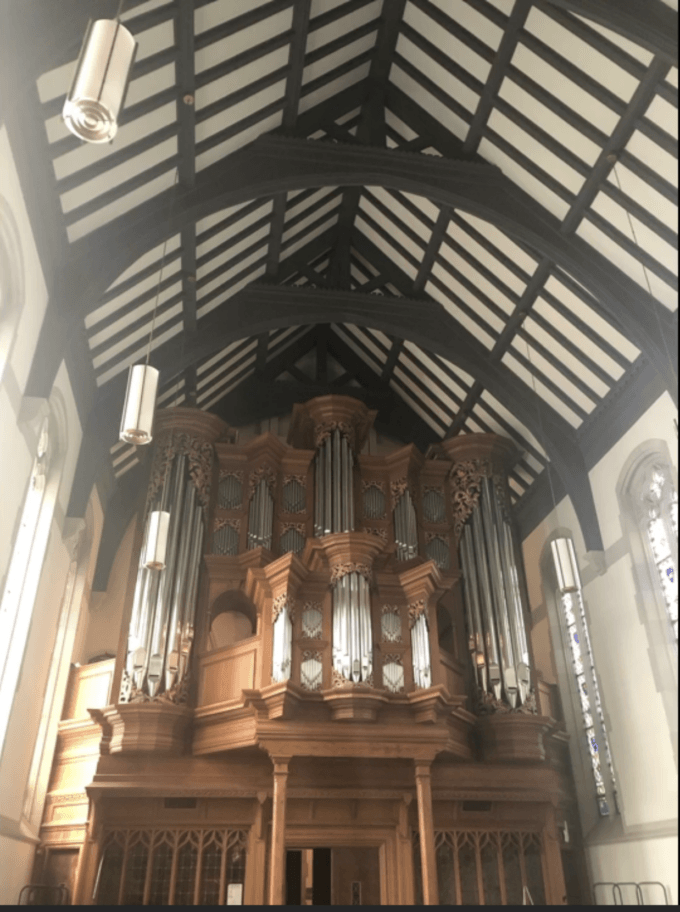
Directly after that conversation, I went and played Cornell’s reconstruction of a Baroque instrument that had been in the Castle of Charlottenburg, that is, in the district of Berlin where Kluge lived after the war. That famous instrument had been destroyed in an aerial attack earlier in 1945.
In the Cornell chapel, I put my iPhone on the altar, pressed “record,” then went up to the organ loft and improvised a prelude to the Symphony of Soles we had discussed. My miniature began with the feet alone playing Renaissance counterpoint—not on the pedal’s biggest and most powerful pipes, but instead using its littlest ones: sweet flutes. This was meant to be an evocation of our ancestors walking on branches. This pedal polyphony then paused on a single pitch, as if overtaken by other thoughts. The music and monkey descended from the tree. A single cluster accumulated, as if the feet were feeling the earth.
Thoughts took flight in fast, rising figures as the drone remained planted on the grass. The creature was upright, standing on the ground, the hands free to grab and gather. I began pulling out more stops, building a crescendo. The stance generated a feeling of power and possibility, terror and triumph, coursing up from the bottom of the feet.
I sent Kluge the recording and heard back from his assistant that he had been delighted and intrigued by the little piece, that he had heard and seen many things in this ad hoc postlude to our conversation.
Kluge’s life was long in human terms, but just a tiny flash measured against the many-million-year spans of his galactic art. He could be precisely attuned to the here and now while contemplating the unfathomable expanse of space and time.
Thank you, Alexander Kluge, for extending the history of musical touch all the way back to our ancestors singing and swaying on branches and then landing on the ground below. Thank you for encouraging me to feel the miraculous, calamitous past and thrilling present from the bottom up, through the contact of living surfaces with human soles.
Kluge at work: Sohlen-Symph
The post Symphony of Soles: A Tribute to Alexander Kluge appeared first on CounterPunch.org.
From CounterPunch.org via this RSS feed
You must log in or # to comment.