

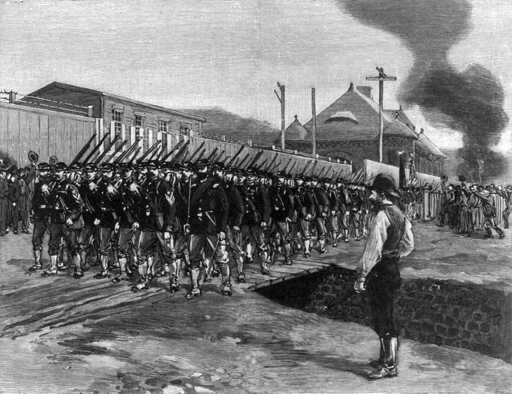
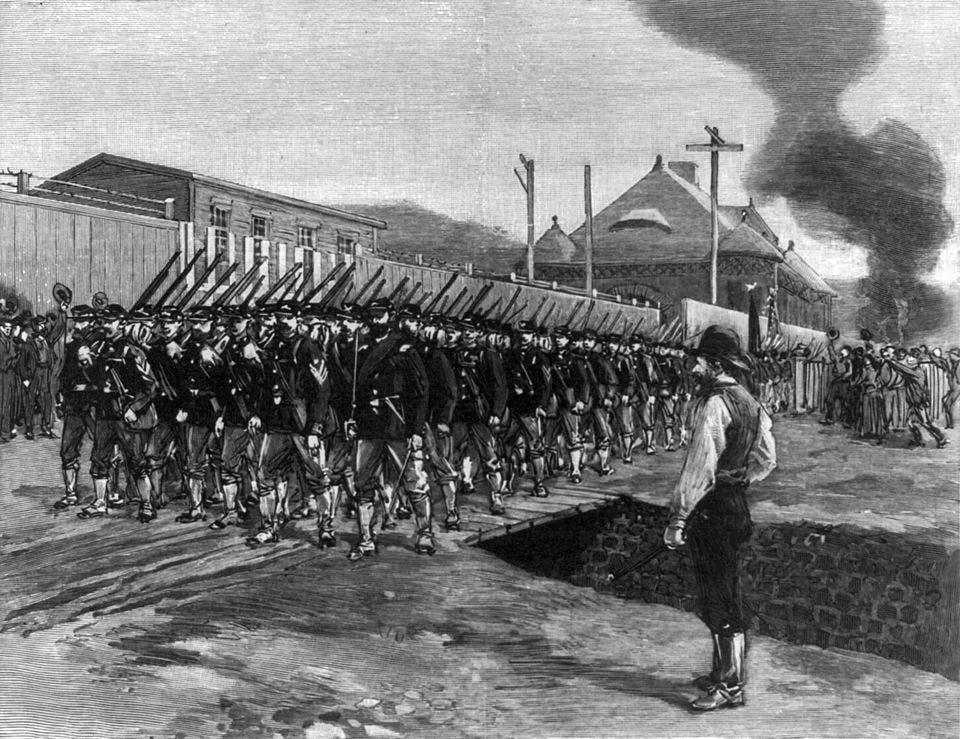
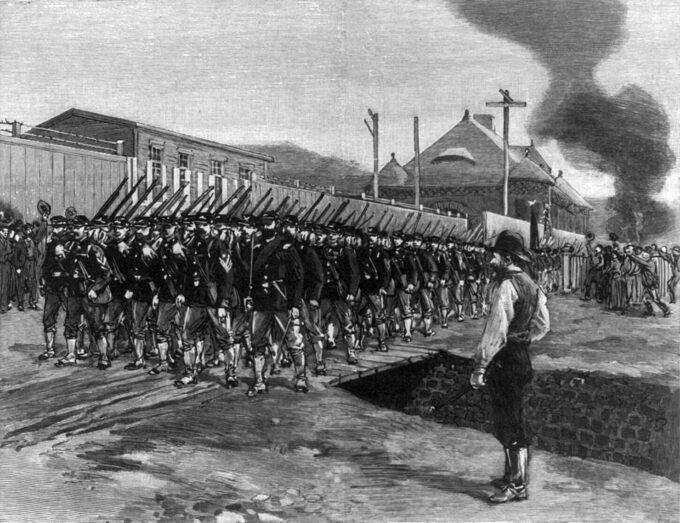
The First Troops in Homestead. Thure de Thulstrup, Public domain, via Wikimedia.
We’ve always had inequality. Go back to feudal Europe — the peasant bound to the lord’s land, the serf who could not leave, the villager whose labor fed a castle he would never enter. The hierarchy was absolute, brutal, and barely concealed. But it was also local. The feudal lord and the peasants he exploited breathed the same air and walked beneath the same trees. Even the most distant king knew that peasants had pitchforks, because kings had felt the sting of them. The Peasants’ Revolt of 1381 in England. The Jacquerie in France in 1358. The German Peasants’ War of 1524. The powerful have always, eventually, been reminded that proximity to the people they exploit carries consequences.
The Industrial Revolution moved that relationship indoors. Factory owners and workers shared, at minimum, the same building, even if management looked down from a balcony onto the production floor. The Gilded Age robber barons — Carnegie, Rockefeller, Frick — were despised figures whose names and faces were known. When Henry Frick sent Pinkerton agents to break the Homestead Strike in Pennsylvania in 1892, it was a brutal and very visible act of class warfare. The strikers fought back. People died on both sides. The relationship between power and the people it ground down remained, however cruelly, clear.
Then came the great distancing. Globalization moved the factory floor to the other side of the world. Financialization, in the 1980s and 90s, moved the source of wealth out of production entirely and into instruments — derivatives, hedge funds, leveraged buyouts — that no ordinary person could see, touch, or name. Under the logic of neoliberalism, we were told the market was magical and also invisible and that this was a feature, not a bug. But it wasn’t the market that was truly invisible. It was the relationship between concentrated capital and political power; between the billionaire class and the lawmakers they funded, between the hedge fund manager in Connecticut and the community that lost its hospital in Ohio that became hard to see.
We see the cruelty. Does Trump see the pitchforks?
That invisibility was its own kind of protection for the powerful.
In his chaotic, wrecking-ball way, Donald Trump is making all these relationships visible again. When he deploys troops and National Guard units into American cities or sends ICE agents, masked and in tactical gear, to seize people from their homes; when two American citizens — Renée Good and Alex Pretti — are shot and killed by federal officers in Minneapolis, the cruelty is not abstract, or far away. It is up close, personal, and filmed on devices we hold in our palms.
Indeed, this administration gets such sadistic glee from punishing and killing that they give their cruelty Hollywood treatment — setting their murderous bombing raids to Top Gun music and making a bloodcurdling point of celebrating a war that most Americans never asked for, and Congress never approved. And the president, in social media, personally revels in the deaths of his perceived enemies, and uses AI to shit on his people. Can any of us forget the 19-second AI-generated video he posted to Truth Social within hours of the second No Kings protest? The feudal lord once looked down from his castle. This one looks down from a cartoon fighter jet. The contempt, however, is the same.
It comes at a cost. As of mid-March 2026, just 37% of U.S. adults approve of Trump’s job performance, and his approval on prices and inflation has sunk to a net rating of -39. One Reuters/Ipsos poll found his disapproval rating reaching 62% — the worst since he returned to power — and just 29% of Americans approve of his handling of the economy, lower than any economic approval rating recorded for Joe Biden. The share of Americans who strongly disapprove of Trump has reached a second-term high of nearly 47%. Even among men, a group that helped elect him: Trump won men by 13 points in 2024; his net approval with men is now -7 points, and among men under 45, he is 19 points underwater.
There is almost nowhere the president can go today without being booed. That is not a metaphor. It is a daily, documented fact. And tomorrow, on March 28, it becomes something larger.
This Saturday could be the largest day of domestic political protest in U.S. history, according to event organizers. More than 3,100 demonstrations are expected in all fifty states — roughly one per county in America — fueled by a suburban groundswell that organizers say includes millions who have never marched before.
As Ezra Levin described on our program, the movement has grown from the first No Kings protest in June 2025 to what organizers describe as the third and possibly largest peaceful day of action yet. The second No Kings demonstration in October drew 7 -11 million people nationwide. For this weekend’s protests, roughly two-thirds of more than 3,000 planned demonstrations will be held outside urban areas — in red-state suburbs, in small towns, in places that have never seen this before.
The people of America are angry, Levin told us. They are the ones powering this movement now.
We’ve always had inequality but the feudal lord knew those peasants had pitchforks because he could see them in the field. Finance capitalism spent forty years making sure you couldn’t see the field at all, let alone who was standing in it. What Trump has done — unwittingly, clumsily, in his brutish, Trumpian way — is rip away the scrim.
The agents are masked, but their cruelty is visible. The courts are being defied in the public square. The billionaires are photographed at the inauguration – and on Jeffrey Epstein’s island and at his rape parties. The survivors, the accusers, the angry and the believers — the peasants of this time are not carrying pitchforks. They are carrying signs and phones, and linking arms, and they are showing up by the millions — in Democratic-majority cities, yes, but also in Bismarck and Fargo and Salt Lake City and places where assumptions were made before.
Do they have pitchforks? Trump and his team may be wondering that today. So are we.
The post Thanks to Trump, the Cruel Hand of Exploitation is Invisible No More appeared first on CounterPunch.org.
From CounterPunch.org via this RSS feed
You must log in or # to comment.