

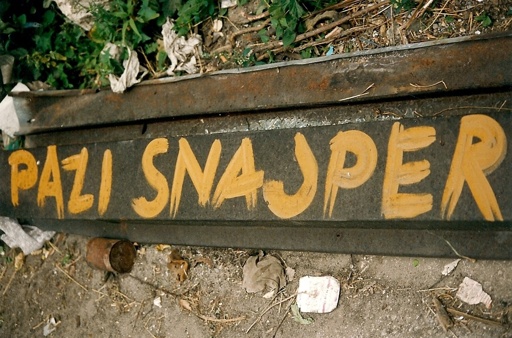
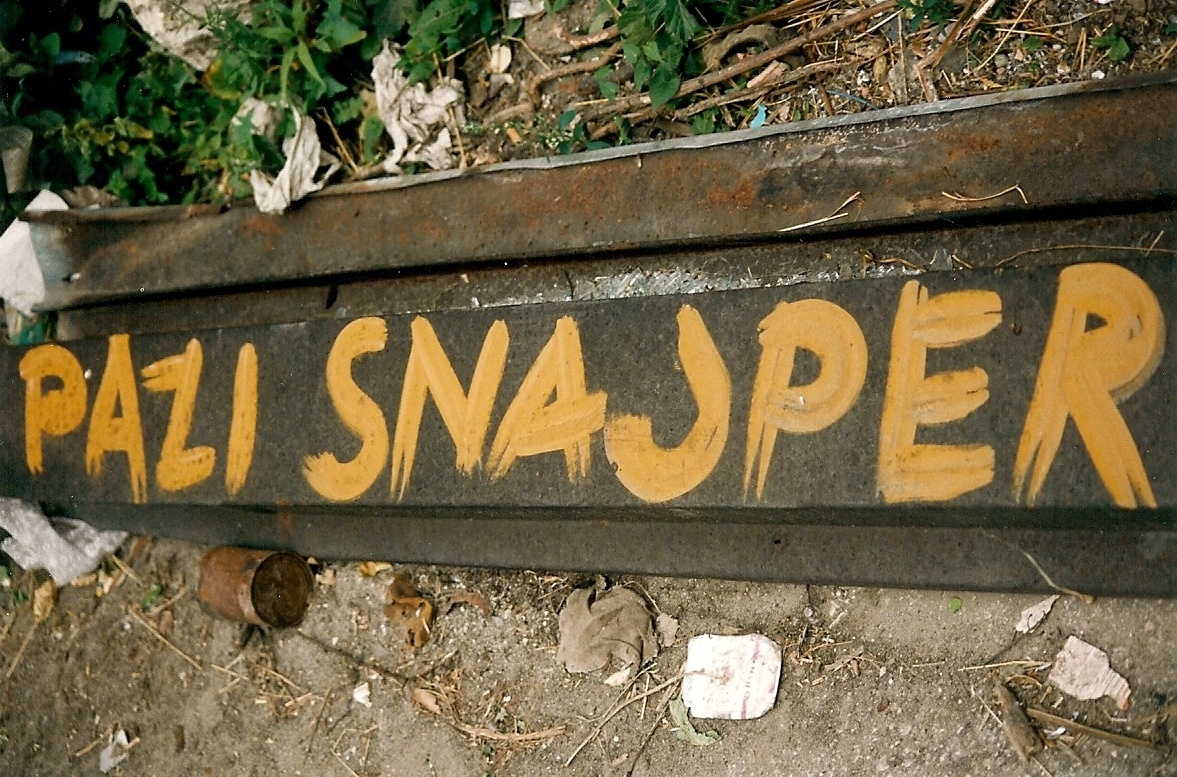
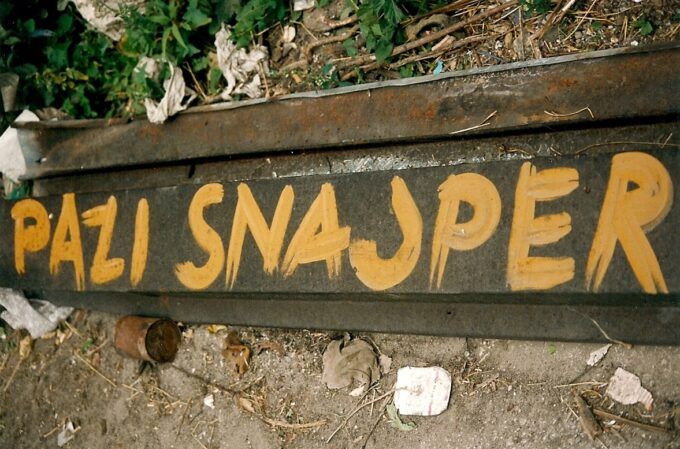
Photograph Source: Paalso – CC BY-SA 3.0
The story of the so-called “Sarajevo Safari” – the alleged arrival of wealthy foreign individuals to positions around the besieged city during the Bosnian War (1992–1995), in order to shoot at civilians – now stands at the intersection between a historically documented phenomenon and a still unproven criminal pattern. What can, however, be reliably reconstructed is the path by which this story, over the course of three decades, moved from newspaper columns into the realm of international investigations.
The first trace leads back to wartime 1995. At that time, the Sarajevo daily Oslobođenje published an article titled “Sniper Safari in Sarajevo,” relaying claims from the Zagreb-based Vjesnik, which in turn drew on reports from the Italian press. These articles marked the first appearance of the claim that wealthy foreigners were coming to positions above the city to shoot at civilians. Although lacking any judicial scrutiny at the time, this archival record shows that the story was not a later fabrication, but a contemporary wartime narrative already circulating in the media:
The Turin-based La Stampa, as its contribution to this grim report, carried what it presented as the authentic testimony of its correspondent. Giuseppe Zaccaria wrote that, in Pale, a year or two earlier, a “gentleman in the uniform of the Serbian army” had led him to the edge of his garden, to a shack barely larger than a doghouse. On the floor lay a rubber mattress; on the opposite wall, a small window, with a sniper rifle set into it. “Look,” the “gentleman” offered. Through binoculars, one could clearly see people running across “Sniper Alley” between the Holiday Inn and the skeletal high-rise that had once been the Bristol Hotel. An elderly woman appeared in the crosshairs.
However, even a basic verification of geography and ballistics seriously undermines the credibility of this account. Pale lies approximately 15–20 kilometers in a straight line from central Sarajevo, while the Holiday Inn is located in the very heart of the city. The effective range of standard sniper rifles used during the Bosnian war (such as the M76 or SVD) typically extends to around 800–1000 meters for accurate fire, with maximum ranges of roughly 1200–1500 meters under exceptional conditions. The distance between Pale and “Sniper Alley” far exceeds these parameters, rendering the described scenario practically impossible.
In that sense, the fact that the text in Oslobođenje was reproduced from foreign press — rather than based on direct Sarajevo reporting or reliable local sources — ultimately does more to obscure than to clarify the phenomenon. Instead of exposing a possible criminal network, such a narrative, burdened with obvious geographical and technical inconsistencies, casts doubt on the entire story and opens space for its dismissal as propaganda or sensationalism. Anyone with even a basic knowledge of Sarajevo’s topography and wartime front lines would have struggled to produce such an account without serious factual errors.
An additional and particularly important archival trace comes from the Italian press of the same period. In March 1995, Corriere della Sera, in its “Cronache Italiane” section, published an article titled “Turisti per fare la guerra” (“Tourists to Make War”), describing foreigners who spent weekends in war-torn areas of the former Yugoslavia, taking part in combat and killing for entertainment. In that context, the name Emanuele Toreggiani appears – a 37-year-old from Magenta, director of a local newspaper and former deputy mayor – who, according to the article, repeatedly traveled to Mostar, organizing or facilitating the arrival of groups of Italians, specifically in areas of the city under the control of the Croatian Defence Council (HVO). These trips reportedly involved transportation, accommodation, local contacts, and movement through the war zone, often combining humanitarian activities with overt wartime adventurism. Renzo Bera, a car dealership owner, is also mentioned as part of this circle.
While the article does not explicitly claim that these individuals participated in sniper killings of civilians in Sarajevo, nor does it link them to specific crimes, it suggests the existence of a broader network of intermediaries who introduced foreigners into the theater of war – not only in Sarajevo, but also in other cities in Bosnia and Herzegovina, such as Mostar, as well as in parts of Croatia.
What is particularly striking, however, is that these early Italian traces — concrete, named, and contemporaneous — have been consistently overlooked or bypassed in later discussions of the “Safari” phenomenon. Despite offering perhaps the most tangible starting point for any serious investigation, they rarely appear at the center of subsequent narratives, which tend instead to rely on later testimonies without fully integrating these initial leads into a coherent analytical framework.
More than a decade later, in 2007, the issue received its first serious legal echo. Before the International Criminal Tribunal for the former Yugoslavia, U.S. Marine John Jordan testified, describing the presence of individuals on Serbian positions who did not resemble local fighters. He referred to them as “tourist shooters” and stated that guides had taken them to sniper positions. Although he did not witness the act of shooting itself, his testimony marked the first moment when this subject moved out of the realm of media rumor and into the official judicial record. Notably, Jordan also pointed to similar occurrences in other war zones, including Mostar, which partially aligns with earlier Italian press reports about a broader phenomenon of wartime tourism.
A turning point came in 2022 with the documentary film Sarajevo Safari by Slovenian director Miran Zupanič. The film brings together multiple testimonies—both anonymous and on record—and, for the first time, systematizes claims about the organized arrival of foreigners to the battlefield. Several unnamed witnesses in the film allege that these individuals were brought to front-line positions by local intermediaries, provided with sniper rifles, and allowed to fire at civilians from elevated vantage points overlooking the city. Some accounts further suggest that such visits were arranged in advance, sometimes over weekends, and that certain participants treated the experience as a form of paid “war tourism.” Among the named witnesses are Edin Subašić, Faruk Šabanović, and Stana and Samir Čišić, the parents of a young girl killed by a sniper during the siege. The film does not constitute legal proof, but it significantly raises the credibility of the narrative and triggers institutional responses.
Shortly thereafter, the Prosecutor’s Office of Bosnia and Herzegovina opened a case, bringing the matter into a formal judicial framework. The investigation, however, has remained opaque, with no public indictments filed—a pattern not uncommon in complex war crimes cases involving an international dimension.
The most recent phase, during 2025 and 2026, has brought the internationalization of the case. Italian authorities have launched an investigation against several individuals, including one identified suspect—an 80-year-old former truck driver from the vicinity of Pordenone—whose identity has not yet been made public. At the same time, it has been confirmed that the case remains active in Bosnia and Herzegovina.
In the same period, new and deeply disturbing details have appeared in media outlets such as Deutsche Welle and Der Spiegel. According to accounts based on witness testimony cited in these reports, the alleged operations may have involved not only shooters but also individuals tasked with counting victims and collecting payment in cash. Some witnesses claimed that a form of “price list” existed, with the cost of killing varying by the type of victim — with children allegedly commanding the highest sums, followed by women, adult men, and the elderly. The same accounts state that spent shell casings were sometimes kept as trophies and marked by color according to the victim: blue for boys, pink for girls, yellow for adult women, red and green for soldiers, and black and blue for elderly men. These claims are highly disturbing, but they remain unverified in court and should be treated as allegations derived from testimony and investigative reporting.
Separately, it is worth recording an additional body of informal testimony. The author of this text, himself a survivor of wartime Sarajevo, has repeatedly heard from former Bosniak university colleagues who spent the war in Dobrinja—a peripheral Sarajevo neighborhood divided between the Army of the Republic of Bosnia and Herzegovina and the Army of Republika Srpska—that Serbian neighbors across the line would warn them in advance about days when “people from outside” were coming to the positions and might shoot at civilians.
The author heard similar accounts from older acquaintances and ARBiH veterans, Naser Husić and Abdulah Bulbul, who stated that VRS fighters would, at times, use walkie-talkies to directly warn ARBiH fighters across the lines about the arrival of so-called “weekend fighters.” According to their testimony, these warnings explicitly advised their counterparts to “keep women and children safe” during those periods. These accounts, while anecdotal and outside formal investigations, nevertheless suggest that the perception of foreign participants was not limited to one side, but was recognized across opposing lines during the war itself.
All of this, however fragmentary and still inconclusive, compels the posing of deeply troubling questions.
If these allegations were to prove true — if wealthy and influential individuals did indeed travel to Sarajevo, Mostar, or other war zones to kill civilians — then what network of local power brokers enabled this, and how was such a system able to function with apparent discretion? Who provided access, protection, and silence?
How is it possible that such claims, circulating since the mid-1990s, remained on the margins for so long, without systematic investigation or public reckoning?
In a broader context of the Epstein files, and in light of controversies and allegations that have occasionally surfaced in connection with international officials involved in Bosnia and Herzegovina — including figures such as Miroslav Lajčák and Jacques Klein — it becomes legitimate to ask whether networks of influence and mutual protection among powerful actors might have played a role in shielding one another. These claims remain unproven and should be approached with caution; however, their very circulation points to a deeper crisis of trust in both domestic and international institutions.
For now, these questions must await further evidence.
Yet one conclusion already suggests itself with uncomfortable clarity: if the allegations surrounding what might more accurately be described as a “Sarajevo and Mostar Safari” were to be substantiated, the resulting scandal would likely transcend regional boundaries. It would not be merely a Balkan affair, but a case of international magnitude – potentially comparable, in its implications for networks of power, secrecy, and impunity, to the revelations associated with the Jeffrey Epstein scandal.
Whatever the ultimate outcome, one point is already difficult to ignore: the wars of the former Yugoslavia created conditions in which the interests of local nationalist profiteers and segments of an opaque international apparatus could intersect in profoundly disturbing ways. If proven, the “Safari” phenomenon would stand as one of the most extreme expressions of that convergence.
If the “Sarajevo Safari” proves anything in the end, it may be this: that war is always a marketplace for the most monstrous traders — and within such markets, the boundaries between victim, perpetrator, and enabler become entangled far beyond what any official narrative is willing to admit.
The post Could “Sarajevo and Mostar Safari” Become Europe’s Epstein Moment? appeared first on CounterPunch.org.
From CounterPunch.org via this RSS feed
You must log in or # to comment.