

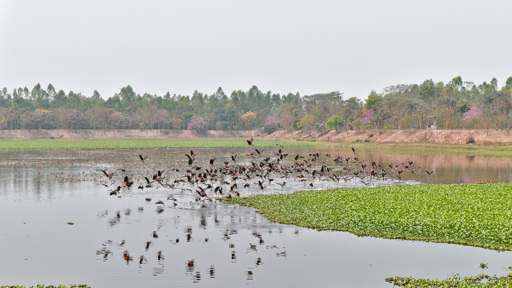
The moment A.K.M. Fazlul Haque learnt that the government had declared two wetlands —Bharardaho Beel and Patuakamri Beel — located in Bangladesh’s northern district of Rangpur as the Special Biodiversity Conservation Area, he smiled with relief, he said. “Our years-long conservation efforts have paid off,” was his immediate response. In Bangladesh, a beel is defined as a large topographically low area that accumulates surface runoff water. As a senior deputy-assistant engineer at the Barind Multipurpose Development Authority (BMDA), the state-run agency responsible for restoring surface water sources, Fazlul, in 2021 and 2023, led the excavation of the two beels that had almost disappeared from the landscape, having been transformed as silted crop field. After excavating the 4.7 hectares (11.6 acres) of Bharardaho Beel, Fazlul and his peers volunteered the plantation of rare indigenous tree species along the ridges. When the BMDA team approached to excavate the nearby Patuakamtri Beel, illegal occupants attacked Fazlul physically and damaged his high-end photography camera, he said. Despite such obstacles, BMDA finally succeeded in the excavation of the 4.5 hectares (11.3 acres) of Patuakamri Beel. Today, both water bodies shelter hundreds of water birds, some of them migratory, and other wildlife around the year. Such conservation efforts are crucial to be replicated in such drought-prone northern regions of Bangladesh where wetlands are depleting fast, experts say. A study published in November 2022 reveals that Bangladesh’s northwest region lost more than 57% of its total wetland area between 1989 and 2020. Md Shafiqul Bari, a professor…This article was originally published on Mongabay
From Conservation news via this RSS feed
You must log in or # to comment.