

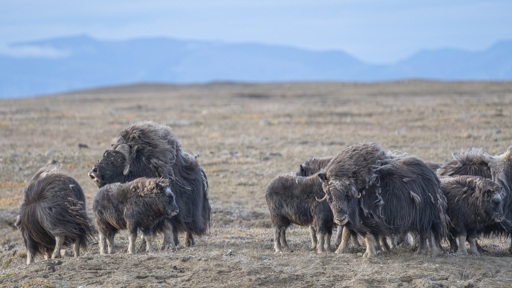
As winter comes to the Canadian Arctic, muskoxen (Ovibos moschatus) abandon the valleys and head to higher ground, where winds sweep away the snow. That’s where we go to find them, Allen Niptanatiak, chairman of the Kugluktuk Hunters and Trappers Organization, tells Mongabay in a video call. The Inuit harvesters focus on culling the younger cows and bulls, leaving the breeding animals alone. It takes a couple hours to skin, butcher and load up the sleds, the older and younger generations working together in -30° Celsius to -35°C (-22° Fahrenheit to -35°F), weather that is “just perfect,” says Niptanatiak, an Inuk hunter and trapper from Nunavut, who is also a retired conservation officer. “Then we eat and have a big meal and just enjoy it and talk and say, ‘Oh, this is a blessing,’” he says. Muskoxen are an integral part of Arctic ecology and, with their thick shaggy coats, are synonymous with the Far North. Nearly driven to extinction by commercial hunting in the early 1900s, surviving in just a few pockets in Canada, they began to recover following a 1917 hunting ban. By the 1990s, the Canadian population was estimated at 108,600. About 70% of the Canadian population was on Victoria and Banks islands, in Canada’s Arctic Archipelago — large islands with a combined area of nearly 290,000 square kilometers (12,000 square miles), about the size of Italy. Niptanatiak lives in Kugluktuk, a small hamlet on the mainland, just across from Victoria Island. Diets vary there, but for…This article was originally published on Mongabay
From Conservation news via this RSS feed
You must log in or # to comment.