

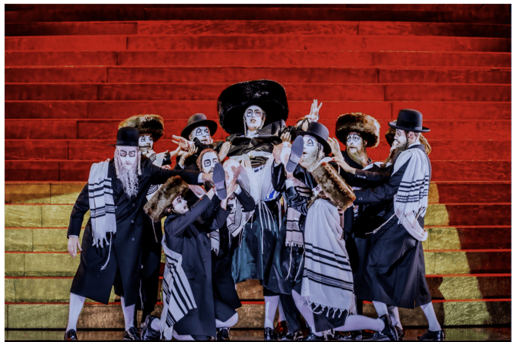
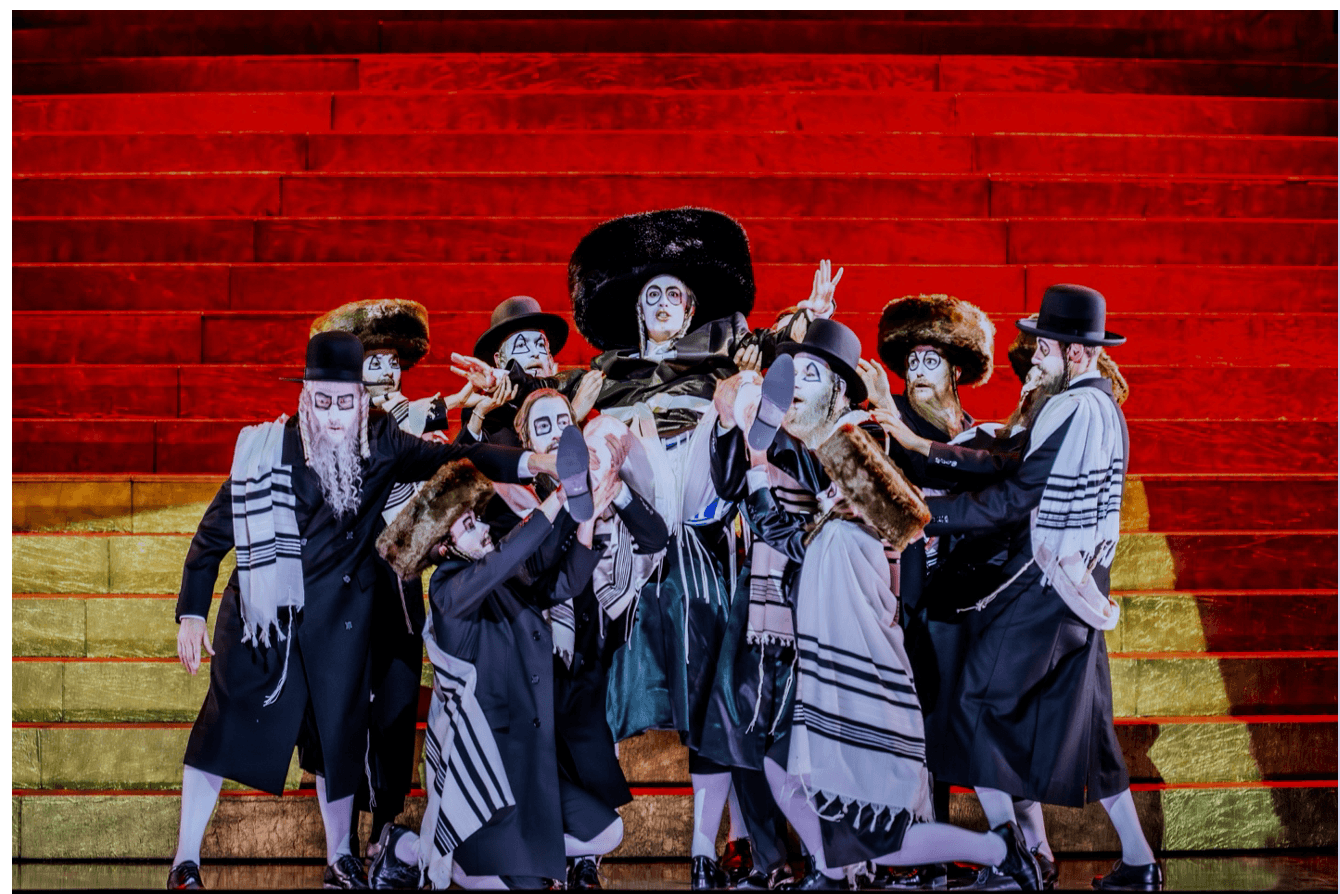
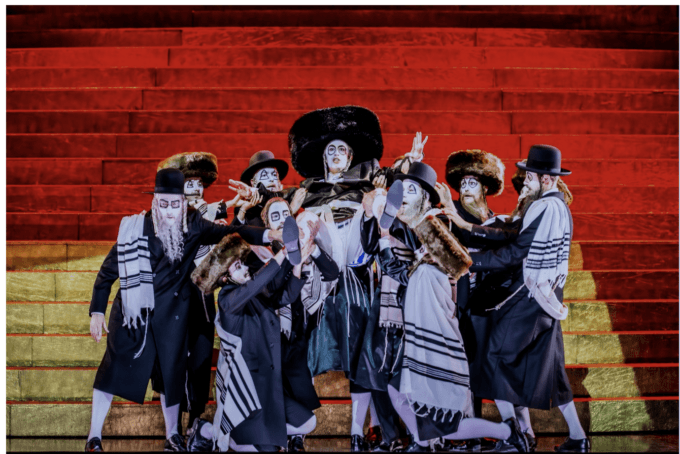
The prophet Daniel (Ray Chenez) held aloft by the Chorus of Jews in Handel’s Belshazzar at Berlin’s Komische Oper. Photo: Jan Windszus.
Handel is now best known for his mighty oratorios. ‘Tis the season for Messiah.
But he was late to that game, deep as he was into Italian opera, the blockbuster genre of the 18th century and the one on which he built his fortunes.
Across the 1730s those fortunes were increasingly sapped by his opera addiction. Feeding it meant paying the celebrity singers of yore like they were soccer stars of the present. Handel also had to contend with increasing competition from London’s other theatrical entertainments and the flagging interest in musical dramas sung in a foreign language. Multilingualism has never been the forte of the stubborn island nation on which Handel landed in 1710 and where he died in 1759.
Oratorio proved the answer to his economic and artistic woes.
On Handel’s 47th birthday—February 23, 1732—a colleague led a performance of the German emigré’sEsther, a dramatization of a tale from the Old Testament in which the annihilation of the Jews is averted by the ardent pleas of the title character, whose own Jewish identity remains hidden from her husband, the Persian King, until the end of the oratorio. Mercy for the evil Persian prime minister who had hatched the plan of extermination is withheld at the close.
The combination of affecting arias and rousing choruses—all sung in English—was a winning one. At a time when the mechanisms of copyright were still not in place, one of Handel’s chief rivals, Thomas Arne, immediately mounted his own performance of the work.
The Bishop of London, Edmund Gibson, was not amused. He promptly banned the staging of biblical dramas in theatres.
But the market offered its own commandments, and these Handel, also a devout Christian, even if of the Lutheran persuasion, obeyed. If others were cashing in on his hits, he would do the same.
At the beginning of May that same year, he mounted his own performance of Esther in the King’s Theatre in London with substantial orchestral and choral forces, appeasing the bishop by assuring him, as the playbill took pains to stress, that “There will be no action on the stage, but the house will be fitted up in a decent manner for the audience.”
By the beginning of the next decade, Handel was all in on Oratorio, Messiah leading the way to the Promised Land of renewed wealth, fame and fulfillment.
But he would have been flabbergasted at many of the uses and abuses to which his music has been put in the centuries since he exited the world’s stage. One of the most astonishing of these developments is the modern staging of his oratorios in opera houses, decidedly so with costumes and acting—in more than a few cases, the more outrageous the better, the late Bishop of London be damned. Decency may have been necessary for oratorio performances back in Handel’s time, but that quality doesn’t sell these days, especially not in Berlin.
Last Saturday night, that city’s Komische Oper (Comic Opera) premiered its new staging of another of Handel’s biblical dramas, Belshazzar. In this one, the eponymous Babylonian King is drinking himself silly for the feast of Sesach even while his redoubt is besieged by Persian forces under Cyrus. Belshazzar’s mother, Nitocris, is worried sick by her son’s debauchery and is also now convinced that the Jews, held captive in Babylon, pray to the one true God. If there is time to put your money on monotheism, it is when the invaders are pounding at the city gates. Hers is the first vocal number in the oratorio—the fretful, hesitating, even terrified, “Vain, fluctuating state of human empire,” that in a few short, soul-searching minutes paints an epic tableau of geopolitical rise and hubris-fueled fall. Her ensuing aria, “Thou, God most high, and Thou alone,” whose first four notes rise upward across seemingly impermissible intervals streaming with visionary colors, portrays her belief not as opportunistic but sincere. Soraya Mafi’s expressively controlled, ardently confessional performance of this mysterious, majestic diptych proved the musical high point of an evening of musical high points.
Belshazzar is having none of it and, against mom’s ardent pleas, doubles down on his drinking binge. In the third of the oratorio’s three acts, the king orders the wine from the sacred vessels taken from the temple in Jerusalem be poured into the party punchbowl. The libretto by Charles Jennens, who three years earlier had collated the biblical texts for Handel’s Messiah, includes this direction: as Belshazzar is going to drink, a hand appears writing upon the wall over against him: he sees it, turns pale with fear, drops the bowl of wine, falls back in his seat, trembling from head to foot, and his knees knocking against each other.
The Jewish prophet Daniel (the airy countertenor, Ray Chenez) is summoned to interpret the obscure message (“Mene, mene, tekel, upharsin”) and he confirms that the writing is indeed on the wall. The Babylonian boss is done for.
The Persians soon storm the palace and slay the drunken despot, and the new ruler Cyrus frees the Jews, victory of the righteous confirmed in a final sublime chorus shot through with trumpet blasts and volleys of “Amen!” commanded with tremendous verve and precision by conductor George Petrou.
Even in these permissive times, especially with bombs falling on Persia and all across the Middle East, prudent types might do well to heed Gibson’s 1732 prohibition against staging these oratorios. But the Comic Opera is notorious for its imprudence, and that attitude, whether born of courage or carelessness or a combination of the two, can lead to startling, even revelatory results.
However, this new staging of Belshazzar by Herbert Fritsch turned butt to Gibson and a blind eye to the writing on its own wall. As Daniel puts it to the doomed dictator, “You have been tried in the balance and found wanting”—make that, in Fritsch’s case, wantonly self-indulgent, exceedingly lazy, and boringly monochromatic even for all the outrageously bright and colorful costumes. Instead of provoking thought or even useful outrage, these rampant crimes revealed nothing about the music, the state of the world or the dilemmas of the characters.
The most basic misdeed was playing a serious drama from start to finish for laughs, incessantly reducing the sublime to the silly. This loss of nerve and creativity not only fails to engage with the content of the work, but also demeans the musicians and infantilizes the audience. Many modern directors take this easy path in their re-interpretations of baroque dramas. Usually, these offences can be classed as misdemeanors. Lacking in ideas and insight, variety and imagination, Fritz’s rampage racked up multiple felonies. The present brief to the court urges that no parole be granted.
The rap sheet is far too long to read out here, but let me start with the most obvious and egregious misdeed. The soccer star singers of Handel’s age commanded their outsized fees largely through the incredible range, speed, and expressive capabilities of their vocal skills. Opera aficionados and professional musicians commented frequently on these qualities, often pointing to one of the trickiest, but also most frequent technical requirements—the trill. This essential maneuver involved rapid, and often accelerating, oscillation between adjacent pitches. The 18th-century term for this was “shake.” All Handel arias have them, often at crucial moments, and inevitably at the final cadences and climaxes. Elsewhere, they are deployed to provide emphasis and emotion to the text. Fritz took a lowbrow, literal approach to this vital stylistic feature. When there was a shake, the singer shook. Maybe one such gag would have been swallowed by the audience, but not when countless times through the evening, the soloists or the garishly clad entourage shimmied as if shocked by their own electro-trills.
On the massive staircase running from top to bottom and front to back of the entire stage of the Schiller theatre, temporary home to the Comic Opera while their house in the center of Berlin is being renovated to the showstopping tune of a quarter-of-a-billion Euros, the foppish and drunken Belshazzar (a campy, but capable Robert Murray) could prance and fall, battling, Benny Hill-like, with his enormous gold cape which when unfurled reached half up or down the steps. When not fumbling with his sail-like train, he fooled with his multi-storied, glittering headgear ziggurat. Perched on, or dangling from, one ledge or another, his royal shakes were meant to appear all the more precarious.
Also near the top of the indictment comes the crime of dressing the Chorus of Jews in Hassidic gabardines, prayer shawls, cartoonishly oversized fur hats, sidelocks, beards, white-face makeup, and oversized mascara eyeglasses of various geometric shapes. The soprano parts were sung by women and rigging them in Orthodox drag was so idiotic it might just barely have escaped the charge of offensiveness.
There is much in Belshazzar that could be brought to the stage to challenge, uplift, and entertain, even allowing opportunity along the way to elicit more than a few laughs. There is no shortage of potential themes in this oratorio, both timely and timeless, that would deserve attention and could animate and engage a theater director: the disastrous self-love and dereliction of political leaders; a mother’s concern for an alcoholic son unfit to lead a nation or even look after himself; egotism and hedonism leading to disaster not just for the elite but for the world; hydroengineering as a military strategy (diverting the Euphrates) and environmental calamity; enslavement and liberation; vengeance and forgiveness.
The fortress of Handel’s music—spectacular in its emotional engineering, thrilling variety, innovative effects—proved impregnable. Fritz’s inane forces put even these battlements to the test. There was collateral damage. Happily, Handel repulsed the assault. Hallelujah!
The post Belshazzar in Berlin: Handel Writes on The Wall of the Comic Opera appeared first on CounterPunch.org.
From CounterPunch.org via this RSS feed
You must log in or # to comment.