

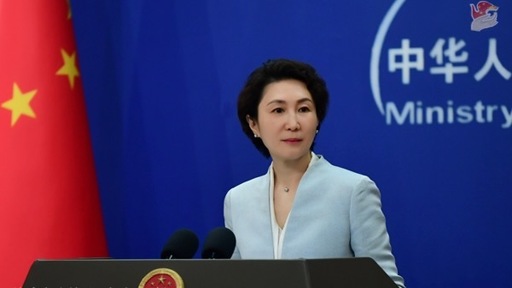
China rejected the use of force as a means to open the Strait of Hormuz and called for the end of the war against Iran, arguing that it is the only way to ensure that the international shipping lane remains open and safe for passage.
Responding to a question regarding US President Donald Trump’s recent call for nations who are affected by the closure of the Strait of Hormuz to intervene directly and “take it” if possible, the official spokesperson of the Chinese Ministry of Foreign Affairs, Mao Ning called instead for deescalation.
“The root cause for the disruption at the Strait of Hormuz is the US-Israeli illegal military operations against Iran. Only by ending the military actions and restoring peace and stability in the Gulf can the international shipping lane be open and safe,” Mao said during a regular press conference on Thursday, April 2.
She also asked the “international community” to work together for deescalation “to prevent regional turmoil from further hitting the global economy and energy security.”
China also reiterated that further escalation does not serve anyone’s interest and demanded that all parties of the war must start engaging diplomatically.
China also warned that, if the war on Iran persists, the world economy and global energy security are going to be severely affected.
Efforts to pressure Iran
The Chinese statement came at a time when the UK, prompted by the US, hosted over 40 countries in a virtual meeting on Thursday, in an attempt to create international coordination to open the strait.
Apart from some countries from Asia and Africa, the meeting was mostly attended by European and Persian Gulf countries.
During the meeting, the UK Foreign Secretary Yvette Cooper accused Iran of “hijacking” the international shipping route and holding the global economy “hostage”.
However, she failed to mention the US-Israeli war, which prompted Iran to restrict movement through the strait.
The countries who attended the meeting also signed a joint statement demanding Iran to stop blocking traffic through the strait and agreeing to contribute in future attempts to open it. However, no specific commitments were made.
Read more: US-Israeli attacks on civilian infrastructure are a form of collective punishment, says Iran
Meanwhile, an attempt on Friday to adopt a UN Security Council resolution on free navigation through the strait was postponed, after some countries objected to the wording of the original draft.
The original draft, as reported in the media, allowed countries to use “all necessary means” to open navigation through the strait, implying the use of military force.
The draft was later revised after China, Russia, and France raised objections, citing that it risks contributing to the intensification of the war in the region. As per the latest draft, prepared by Bahrain, countries are allowed to use “all defensive means necessary” to pass through the strait.
The vote on the new revised draft is expected to be held on Saturday.
Future of navigation through the Strait depends on end of the war
Iran has maintained that the Strait of Hormuz is open for all except those who are involved in attacking the country.
It has allowed scores of ships belonging to various countries to pass through since it imposed the restrictions in early March, reportedly after charging a fee in return for providing safe passage.
Media reports indicate there was increased traffic through the Strait on Wednesday in comparison to most days in March. However, overall traffic (16 ships allowed on April 1) remains far less than pre-war days (on average 130 ships everyday).
Iran imposed restrictions on the movement of container ships through the Strait following the launching of US-Israeli attacks on Iran on February 28. It has called it a significant defensive move and has now claimed that the future of navigation through the Strait would be jointly decided with Oman once the war ends.
Read more: Iran says there is no honesty in US offers for talks, seeks credible guarantees against future aggressions
The Strait of Hormuz, a narrow waterway located between the Persian Gulf and the Gulf of Oman, falls under Iranian and Omani sovereignty. It is crucial for international trade as over 20% of global energy exports flow through it, apart from significant amounts of trade in other commodities crucial to countries in the region.
The post Ending the war on Iran is the only way to open Strait of Hormuz, says China appeared first on Peoples Dispatch.
From Peoples Dispatch via this RSS feed
You must log in or # to comment.