

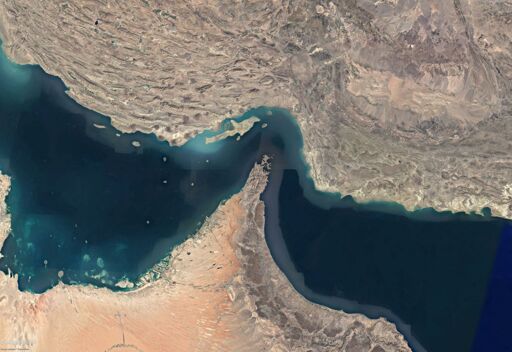
Ukraine is positioning itself as a security partner in efforts to reopen the Strait of Hormuz, after Iran effectively restricted shipping through the critical energy route — but what can Kyiv actually offer?
President Volodymyr Zelensky has offered to help partners with battle-tested weapons and operational experience, citing Ukraine’s efforts to keep maritime exports flowing in the Black Sea despite a Russian blockade.
“We will do what we can,” he told reporters on April 2. “Our expertise in unblocking the Black Sea corridor is very important, and this issue is being raised.”
“If we are involved, we will listen to the proposals and help.”
His comments signal Ukraine’s ambition to transition from a recipient of security aid to a provider — here’s how that could happen.
Why the Strait of Hormuz matters
The Strait of Hormuz links the Persian Gulf to the Arabian Sea and narrows to about 33 kilometers (20 miles) at its tightest point. It runs between Iran to the north and Oman and the United Arab Emirates (UAE) to the south.
While the strait lies within their territorial waters, it is considered an international transit route, allowing ships to pass through without restriction.
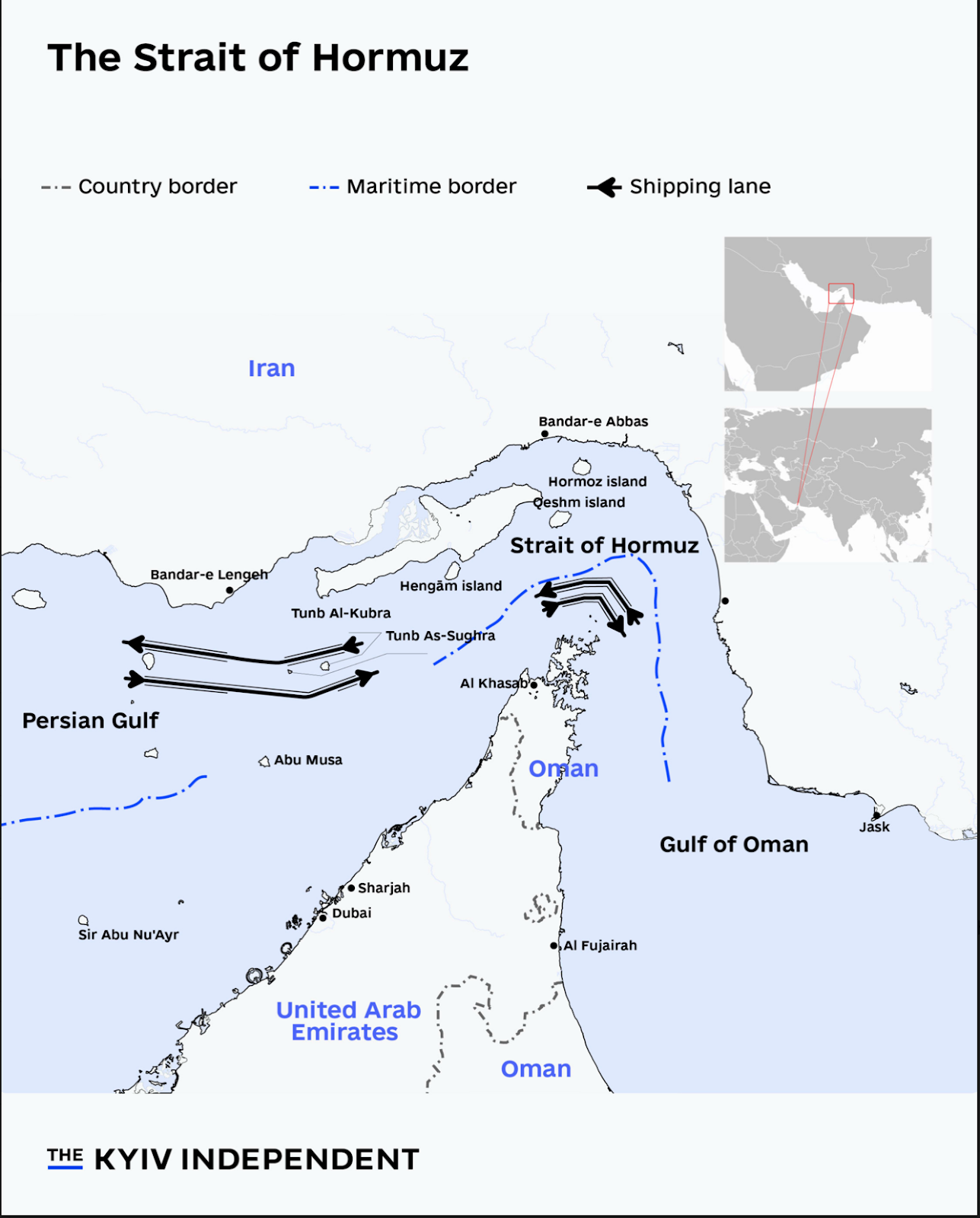
The map shows the Strait of Hormuz, which links the Persian Gulf to the Arabian Sea and narrows to about 33 kilometers (20 miles) at its tightest point between Iran to the north and Oman and the United Arab Emirates to the south. (Nizar al-Rifai/The Kyiv Independent)
In normal conditions, about a fifth of the world’s oil and liquefied natural gas moves through the strait, much of it produced in Gulf countries such as Saudi Arabia, Iraq, the UAE, Iran, and Qatar, and largely destined for Asian markets.
LNG is gas cooled into liquid form for transport, allowing it to be shipped in large quantities before being converted back for use.
Around 3,000 vessels typically pass through the strait each month. However, since Iran’s Islamic Revolutionary Guards Corps threatened to — and did — “set ablaze” unauthorized vessels attempting to transit the route, traffic has dropped by at least 94% during March.
Several commercial ships have been damaged or forced to turn back since the start of the U.S.-Israeli war against Iran, while others remain anchored near the entrance, waiting for safer conditions.
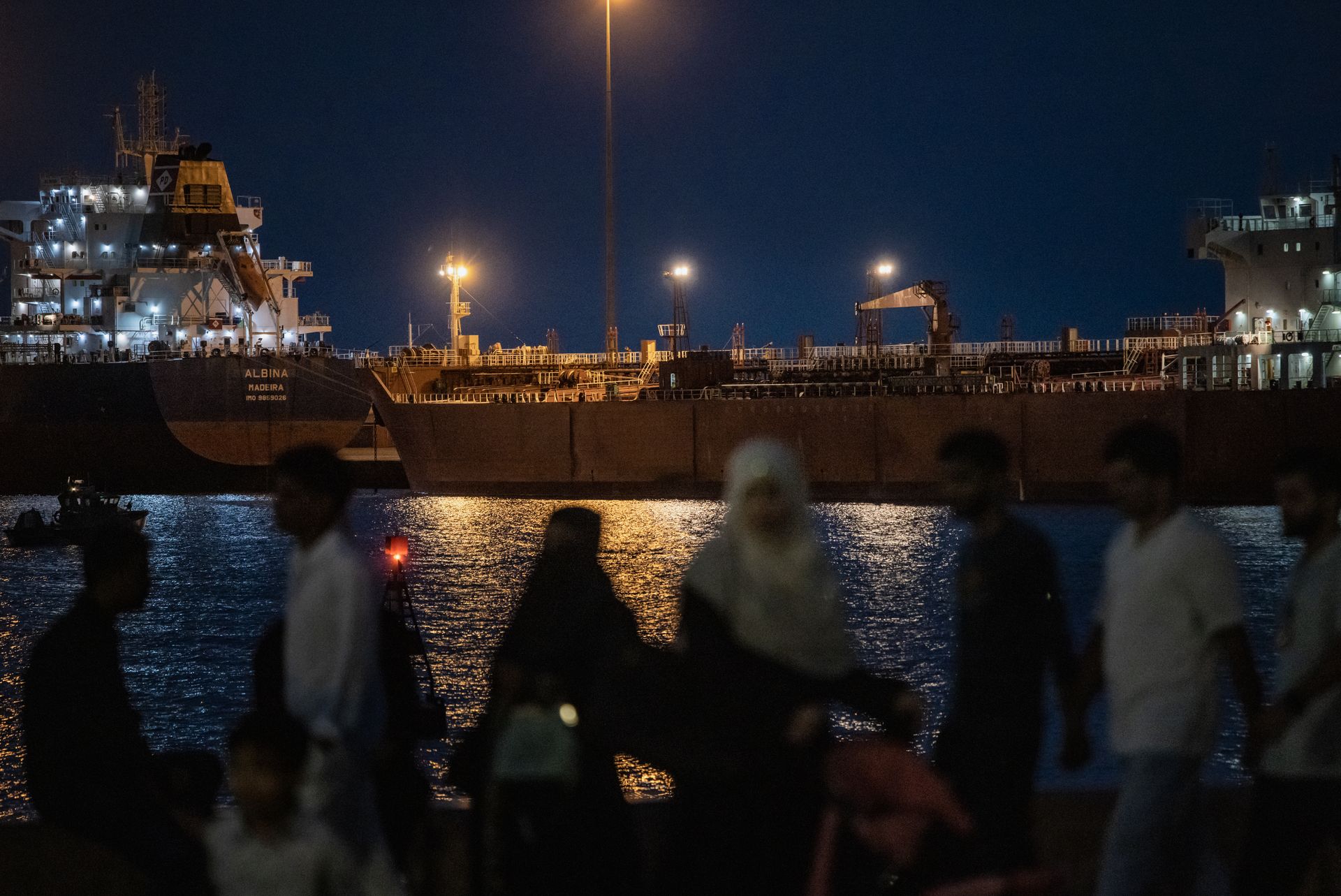
The Albina Bulk carrier sits anchored at Sultan Qaboos Port in Muscat, Oman, on March 22, 2026. Maritime traffic through the Strait of Hormuz has mostly come to a halt. (Elke Scholiers / Getty Images)
Tehran has allowed only limited passage to the Gulf of Oman under tightly controlled conditions, often tied to political alignment or payment arrangements.
This disruption has created a surge in oil and gas prices worldwide amid fears of prolonged supply shortages.
Why Kyiv wants in
The crisis has also exposed uncertainty within Western alliances over who would take the lead in reopening the strait.
While Washington initially signaled readiness to ensure freedom of navigation, that stance appeared to shift.
“As for other issues related to Hormuz, in my view, this is being handled by the U.S.,” the Ukrainian president said earlier this week.
U.S. President Donald Trump later suggested Washington might not intervene directly.
“Build up some delayed courage, go to the Strait, and just TAKE IT…. The U.S. won’t be there to help you anymore, just like you weren’t there for us,” Trump wrote.
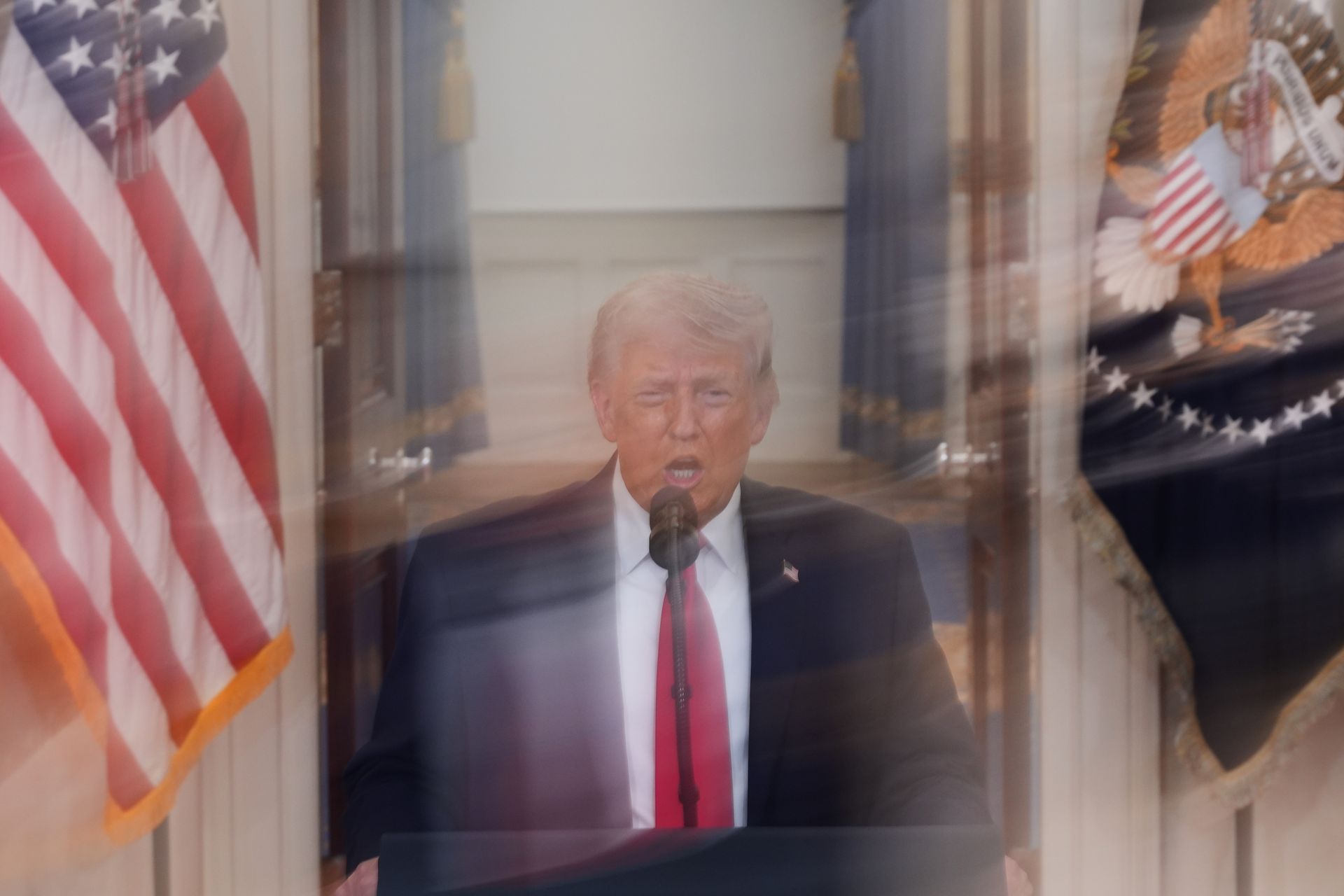
U.S. President Donald Trump speaks during a prime-time address to update the nation on the war in Iran from the Cross Hall of the White House in Washington, D.C., U.S., on April 1, 2026. (Alex Brandon / Pool / Getty Images)
More than 40 U.S. allies held a virtual meeting on April 2 to discuss reopening shipping routes, including plans that do not rely on American participation.
Against this backdrop, Ukraine has presented itself as a partner capable of contributing operational solutions.
Iuliia Osmolovska, head of the Slovak think-tank GLOBSEC’s Kyiv office, said Kyiv is increasingly shifting from a “security challenger” to a “security enhancer” for its partners.
“We have been talking about this transformation since the start of the full-scale invasion,” she said, arguing that Ukraine’s wartime innovations demonstrate its ability to deliver practical security solutions.
She described the Middle East crisis as a “window of opportunity” for Ukraine to expand defense cooperation while strengthening its geopolitical role.
The potential economic benefits are also interesting to Kyiv.
Peter Dickinson, the editor of the UkraineAlert blog at the Atlantic Council’s Eurasia Center, said cooperation with Gulf states could generate revenue for Ukrainian drone companies and attract investment.
“In the short term, it can help generate much-needed revenues for Ukrainian drone companies and financial backing for the Ukrainian state,” he said, adding that deeper ties could follow.
What reopening the Strait would require
Diplomatic efforts to de-escalate the crisis have stalled.
Washington claims progress, with Trump claiming on April 1 that Iran’s new leader had sought a ceasefire, a statement Tehran rejected as “false and baseless”.
In the absence of a diplomatic resolution, reopening the strait against Iran’s wishes requires a coordinated military effort across sea, air, and land.
Bryan Clark, senior fellow and director at the Center for Defense Concepts and Technology at the Hudson Institute, told the Kyiv Independent on April 1 that reopening the strait through military means would unfold in three stages.
First, clearing mines from transit lanes. U.S. assessments suggest that mines may already be present, with some vessels reportedly rerouted closer to the Iranian coastline to avoid them, where passage is more tightly controlled by Iran.
Second, suppressing threats along the coast. Iranian forces could deploy drones, missiles, boats, and other assets from concealed positions, so any effort to reopen the route requires constant surveillance and rapid interception.
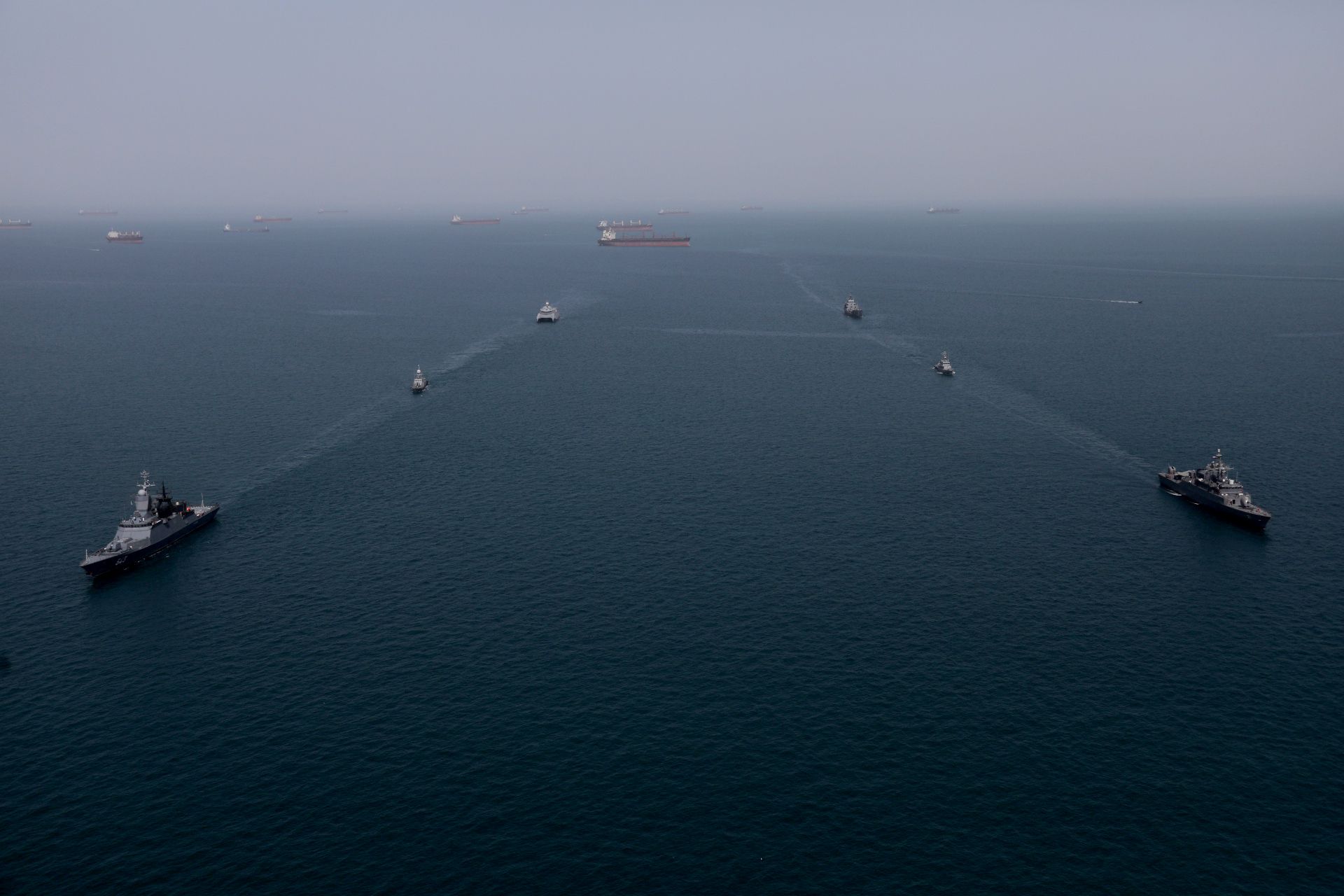
Naval units from Iran and Russia during joint naval drills held at the Port of Bandar Abbas near the Strait of Hormuz in Hormozgan, Iran, on Feb. 19, 2026. (Iranian Army / Handout / Anadolu via Getty Images)
Third, and most challenging, defending ships in real time. Once drones or missiles are launched, response windows are short.
In parts of the strait, shipping lanes run just a few kilometers from the Iranian coastline, where strikes can reach their targets in under two minutes. Interception must therefore happen close to the target, against possible strikes coming from both the air and the sea.
It is in this third stage, defending against fast, low-cost, short-range drones, that Ukraine’s experience and expertise become particularly valuable to the United States and its Gulf partners.
What Ukraine brings to the table
After Russia imposed a de facto blockade of Ukraine’s Black Sea exports in 2022, Kyiv, lacking a viable navy, turned to an asymmetric strategy.
Using missiles, naval drones, and strikes on Russian-run infrastructure in occupied Crimea, it degraded Russian capabilities and pushed its fleet away from the coast.
“Our expertise in unblocking the Black Sea corridor is very important, and this issue is being raised,” Zelensky said.
Alongside military measures, Ukraine worked to reduce shipping risks by partnering with two major British insurers.
In November 2023, it launched the Unity Facility program with Lloyd’s of London and Marsh McLennan to share insurance coverage for non-military cargo vessels.
This combination of military and commercial strategy could prove useful in the Persian Gulf.
In comparison, most Western naval platforms currently deployed in the Gulf are designed to counter high-end threats, such as missiles and aircraft, and rely on sophisticated, costly interceptors.
This model is poorly suited to dealing with swarms of low-cost drones or fast-moving surface vessels that Iran possesses.
Ukraine’s innovative approach, built around scalable, relatively inexpensive systems, is far better suited to countering such attacks.
A central element of that approach has been the rapid development of naval drones. Ukraine now operates a wide range of unmanned surface systems that can be used both for kamikaze strikes against surface ships and, in modified versions, to launch first-person-view (FPV) drones or carry air defense systems.
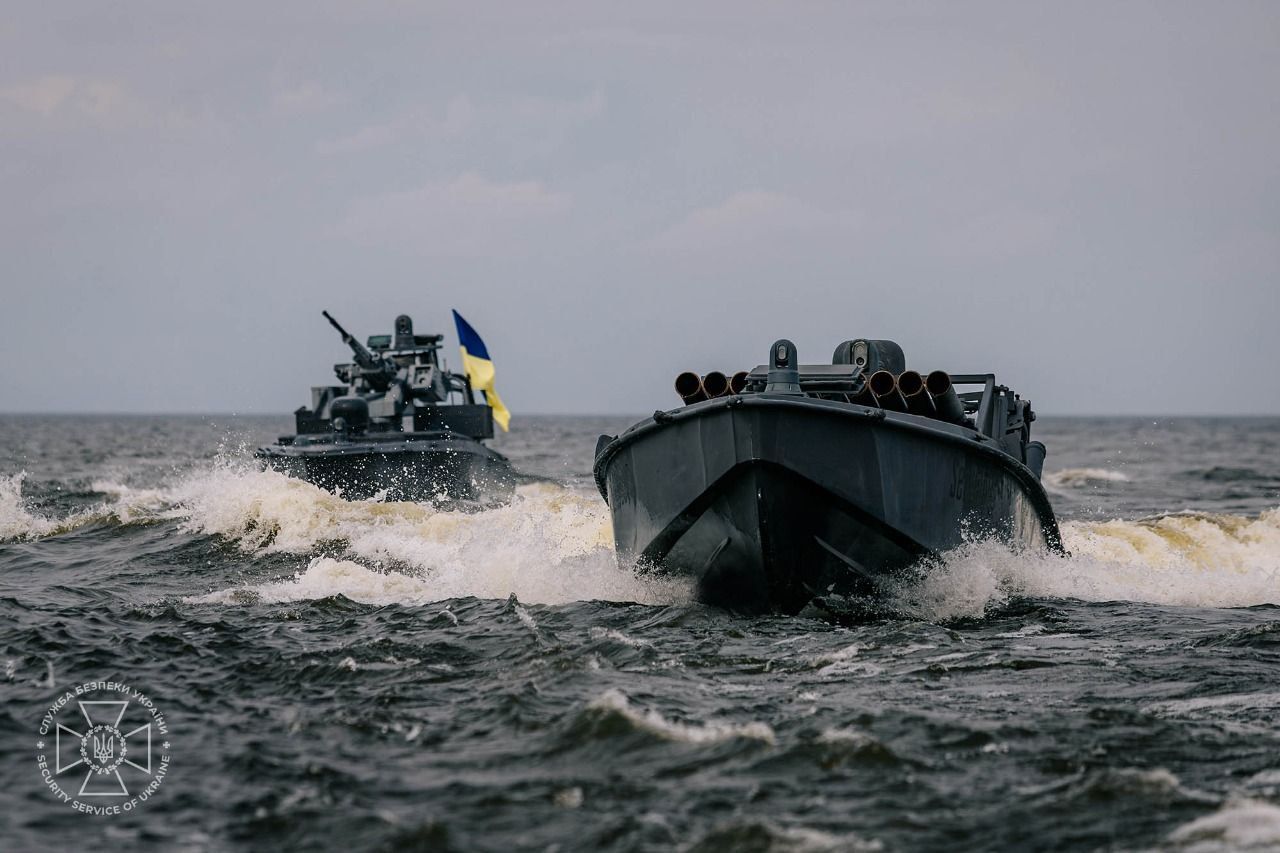
A new generation of Sea Baby drones, released by the Security Service of Ukraine in an undisclosed location, in an undated photo. (The Security Service of Ukraine / Telegram)
Models such as the Magura V5, Sea Baby, and Mamay are among the most prominent. These drones have already proven effective in destroying small Russian boats as well as larger vessels, including the patrol ship Sergey Kotov and the landing ship Caesar Kunikov.
According to Clark, those same systems could be adapted to defend commercial shipping in the Strait of Hormuz by forming a forward defensive layer.
“The maritime drones would basically position themselves between the shipping and the coast and get in front of any maritime drones coming to attack,” Clark says.
Rather than relying solely on escort ships, which can struggle to intercept threats approaching at short range, unmanned systems could operate alongside vessels, maintaining constant coverage.
“They’ll just be sacrificial barriers,” Clarkson says, adding that deploying large numbers of such drones could provide an initial layer of protection for convoys moving through the Strait of Hormuz.
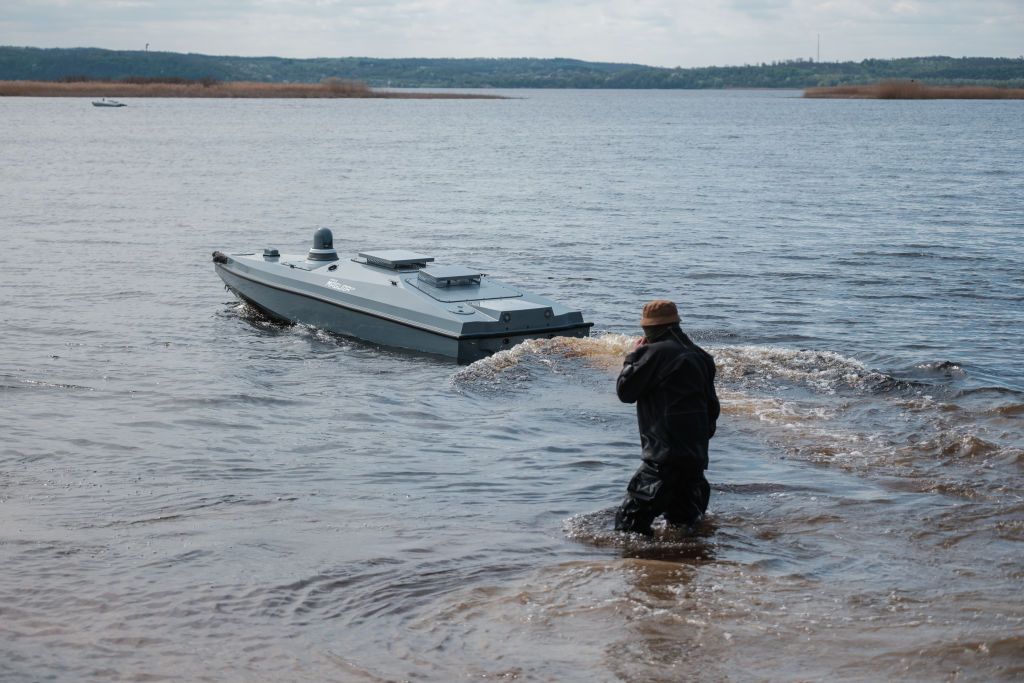
A Ukrainian serviceman of the military intelligence agency launches a naval drone Magura during a demonstration for journalists in an undisclosed location, Ukraine, on April 13, 2024. (Vitalii Nosach / Global Images Ukraine / Getty Images)
This idea would address a key limitation of traditional escorts.
Warships are often positioned slightly ahead of or behind the vessels they protect, making it difficult to engage threats approaching from certain angles or at close distance.
The Ukrainian president also told NewsNation that, in his understanding, opening the route would require “interceptors, military convoys to escort ships, a large integrated electronic warfare network, and other tools.”
“We’re here to help with that,” he added.
Limits to what Ukraine can do
Still, Ukraine’s possible contribution to reopening the strait remains limited.
Its weapons and experience are only applicable to the third stage described by Clark — defending vessels against incoming drones and missiles — and cannot help in clearing mines or suppressing launch sites along Iran’s coastline.
Geography also works in Tehran’s favor. In the Strait of Hormuz, shipping lanes run close to Iranian territory, allowing drones, missiles, and fast boats to be launched from short range, leaving minimal reaction time for defense.
This proximity makes it far harder to create the kind of sustained buffer zone Ukraine was able to establish in parts of the Black Sea.
Ukraine’s defensive model depends on volume. Its strategic contribution would rely on large numbers of relatively inexpensive, often expendable systems.
Applying it to one of the world’s busiest maritime corridors would require a constant supply that, while still fighting a full-scale war at home, it cannot sustain.
Lastly, even if Ukraine could offer sustained military assistance against Iranian attacks, Clark argues that Iran’s ability to disrupt shipping would likely be reduced rather than eliminated.
Ukraine’s contribution would thus act as a band-aid, reducing immediate risks to shipping but leaving the broader threat intact.
Note from author:
Hi, this is Tim, one of the authors of this article.
At the Kyiv Independent, we work with leading experts to deliver you in-depth, accurate reporting.
If you found this article interesting, consider supporting us by becoming a member.
From The Kyiv Independent - News from Ukraine, Eastern Europe via this RSS feed