

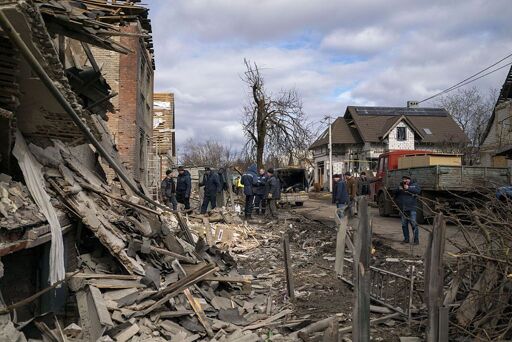
In March, Russia dropped the largest number of aerial guided bombs (or glide bombs) on Ukraine since the start of the full-scale invasion, Ukraine’s Defense Ministry reported on April 3. Russian forces launched 7,987 glide bombs last month — over 1,500 more than the previous record in February. Russian forces also carried out 115,000 artillery attacks, including 2,834 multiple launch rocket systems (MLRS). “Having failed to achieve the desired successes at the front, the Russian army is trying to apply pressure by increasing the number of airstrikes,” the Defense Ministry said. Guided aerial bombs, while having a shorter range than missiles, are cheaper to produce. They are launched from aircraft behind the front lines within Russian territory or Russian-occupied territories — beyond the reach of Ukrainian air defense.They are nearly impossible to shoot down due to their heavy iron construction and their tendency to approach at extremely fast speeds, and from high altitudes, unlike cruise missiles or drones, according to experts.But Ukraine has been able to deploy jammers that divert the bombs away from their targets. In the war’s typical cat and mouse game, Russia upgraded the weapon to overcome jammers last year, pushing Ukraine to develop a new jammer this year. But it’s not just glide bomb attacks that have increase. Russia also launched a record 1,000 drones over a 24-hour period on March 23-24, including a rare mass attack during daytime, killing 7 and injuring around 50. In total, Russia launched nearly 6,500 drones in March. And there’s no signs that Moscow intends to slow down, particularly as U.S.-brokered peace negotiations take a backstage following the outbreak of the American-Israeli war on Iran.
Read also: ‘Sense of constant danger’ — Ukraine scrambles to adapt to Russia’s new aerial attack tactics
From The Kyiv Independent - News from Ukraine, Eastern Europe via this RSS feed