

With more than 6 million members, deep pockets, and an ability to directly disrupt the economy, trade unions are easily the British left’s most important institutions. Zack Polanski has long said that he wants the Greens to replace Labour. Doing this properly will require winning over the labour movement.
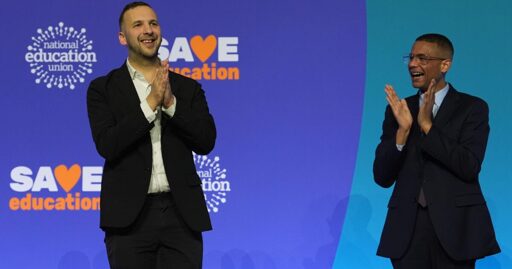
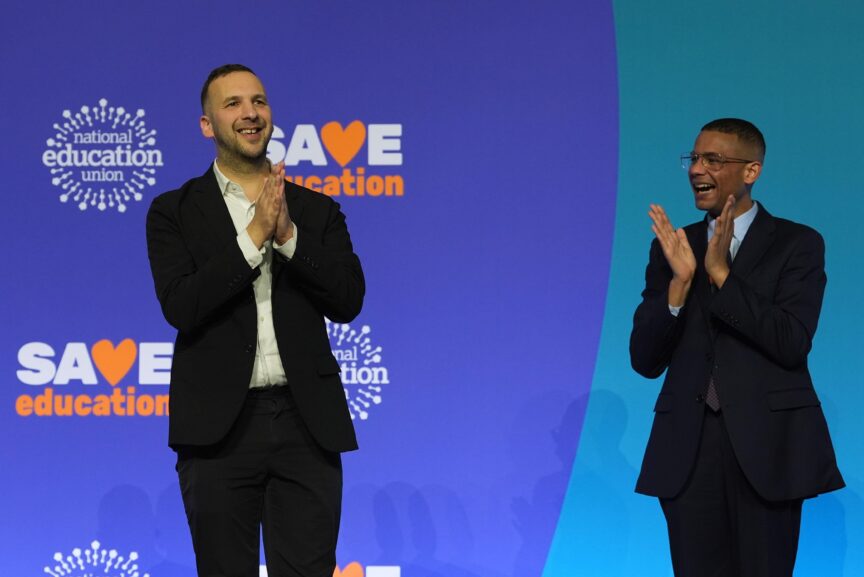
And so the Green leader is setting to work. Last week, Polanski delivered his first major speech at a union conference, telling the National Education Union (NEU) that the Greens would tax the rich, raise teachers’ pay, abolish Ofsted and oppose academisation. He received a standing ovation. Speaking to Novara Media, Polanski said he was “blown away by the warm reception to the speech. It’s really clear that after years of being ignored by Labour and the Conservatives, teachers and school staff are crying out to be listened to by politicians.” The University and Colleges Union and the Bakers, Food and Allied Workers’ Union will also host Polanski at their conferences this spring.
The NEU, one of the UK’s two main teaching unions, is left-leaning, and has never been Labour-affiliated, but two-thirds of its members voted Labour in 2024. In January, polling revealed that less than one in five would do so now; around a quarter plan to vote Green. These numbers reflect a wider collapse in Labour’s support among the general public. Key drivers of this among union members are Starmer’s continued austerity politics, the government’s record on Gaza, and Shabana Mahmood’s harsh anti-migrant measures.
Paul Valentine and Kate Jones are the joint trade union liaison officers on the Green Party’s national executive, a role whose existence long pre-dates the current surge. “It’s clear to a lot of people in the union movement that the affiliation model is not serving the needs of workers,” Jones said. The relationship between Labour and the unions has patently degenerated, with unions being dragged away from industrial fights and their own members’ interests by their proximity to Labour. Their immediate aim is to get unions to break with Labour, rather than to affiliate to the Greens. “What we’re doing is much bigger than partisan politics”, Jones explains, “it’s about a pluralist perspective on the labour movement.”
The pair are pushing at an open door. “When I did this job in the late 2010s,” says Paul Valentine, “things were very different. I spent ages doing political education because lots of Greens honestly didn’t know much about trade unions. Now, it’s easy to make the case that trade unionism and Green politics are two sides of the same coin.”
‘The end of the line as far as Labour is concerned.’
For Labour, unions aren’t just any stakeholder: they founded the party, and appoint representatives to its national executive and other committees. Labour-affiliated unions get decisive bloc votes at party conference; their members vote in leadership elections.
The influence of the unions on Labour hasn’t always been a progressive one. In fact, union bureaucracies have historically been key allies of the Labour leadership in managing the party internally, moderating the more radical inclinations of party members. Even during Jeremy Corbyn’s leadership, unions played a key role in blocking open selections for MPs, and in preventing conference debates on tricky topics like Brexit and immigration policy.
Under Starmer, the union affiliation system is breaking down, and on both sides. Affiliated unions are now overwhelmingly led by figures aligned to the left, and even if union leadership wanted to stay in Labour, their members have begun to look elsewhere. Rather than court the labour movement, Starmer has consciously antagonised it and the wider left, refusing to back industrial action, maintaining a rigid adherence to fiscal rules, and taking more money from corporate donors than from the unions.
Now, the chickens are coming home to roost. In September, Andrea Egan was elected general secretary of Unison, Britain’s biggest union and a Labour affiliate, in a revolt against what she described as a “subservient approach” to Labour. Egan was herself expelled from the party in 2022 for sharing social media content from a banned socialist group, though she has not explicitly come out in favour of disaffiliation.
Unite, another Labour affiliate with around a million members, is further down the road. In response to the Birmingham bin strikes, where its members have been on the receiving end of a fire-and-rehire policy backed by the Labour government, the union voted to “re-examine” its relationship with Labour at its conference last year. It also suspended several senior Labour figures, including then-deputy prime minister Angela Rayner, as members. On the anniversary of the strike last month, Unite cut its funding to Labour by 40%, with general secretary Sharon Graham warning that “Unite members are coming to the end of the line as far as Labour is concerned”.
Despite these strong words, the “big two”, Unite and Unison, are unlikely to move quickly. Unison has an arcane “Labour link” system that insulates its affiliation from being dissolved by a simple conference vote. Unite is affiliated in its rule book and will have to wait until summer 2027 for its next “rules conference”, unless an emergency one is called. The medium-sized Labour-affiliated unions, GMB and Usdaw, are led by Starmer allies – though Valentine is confident there are “pockets of grassroots resistance” in both.
Smaller, less bureaucratic unions are likely to be the canary in the coalmine. A number, including the Communications Workers Union, have Labour disaffiliation motions on their conference agendas this spring.
For Polanski, the opportunity is clear. “Historically, most trade unions have been very strongly linked to the Labour party”, he said, “but that link is starting to break as it becomes clear the Labour party is no longer the party of working people.”
Green baggage.
Like all political parties, the Greens come with baggage. “There is just a reality that when the Greens have been in power in local government, they haven’t always been rock solid defenders of workers”, a member of Unite’s national executive and Green party member said.
As recently as 2021, the Green-led Brighton and Hove Council had its own bin strike, placing the unions and the Greens at loggerheads. Unite’s attitude to the Greens, the Unite executive member says, “will depend on how briefcase-y it gets, and how much the Greens can really become a party of and for working-class people. Hannah Spencer was a good candidate from that perspective.”
Emma Runswick is deputy chair of council at the British Medical Association (BMA), the UK’s main doctors’ union. “The BMA is non-partisan and has no political fund, but plenty of BMA activists are joining the Greens,” Runswick told Novara Media. “It isn’t an organised shift in the same way that leftwing doctors and students joined Labour in 2015, more of a steady trickle. There is less interest in party politics on the left now, partly because of the experience of Corbynism and a will not to repeat the mistake of subsuming everything into electoralism.”
2022 and 2023 saw a wave of cross-sector strikes over pay, by some measures the biggest since the 1980s. When Keir Starmer instructed his shadow cabinet not to attend picket lines, the Green party’s councillors, assembly members and its only MP, Caroline Lucas, visited regularly. For BMA members, for whom the strike wave is effectively ongoing – they were on strike as recently as December, and are on strike again this week – the Greens’ support matters immensely.
“Polanski made a huge impact during the recent wave of strikes,” said Runswick. “He was really the only big politician who didn’t buy into any discourse about workers competing with each other, or doctors being greedy.” His broadcast clips on shows like Good Morning Britain were shared widely among doctors. The r/doctorsUK subreddit, which gets 3.5m views a week, was awash with support for the Green leader. “Maybe full pay restoration can be achieved through the power of hypnosis”, joked one user.
A slow burn.
The exact shape of any relationship between the Greens and the unions is only beginning to be sketched out. The Unite executive member I spoke to views the current model of party affiliation as “very bureaucratic and not good for building relationships between union activists and politicians”. Much better, they say, would be to “have the union participate through branches, on a regional basis or on a sectoral basis – which would make politics much more democratic and led by workers.” The union could continue to make big national-level donations, but would not be bound only to donate to Labour.
Decentralising political strategy could come with risks as well as upsides, however. With democratic participation low, any political group could theoretically extract donations from union branches. In some parts of the trade union movement – especially those with older, male-dominated memberships – that could mean Reform UK. Nigel Farage’s party has already made a point of appealing directly to workers, calling for the nationalisation of steel in response to threats to Scunthorpe steelworks, and opposing job losses at Prax Lindsey oil refinery in Lincolnshire. Unions would have to explicitly bar certain parties from receiving support, or block on a case-by-case basis.
There is ample precedent for unions taking a politically independent approach. Since the National Union of Rail, Maritime and Transport Workers (RMT) was expelled from Labour in 2004 for endorsing the Scottish Socialist party, it has made donations to numerous leftwing Labour figures, as well as Green MP Caroline Lucas. It has also supported the Trade Union and Socialist Coalition and initiated No2EU, which ran in EU parliamentary elections in 2009 and 2014.
While Labour’s grip on many unions might seem precarious, the status quo could prove stubborn. “A lot will depend on who the PM is,” said the Unite executive member I spoke to. Were Starmer to be replaced, “some activists currently backing disaffiliation could be swayed back by a genuine social democratic offering.”
In reality, trade union bureaucracies tend to be risk-averse. Some will be looking for a reason to return to a safe equilibrium of staying in Labour while grumbling, with varying degrees of gusto, about its shortcomings.
The deciding factor for many unions will not be which party best reflects their values, but which can deliver in government. Polanski is right to point out that Labour has “U-turned on key workers’ rights measures like day-one protection against unfair dismissal”. But the Employment Rights Act, however watered-down, is still a landmark piece of legislation, and the first time since Thatcher that anti-strike laws have been rolled back.
The Green party says it would go much further, but its first challenge is electoral. For many unions, it will be important for Polanski to show his party has a serious prospect of being in government, and that it is best-placed to defeat Reform. From that perspective, the recent Gorton and Denton byelection, and the upcoming local and devolved elections on 7 May, could prove key milestones.
Whatever happens, however, the current Green surge will almost certainly lead to closer ties between the party and the labour movement. “I’m not thinking about this primarily in terms of union leaderships,” said Jones. “They know our door is open, and we’re not expecting everything to happen overnight. What we are going to see in the next year is the party walking the walk on class struggle and labour movement solidarity. Grassroots union members need to know that this is a home for them.”
From Novara Media via this RSS feed