


By World BEYOND War, April 7, 2026
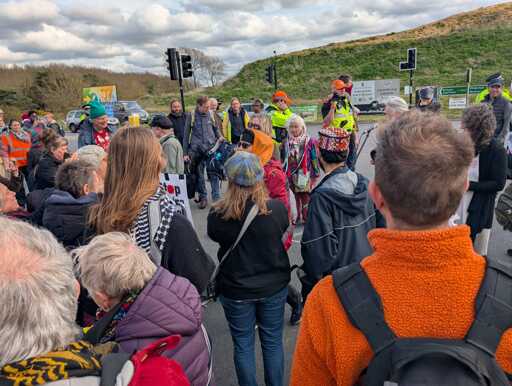
From Friday 3 April to Sunday 5 April 2026, World BEYOND War Education Director Phill Gittins took part in the third annual Lakenheath Peace Camp, organised by Lakenheath Alliance for Peace — a coalition of around 40 groups opposing the return of US nuclear weapons to RAF Lakenheath. The camp marked its third year, reflecting a sustained and growing effort to resist nuclear escalation and militarism at RAF Lakenheath and beyond.
Full programme: Lakenheath Peace Camp 2026
Bringing together activists, campaigners, and organisations from across the UK and Europe, the camp combined protest, public education, creative action, and exchange. It formed part of wider efforts to challenge militarism, resist nuclear escalation, and oppose foreign military bases.
RAF Lakenheath is part of a wider military system linked to war preparation and global force projection. Reporting during the camp also drew attention to that wider role, including claims that a US fighter jet shot down over Iran may have been linked to a squadron based at RAF Lakenheath.
Across the three days, Phill facilitated two workshops and gave a public talk as part of a wider programme of speakers, organisers, performers, and activists.
Friday 3 April — Environment Day
Environment Day focused on the relationship between militarism and the natural environment.
The day began with an early morning nature walk at Cavenham Heath, before returning to the camp and main gate for a public programme that included Phil Laurie of Defend Our Juries speaking on War on Protest. Later in the day, participants took part in War on Nature, a walk to Maids Cross Hill on the other side of the base overlooking the runway.
Phill also facilitated a workshop on war and the environment, exploring how militarism is not separate from the climate crisis, but a major contributor to it. The session explored the environmental costs of war and military activity, which often escape full scrutiny because of weak reporting requirements and loopholes in climate frameworks.
Friday video highlights:


Saturday 4 April — “Give Peace a Chance” Big Blockade
Saturday was the camp’s main public day of action, bringing together protest, music, performance, and public speaking at the main gate.
Speakers and contributors included:
Jacqui Hadfield, Resisting the Manchester Arms Fair****Leigh Evans, retired nurse and Gaza medic, linked to the Freedom Flotilla****Emeritus Professor Lee Marsden, speaking on genocideSophie Bolt, General Secretary of the Campaign for Nuclear Disarmament****Junayd Islam, student activist and poet


Phill spoke about World BEYOND War’s work. He highlighted how discussion of war is often too narrow, focusing on the war of the day rather than the War System. Too often, the focus remains on making war more humane, efficient, or even “green,” rather than advancing abolitionist alternatives. He also connected Lakenheath to the wider network of foreign military bases that enable and sustain war-making.
Performances and actions by groups such as the Red Rebels and Seize The Day helped create a strong and visible public presence throughout the day.
Saturday video highlights:
Sunday 5 April — Coming Together, Rising Up
Coming Together, Rising Up focused on reflection, learning, and building forward from the experiences of the camp.
The day began with a Quaker Meeting, followed by Phill’s workshop on unarmed civilian defense. The session drew on World BEYOND War’s growing list of examples and resources on unarmed civilian defense, as well as its online course on the subject, and explored how communities can prevent, resist, and respond to violence without relying on military force.
Later in the day, the programme continued with a creative workshop from Resisting the Manchester Arms Fair, before closing with music and poetry hosted by the EarthFirst! Network.
Beyond the formal programme, Phill also spent time listening to and learning from people of different ages, backgrounds, and experiences — from those attending for the first time to those bringing decades of activism.
A short accompanying video captures some of these reflections through one shared question: Why are you here, and why does it matter?
Voices from the camp:
Across these conversations, common themes emerged: concern about nuclear weapons, opposition to militarism, the environmental impacts of war, and the importance of public action. Many also spoke about the value of coming together — not only to protest, but to build relationships and strengthen movements.


Part of a Wider Effort
Lakenheath Peace Camp is about more than one place. It is part of wider efforts to challenge the infrastructure of war, including global days of action and initiatives to map militarism and challenge the global network of military bases.
Through education, dialogue, and shared action, the camp helps raise awareness, strengthen relationships, and build support for a different understanding of security and defence — one grounded not in militarisation, but in cooperation, justice, and peace by peaceful means.
What is happening at Lakenheath is both local and global: rooted in a specific place, yet connected to a wider system and a broader peace movement.
More photos and follow-up videos can be found here:https://www.facebook.com/reel/1272242368354852https://www.facebook.com/reel/1458392182490158


The post Lakenheath Peace Camp 2026: Action, Learning, and Resistance at RAF Lakenheath appeared first on World BEYOND War.
From World BEYOND War via this RSS feed