

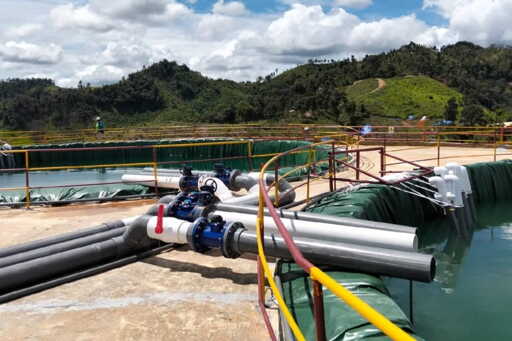
BANGKOK — New data show a recent proliferation of rare earth mines across river basins in Laos, potentially posing a transboundary water pollution threat to Vietnam and the entire Mekong River system. The new findings suggest that Chinese demand for rare earth minerals has led to the industry’s expansion into Laos, even though rare earth mineral extraction is currently illegal there. Research from U.S.-based think tank the Stimson Center has identified 27 rare earth mines that have opened across river basins in Laos since 2022, including seven identified via satellite imagery analysis as having opened this year. Twenty-three of these mines appear to be in protected areas, but it’s unclear whether or not they’re operating with permission from officials. Fifteen of these mines are operating within the Mekong River Basin: 12 on the Nam Khan River and three on the Nam Ngiep River, both of which feed into the Mekong, the roughly 4,900-kilometer (3,000-mile) river that flows from Tibet through Myanmar, Thailand, Laos, Cambodia and Vietnam before emptying into the South China Sea. The Mekong River Basin is a biodiversity hotspot that sustains the lives of more than 50 million people who rely on it for food, water and livelihoods. Another 10 rare earth mines were identified by the Stimson Center on the Nam Hao and Nam Xan rivers, in the Ma River Basin, where they not only pose a transboundary risk to Vietnam, but also to the Nam Xam National Biodiversity Conservation Area on the border of Laos and Vietnam,…This article was originally published on Mongabay
From Conservation news via this RSS feed
You must log in or # to comment.