

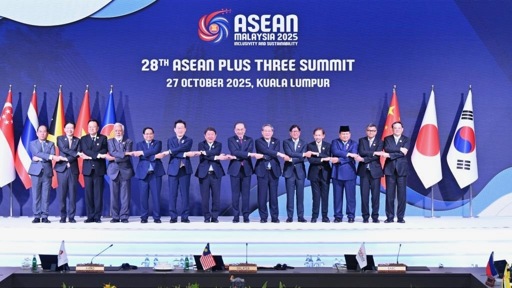
China pitched for greater integration among the countries in the region to defeat the growing protectionism and instability around the world during the 47th ASEAN Summit, which concluded in Kuala Lumpur on Tuesday, October 28.
Malaysian Prime Minister Anwar Ibrahim inaugurated the summit at Kuala Lumpur Convention Center on Sunday in the presence of all the heads of state from the ASEAN nations as well as other leaders.
Along with the ASEAN summit, several other related summits, such as the 28th China-ASEAN summit, the 28th ASEAN+three summit, 20th East Asia summit, and the fifth Regional Comprehensive Economic Partnership (RCEP) summit were also held.
Several global leaders, including US President Donald Trump, Chinese Premier Li Qian, Japanese Prime Minister Sanae Takaichi, Brazilian President Luiz Inácio Lula da Silva, and South African President Cyril Ramaphosa, among others, participated in ASEAN and its related summits.
During the ASEAN summit, Timor-Leste joined as a new member of the 10-member grouping of South-East Asian nations, first formed in 1967. This was the first expansion of the block since 1999 when Cambodia was added as the tenth member.
Based on the theme “inclusivity and sustainability”, the 47th summit focused on strengthening the cooperation among the member states, along with their attempts to widen the areas of mutual interactions with its partners at various levels such as ASEAN+three and RCEP.
RCEP, considered the world’s largest trading block representing over 30% of global GDP, was formed in 2020 with membership encompassing most of the countries in the Asia-Pacific region including ASEAN members, China, Japan, South Korea, and Australia among others.
Trump faces protests
Trump, who is on an extensive tour in the region and expected to attend the APEC meeting in South Korea later in the week, faced popular protest on his arrival to Kuala Lumpur on Sunday. Protesters pointed to his role in the Gaza genocide and condemned US attempts to bully nations across the globe through unilateral economic and military interventions.
He attended the signing of a ceasefire deal between Cambodia and Thailand apart from addressing the ASEAN-US summit.
The US signed four bilateral trade deals with countries in the region without reducing the newly-announced high tariffs against them and forcing them to buy more US goods, including its energy products.
Malaysia and the US signed a trade deal which led to the fixing of tariffs on Malaysian exports to the US at 19%. Malaysia agreed to buy additional aircrafts and energy products from the US. In return, the US agreed to exempt certain crucial commodities from the high tariff.
China pitches for further regional integration
China and ASEAN signed another free trade area deal on Monday. ASEAN remains the largest trading partner of China with around a trillion dollar trade expected by the end of the current year.
Chinese Premier Li Qiang addressed the East Asia summit and emphasized the greater need to implement President Xi Jinping’s Global Governance Initiative (GGI). He argued the GGI was necessary to face the growing challenges in international politics as it focuses on the sovereign equality of countries, international law, and multilateralism.
Read More: Xi Jinping proposes a new global governance framework based on sovereignty and multilateralism at SCO summit
“China will work with all parties to ensure that this mission is observed, and take vigorous actions to promote the GGI to boost peace and development in our region,” Li Qiang said.
Li warned against the growing protectionism and trade war increasingly waged by the developed countries in the West and emphasized the need to firmly uphold the free trade regimes and regional integration to expedite the mutual growth of developing countries.
“Uphold free trade and the multilateral trading system, oppose all forms of protectionism and continuously advance regional economic integration,” Li Qiang said at the meeting.
Li made similar remarks during his address to RCEP summit as well, underlining the growing need for openness and cooperation among its members.
Brazilian President Lula opposed the attempts to invoke a new Cold War in the world. He also expressed his opposition to the tariff war unleashed by the US and emphasized on the need to have increased trade and economic cooperation among the developing countries across the globe.
The post China pitches greater regional integration at the ASEAN summit at Kuala Lumpur appeared first on Peoples Dispatch.
From Peoples Dispatch via this RSS feed
‘but let us carry out incursions, aggressive marine maneuvers and clandestine island/ airstrip building on otherwise international bodies of water’ - china
‘oh, heres some money so you can pretend you don’t see us’