


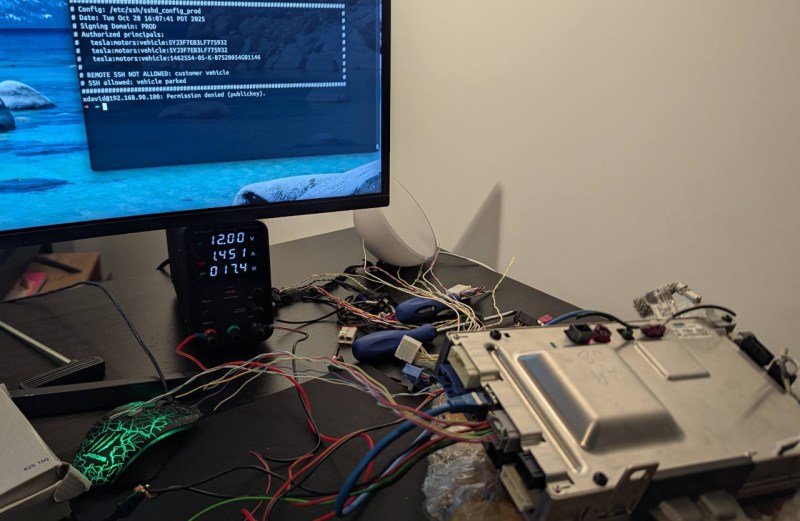
Like many high-tech companies Tesla runs a bug bounty program. But in the case of a car manufacturer, this means that you either already have one of their cars, are interested in buying one, or can gain access to its software-bits in another legal manner. Being a Tesla-less individual, yet with an interest in hunting bugs [David Schütz] thus decided to pursue the option of obtaining the required parts from crashed Tesla cars.
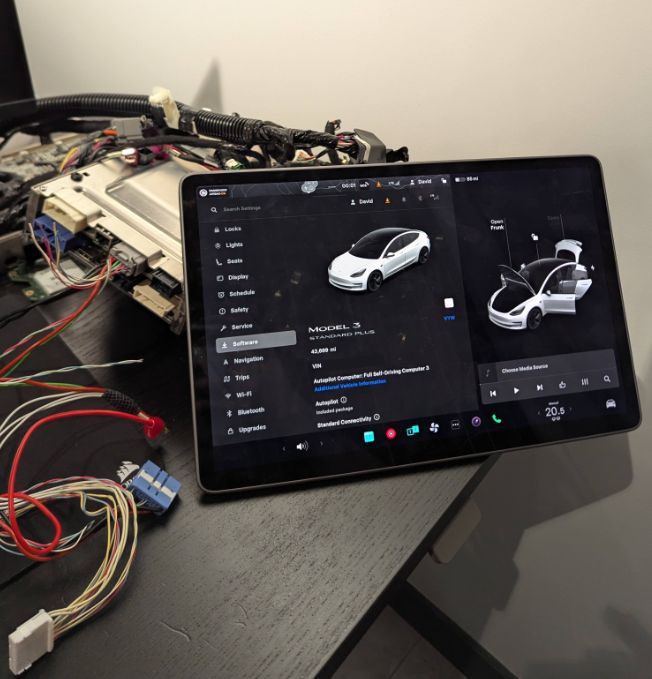
Specifically [David] was interested in the Tesla Model 3 and its combined Media Control Unit (MCU) and Autopilot computer (AAP) assembly. In addition to the main unit, it also requires – obviously – a power supply, and the proprietary display. These were all obtained fairly easily, but unfortunately the devices all had their cables cut off, leaving just a sad little stump of wiring with the still plugged-in connectors.
After trying his luck with an incompatible BMW LVDS cable from one of their headunit infotainment systems, he then proceeded to try and use the cable stumps with some creative patching. This briefly worked, but some debris fell onto the MCU board and blew a power rail IC.
Ultimately this IC got swapped after [David] had already purchased a whole new Model 3 computer, leaving him with two units and the easy way out of buying the Dashboard Wiring Harness cable loom that contained the Rosenberger connectors he needed to connect the display to the main unit.
From Blog – Hackaday via this RSS feed
You must log in or # to comment.
It amazes me how connectors tend to be a point of resistance. Solder wires people. Put metal connectors on all of the pins and hot glue the back side of them. Use acupuncture needles. The cheap ones are just wound guitar strings with the center core wire exposed. So use guitar string versions yourself but shorter. That is brass and steel. It solders fine. Old headphones have flexible enameled copper wire. Any old switching power supply’s transformer will have a small spool of solid core enameled copper wire.
The only thing that really matters is mounting the whole thing on a jig, and not fiddling with it too much or allowing stuff to continue to move around.
